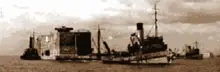
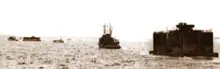
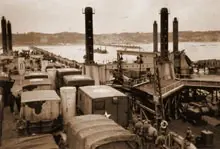
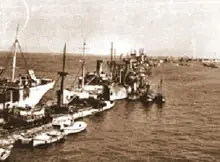
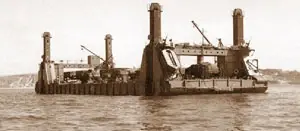
The two artificial ports which were to be installed, to supply the troops after the Landing on the Normandy Beaches were given code names Mulberry «A», for «American» and Mulberry «B», for «British». The choice of this name was totally fortuitous. It covered the entire operation of the harbor, other code names were given to the various elements. The purpose of the Mulberries was to provide sheltered water for shipping and, secondly, help with unloading the cargo. The shelter structure was composed with concrete blocks (Phoenixes) sunk in line offshore, reinforced with a line of floating steel tanks in a cruciform shape (Bombardon) moored about three miles out of sea. The unloading facilities were set up with floating pierheads which were able to follow the rise and the fall of the tide (Spud Pontoon or Lobnitz Pontoon), connected to floated piers (Whales) supported by steel and concrete floats (Beetles) all moored with anchors into the seabed, and connected to shore.
A few months before D-Day, it was decided to widen the area for the assault. A previous harbour in a curved shape had to be studied (Gooseberry), it was to be made of old cargo ships (Corncobs) which will be scuttled after they were placed into position on the far shore under their own steam. Five gooseberries had to be set up facing the five landing Beaches, they were also named the Blockships.
The strategic situation convinced the Prime Minister, Winston Churchill, to promote plans for this project. The intermediary was Admiral Lord Louis Mountbatten, the Chief of Combined Operations.
Mountbatten's team was Col. Bruce White, Col. Steer Webster, Brigadier (later Major General) Harold Werhner, Admiral Hughes Hallett, and Admiral Harold Hickling.
The War Office was responsible for Ports, the construction and the maintaining was to be given to civil Engineers and the Admiralty was responsible for the shipping operations. The plans for landing in Normandy were almost achieved and were code named Overlord.
They were checked out and were accepted by the Prime Minister, the President and the Chiefs of Staff at Quebec in August. En route to North America, on board the Queen Mary, Mountbatten gave a lecture. Several senior officers were regrouped in one of the luxurious bathrooms of the ship for a demonstration given by Professor J.D. Bernal, an eminent physicist and one of Mountbatten's scientific advisers. Standing on a lavatory seat, Admiral Sir Dudley Pound, First Sea Lord, invited his colleagues to imagine the shallow end of the bath as a beachhead; Bernal now floated, with the assistance of Lt-Cdr D. A. Grant, a fleet of twenty ships made of newspaper. Grant was then requested to make waves with the aid of a back brush. The fleet sank. Area West lifebelt was then inflated and floated in the bath so as to represent the harbour. The fleet of paper boats were then placed inside it. Once more Grant applied his brush vigorously to create waves, but this time they failed to sink the fleet. As much importance was, of course, the requirement of facilities for discharging cargoes.
On Sunday, June 4 these were two US wooden submarine chasers, which were the flagships for Clark and Stanford in the Solent .The landing had already been delayed by Eisenhower of twenty four hours. In the afternoon of June 6, right after the troops had landed in Normandy, the order was given to the Mulberry Force to sail.
The Mulberry B was the first one across because the enemy opposition, apart from mines, was not so bad in comparison to Omaha. The American had to fight hard to progress inland and to prepare a suitable beach to set up their Mulberry A. The beach clearing was done by the veteran 531 Engineer Shore Regiment of the US Army. The first Blockships arrived on June 7. Gooseberry 1 was for Utah. The operation was conducted by Stanford and stopped by the fire of German guns. The «Wason» was the first ship to be scuttled, she swung round because the tugs skippers anxious about the German shelling, cut loose too soon. To underline, how risky their situation was, the second and the third ships were sank by the Germans. Who confirm their destruction later to Radio Berlin. Fortunately they were set down on their approximate previous site. Stanford worked on the opportunity and decided to shape two curves with the other ship sunk accordingly. On June 13 Gooseberry 1 was completed and was able to accommodate 75 Liberty Ships and masses of small crafts.
Two causeways were made of Rhino ferries Pontoons, with one of them extending beyond the Gooseberry. Then the troops could land «dry» and small craft could moor and unload alongside them.
Gooseberry 2 provided the first shelter for craft discharging in Mulberry A. In order to allow rapid access to the beach for light craft, the Americans decided that two gaps should be left between the ships, in effect making three breakwaters. Royal Navy Officers had warned that the sea would pour through the gaps in bad weather, which was proved correct when a storm blew up on June 18. Cdr. C. R. Dennen, USNR, directed the scuttling operation and the great bulk of Centurion provided a cornerstone to the breakwater. The next three ships, «James Iredell», «Baialoide» and «Galveston», were sent to the bottom under sporadic gunfire from inland; however, the Gooseberry was completed by June 10. Here too, a pontoon causeway was erected by the Seabees opposite the Saint-Laurent exit and was in use by that date. At Mulberry A the Bombardons were laid by Cdr. L.D. Ard, USNR.
That breakwater was a mile long and composed of twenty four Bombardons, completed by June 17. The first two Phoenixes arrived on June 10; they were delayed due to the enemy fire, then in the next four days a batch of thirty two of the fifty one units planned were sited and start to provide a breakwater. As the Blockships, they were not always easy to sink. Several units cut loose of their tugs.
The Americans experienced a more dangerous start to their pier construction than the British. They had to work under the range of snipers and there were more obstacles than in the British Harbour area. Although tows began to arrive on June 9, construction did not start until June 12. Clark therefore decided to concentrate on completing the center piers, combining a stores pier with an LST pier, as it was important that tanks should be brought ashore to cut off the Cherbourg peninsula and advance inland.
Work now went ahead with the utmost speed under the direction of Lt. W. L. Freeburn and his assistant, Chief Bos'n F. F. Hall.
While there was no doubt that the work of the Seabees was good, their initial work on the equipment in Scotland had begun too late for them to benefit from actually linking the spans and anchoring the floats themselves, and this task was completed by the British.
Moreover, the officers who had been sent on the courses did not seem to appreciate, in the way that the British did, the need to secure the floats properly. Later they turned a deaf ear to Beckett's warnings, and training before D-Day was, in any case, limited to coupling a few spans.
For this reason, the Americans thought that the mooring of alternate spans would be enough, but when the bad weather came the anchors dragged and the spans swung out of position. The British, on the contrary, doubled their moorings when the gale warning was given.
It is true, however that the American harbour was more exposed than the British and the worst factor was the sea bed, where it was impossible to obtain a suitable anchoring. Like the Americans, the British suffered from the loss of tows during the Channel crossing.
Ellsberg was already on the beachhead waiting for orders to clear the Port of Cherbourg. Clark asked him whether it would be possible to use the lighter floats, intended to carry a 25 ton load, for the Sherman tanks of the 2nd US Armored Division weighing 38 tons. Or would they submerge under the strain? Ellsberg, who had a slide rule with him, set to work to measure a float and then spent most of the night alone in Clark's headquarters ship cabin working out the problem. He was able to reassure Clark's headquarters ship cabin working out the problem, which finally get's solved.
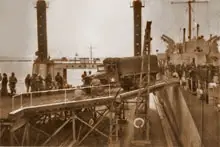
«25 ton pontoons would remain afloat, though only by an eyelash, under a 38 ton load, but I will guarantee they will remain afloat». It was of course essential that two tanks were never simultaneously over the same span. Ellsberg himself, walking backwards over the half mile to the shore, supervised the passage of the leading tank on June 16 when the center pier was completed and joined to the pierhead.
A second pier and pierhead were ready on June 18.
Eleven LSTs docked and discharged taking about 1 hour per ship, opposed to the 12 or up 14 hours spent waiting for the next high tide. The average time of discharge, states Stanford, was just under two minutes per vehicle. Artillery which would have been difficult to haul over the soft sand was also landed.
It must not be overlooked that until the piers and pierheads were completed stores and equipment were being brought ashore by the DUKWs, Rhino ferries and barges. There were about 115 Army crafts, barges lighters, ferries and 100 DUKWs being used in each harbour. The DUKWs especially became virtually indispensable to the success of the operation, operating from D-Day onwards despite the rough weather.
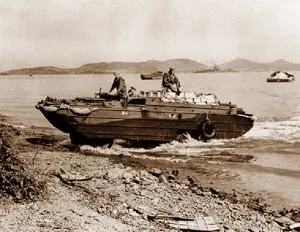
They not only moved «from ship (often three miles out to sea) to shore, as other ferry craft could, but (transported) that cargo overland to a dump». They went far to remedy the shortage of cranes and trucks in the early stages of the assault and «might have been a random piling of supplies on the beach (was converted) to an orderly movement from ship to supply dump». The loads, mainly ammunition and petrol, were carried in three nets, the contents of which were transferred into trucks on shore.
The DUKWs were not, of course, able to handle some of the larger, awkward loads, like bailey bridges sections, included in the cargos. By June 16 the Germans appreciated the significance of the Mulberries, and started to build up air attacks, but facing the very large Allied air supremacy supported by all their anti Aircraft systems, those attacks never succeeded in getting through. To complete these over defended sights, we need to talk about the barrage balloons and the smoke screens laid out by trawlers.
In the early hours on June 19 a enemy aircraft began to drop pressure or «Oyster» mines which were detonated by the pressure wave of a ship's hull moving through shallow water. Two of these mines were discovered intact on dry ground and shipped to Portsmouth for examination.
Their use had long been anticipated and although there was no fully effective counter-measure used, in responsea ship's speed was reduced to under 4 knots proved sufficient to reduce the danger.
| Troops | Supplies (long tons) | Vehicles | |
|---|---|---|---|
| British Beaches (excluding Mulberry B) | 120.729 | 50.400 | 286.586 |
| Omaha | 74.563 | 29.242 | 205.762 |
| Utah | 49.841 | 14.344 | 126.507 |
The American and British beachheads were now linked up.
Twenty Divisions were ashore with a great numerical superiority on the enemy
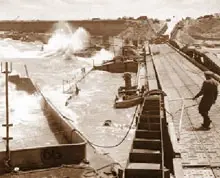
On June 16 and 17 the Channel was too rough for any towing operations. On the evening of the 17th an overdue spell of fine weather appeared likely and Admiral Tennant ordered a maximum effort for the evening of the 18th. Four Phoenixes and twenty-four Whale tows were dispatched to the beachhead, but before they sailed a cold front from Iceland was already spreading rapidly over the British Isles. At the same time a depression from the Mediterranean moved northwards over France. These two disturbances combined to produce a north-north-west wind, later veering to north-east, of force 6-7 during 19-20 June and moderating only slightly on 21-22 June. The wind swept along the north French coast reaching gale force and the sky was overcast with thick low clouds. Eleven of the tows were sunk and one of the Phoenixes ran aground near Omaha beach. At Mulberry A no less determination was displayed than at the Mulberry B. The sailors and the Seabees work days and night against the rough sea, but being so exposed they received the full brunt of the storm. Unfortunately some of the LCTs and other crafts were moored to the piers which increased the waves hold on them. Clark concentrated on trying to save the piers and pierheads. Already exhausted by urging on his men while under fire from shore, he wore himself out and was compelled to return to England, his place being taken by Ard, now specialist of his Bombardons.
One of the piers was completely ruined. Its center spans of bridging was bent and twisted in a great arc curving to the west, and its Beetles were either broken loose or beached, or smashed and filled with water. The other pier was not as badly damaged, but was also bent in a great arc. On the night of the 21st the spuds of two pierheads broke and the pontoons were carried ashore. Stanford now concentrated on saving the remaining pierhead. The clutch was released allowing the pontoon to ride freely up and down the spud legs. In this way, it survived, rising and falling with the tide. But it was the destruction of the Phoenixes breakwater that put an end to any chance of saving the harbour. Out of thirty-one units twenty were destroyed; three of them having their backs broken through scour; the others through having their sides burst open by the water pressure within. Several were hit by Bombardons descending on them. Seven blockships broke their backs and others settled deep into the sea bed. Well other 100 crafts were lost and discharge of supplies was brought to a standstill. Vital ammunition supplies had to be flown in and several ammunition ships were beached for unloading. In spite of all this, as soon as the storm abated the DUKWs and ferries began to operate again.
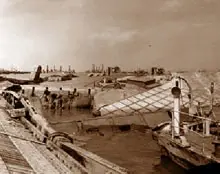
On June 23 10.000 tons were unloaded at Omaha and shortly afterwards normal output was being achieved, though without the advantage of the piers. The gooseberries protected the other beaches. Utah, also being exposed to the west, lost two blockships and three others were in a poor state. Shipping tended to be diverted to Grandcamp and Isigny. After the gale, the commanders of the respective harbours inspected the damage. Mulberry A had undoubtedly suffered the greatest. Yet such was the spirit of the construction force that it believed that, despite the chaos, the port could be restored to working order. Ellsberg, an expert salvage officer, supported this view. But the Mulberries had always had their detractors. Apparently Commodore W. A. Sullivan, Supervisor of Salvage, US Navy Department was one of these. Moreover, he and Ellsberg had not, on a previous occasion, seen eye to eye. After a cursory inspection Sullivan reported to the senior naval commander, Admiral Kirk, that a salvage operation was impracticable. Kirk accepted his verdict, influenced by some of his staff who were scornful about the force of the gale, implying that the harbour itself was inadequate.
Eisenhower therefore ruled that Mulberry A should be abandoned but that the Gooseberry should be reinforced with additional caissons and all the spare parts and salvage equipments would be reused to fill up the Mulberry B breaches. Apart from the first half of August, the weather continued to be uncertain right into the autumn. Fog and high winds were experienced late in July and another severe storm interrupted discharge of men and supplies on August 1st. Heavy seas pounded the coastline at the beginning and end of September so that strengthening of the Mulberry and the Gooseberries at Omaha and Utah assumed great importance. The new Phoenixes being built around the English coastline were awaited with impatience but the V weapon offensive, which began soon after D-Day, drew away a number of workmen for emergency repair of houses. American Army Engineers were called upon to build five large square-ended caissons at Grays and Tilbury. During the summer Omaha have been strengthened with a further ten Blockships and twenty-one caissons, but a gale on October 6 broke the backs of four of them and twelve Phoenixes were also destroyed. In spite of the bad weather, according to the Commander, US Ports and Bases, the Gooseberry continued to be of tremendous value. Ships had to be beached now that the piers had gone but it was discovered that the rock inshore was crumbly, almost to the consistency of sandstone. Bulldozers planed down these rugged surfaces thus enabling ships to ground on the beaches without damaging their hulls.
Utah also continued to discharge quantities of men, vehicles and supplies. On the last two days of July a record of 25.853 tons were unloaded at the two beaches. The target tonnage for the two beaches had recently been raised from 5.700 to 10.000 tons for Utah and from 10.500 to 15.000 tons for Omaha.
The flow of vehicles during that month continued unabated. An average of 3.283 per day was brought ashore but as the autumn advanced the tonnage began to decrease.
By October 1st it seemed unlikely that the rate of discharge would recover momentum. The weather was becoming increasingly difficult and the DUKWs, most of which had been operating since the early days of the landing, were showing signs of wear and tear.
The senior commanders were at least grateful for the Mulberries. According to Eisenhower, «Mulberry exceeded our best hopes... average tonnage per day from 20 June to 1 September was 6.765 tons». Eisenhower's deputy, Air Chief Marshal Sir Arthur Tedder, acknowledged Churchill's persistence in advocating the Mulberries without which «that extraordinary operation might never have come to fruition. Indeed the whole question of the invasion of Europe might well have turned on the practicability of these artificial harbours». And although there is force in the detractors of Mulberry's arguments, they ignored, as Australian war correspondent and military historian, Chester Wilmot, has ably argued, important strategic and psychological factors. Strategically the «possession» of Mulberry gave the planners the freedom to choose a landing area away from the heavily fortified major ports; psychologically, it gave the Allied High Command a degree of confidence without which the venture, which seemed so hazardous, might never have been undertaken. Albert Speer, Reichsminister for Armament and War Production, supported this argument when he concluded that having by-passed the Atlantic Wall «means of a single brilliant technical device» the Allies made the German defence system completely irrelevant.
On April 27th 1944 was established the first Headquarter «SHARPENER» located at 0.8 mile from Southwick House, close by the huge SHAEF Camp «SHIPMATE». General Eisenhower stayed there from June 2nd to June 12th 1944.
Regarding the inland movement on the continent, it had been decided to establish an advance HQ in the village of Maison in-between Port-en-Bessin and Bayeux on D6 road. Maison was selected because of its immediate proximity with Longues Air Strip (B11) and Tour en Bessin Airstrip (A13) and also a midway position between Omaha and Gold Sectors. This CP will be operational from July 31st and will be referenced as CP12.
But it wasn't used by Eisenhower, only as a SHAEF transit camp in August 1944. It was decided to organize a new CP at Le Planitre near Molay Littry close by A9D, this camp will be use from August 5th but still not by Ike. Another one is activated on August 7th at Tournières, referenced as CP21 «SHELLBURST» where Ike welcomed Prime Minister Churchill, Gen. Montgommery, on August 20th Gen. De Gaulle with Gen. Koenig and many other celebrities. An airstrip was built in the next field. After the Saint-Lô breakthrough («Cobra» Operation) the SHAEF HQ was transferred near Grainville, on August 16th, Communication Service was established in the Hôtel Normandy, code-named «LIBERTY».
On September 15th the new Grand HQ was moved to Saint-Ouen at Jullouville. Almost 3000 people worked there, and on August 30th Ike stayed at Château Montgommery at Saint Jean le Thomas 4 miles away from Jullouville. On September 10th the Grand HQ was transferred to Versailles (Palace Trianon).
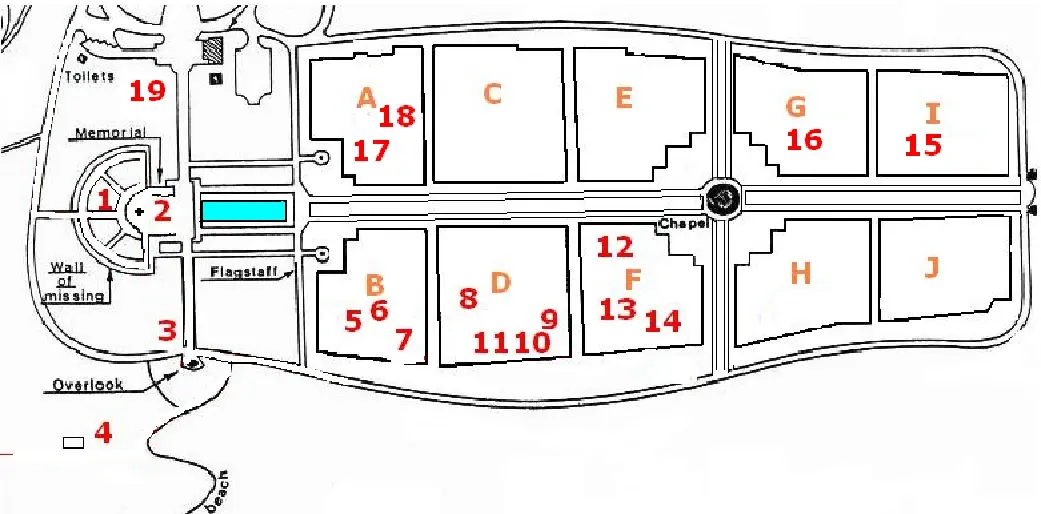
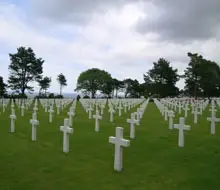
The letters marks the Plots and the numbers the sites to visit. From number 5th the sites are burial site, to find them easily in the Cemetery they are followed with the row and grave number.
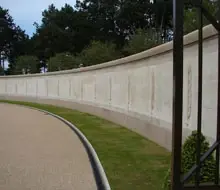
1 The Garden of the Missing
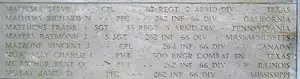
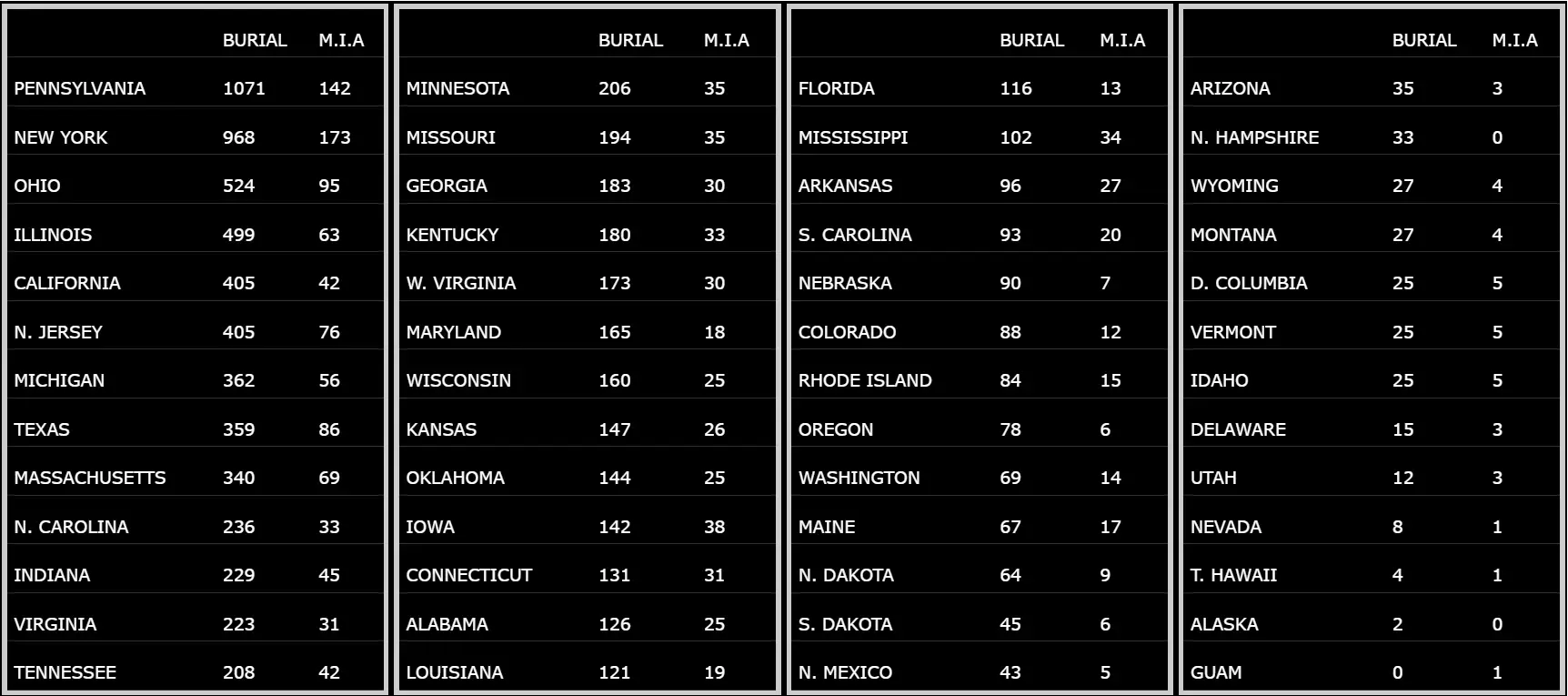
Its semi-circular wall contains the name of 1.557 MIAs, they come from 49 of the 50 States. The tragic night of December 24th is engraved on that wall. German U-Boats were trying to prevent Allied reinforcements from reaching «The Battle of the Bulge». The 66th Infantry Division was not going to the Bulge, but Saint-Nazaire. At 6.00 pm on Christmas Eve, a torpedo exploded into the starboard aft hold of the transport ship «Leopoldville», packed with 2,235 G.I.'s from the Division. The ship remained afloat for 2-1/2 hours before sinking into the English Channel 5-1/2 miles north Cherbourg. Because of the holiday celebrations, rescue was slow in coming to the ship. When rescue ships arrived while the ship was taking on sea water, many different scenarios developed around victims and survivors. Approximately 516 G.I.'s were missing and presumably went down with the ship, and another 248 died from injuries, drowning, or hypothermia from the 48° sea water. The huge loss of lives proved embarrassing to the governments of France, England, Belgium, and the U.S.A. Wartime security kept the tragedy details buried for fifty years. Many families of the 764 victims and the 1,471 survivors still do not know details about the Christmas death of their sons.
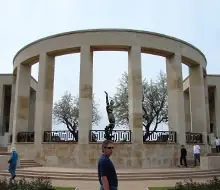
2 The Memorial
The Memorial is centered by a 22 foot bronze statue, on both sides two enamel maps, representing the Battle of Normandy in South loggia till August 1st and the Battle of Europe in North loggia, notice the shingles on the ground, reminding the beach. The four scenes on the urns in the north loggia are the same in the south one. The Statues and the urns were made by De Lue.
3 The orientation table at the overlook
This small jut of land affords a great view of «red and fox green». From here you realize how are troops were exposed to the German storm firing. Without any protection, they were like sitting ducks. Now you understand how the loss is estimated to be almost 3.000 men during this operation. The path below can conduct you down the beach, but I would suggest you to use it to go to the Mulberry A table Memorial and then walk to WN 62.
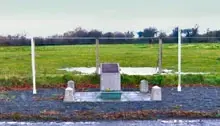
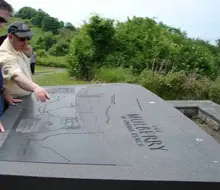
4 Mulberry «A» Memorial
This table shows the Artificial Harbor in some details.
5 The first Americans KIA in the European theatre of WWII
They were from the 1st Ranger Bn. Involved in Dieppe Raid on the 19th of August 1942. Edward V. Loustalot buried in Ardenne Cemetery and Howard M. Henry buried here. Plot B, Row 18, Grave 5. The third one was taken back home.
6 The only crew (B17) buried side by side from the 615 Bomb. Sq. 401 Bomb; Gr (H)
Plot B, Row 9 , Grave 29 to 32 William M. Rumsey Jr, Frank A. Rothwell, Robert D. Kaercher, William W. Carter and Michael R. Walsh Row 10, grave 13. Lyle P. Wheaton grave 28 was killed on August 1st. His crew members are random burials.
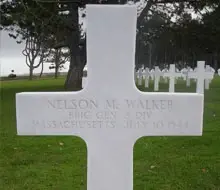
7 General Nelson Walker
KIA on Jul 10th 1944 Plot B Row 23 Grave 47.
8 Mary H Bankston
Women's Army Corps, Died 8-Jul-45, Plot D Row 20, Grave 46.
9 Theodore J. Roosevelt
Theodore J. Roosevelt, President Theodore son's and President Franklin D. Roosevelt nephew's. Born: 9/13/1887. Medal of Honor. Dead from heart attack at Méautis on July 12th during the night. Plot D, Row 28, grave 45.
10 Quentin Roosevelt
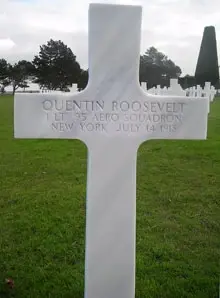
Quentin Roosevelt grave
Quentin Roosevelt, President Theodore son's and President Franklin D. Roosevelt nephew's. Theodore's youngest brother. Born 11/19/1897.Dead in a Nieuport 28 fighter, was shot down behind German lines by Sgt. Thom, a German ace with 24 victories on Jul 14th 1918 WWI. Plot D, Row 28, grave 46.
11 Gafford W. Sanders
Gafford W. Sanders was KIA in Anzio where he was initially buried. His family made a special request to have their two sons buried together on Omaha. He was then re-buried in 1995. Plot D, Row 25, grave 46.
12 The Niland Brothers
The Niland Brothers were four American brothers serving in WWII. Of the four, two survived the war, but for a time it was believed that only one, Frederick Niland, had survived. He was sent back to the States to complete his service, and only later was learned that his brother Edward, presumed dead, was actually captive in a Japanese POW camp in Burma. Steven Spielberg's movie «Saving Private Ryan» was inspired by their story although it is very different. The brothers are:
13 Dolores M. Browne
Women's Army Corps. Died 13-Jul-45. Plot F, Row 13, Grave 19. She was in the same jeep with Mary H. Bankston and Mary J. Barlow. The two Mary's died instantly in the accident and Dolores died from her wounds 5 days later.
14 General Lesley J. Mc Nair
Died 25-Jul-44. Plot F, Row 28, Grave 42. KIA by friendly bombing during «Operation Cobra» Operation during a top secret reconnaissance mission.
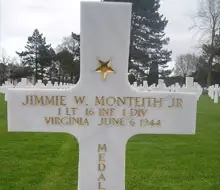
15 Jimmie W. Monteith, Jr
Medal of Honor. Died 6-jun-44. Plot I, Row 20, Grave 12.
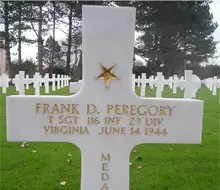
16 Frank D. Peregory
Medal of Honor. Died 14-Jun-44. Plot G, Row 21, Grave 7.
17 Elisabeth Richardson
Civilian, American red cross, plot A, Row 21, Grave 5 and William R. Miller Liaison Squadron, Plot A, Row 20, Grave 22 were killed in the same plane crash near Rouen city.
18 Mary J. Barlow
Women's Army Corps, Died 8-Jul-45, Plot A Row 19, Grave 30.
19 The Time Capsule
The Time Capsule in which have been sealed news reports of the 6 June. The engraving says: To opened June 6. 2044.
Black American soldiers Burials
As far as I know, there are 109 Afro-Americans buried in this Cemetery, I only identified 3 of them belong to the 320th Anti-Aircraft Artillery Balloon BN.:
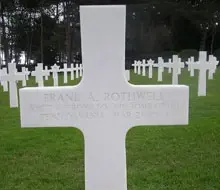
B-17, 42-37833, 401st BG, 615th BS
Shot down by Flak on March 25, 1944 crashed near Bouquemaison, France
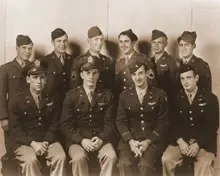
Front row L-R:
1st Lt. Michael R. Walsh Navigator, 1st Lt. Robert D. Kaercher Co-Pilot, Captain William M. Rumsey, Jr. Pilot, 1st Lt. James Daniel Haffner Bombardier (POW Stalag Luft I).
Back Row L-R:
1st person unknown... then T/Sgt. William W. Carter radio operator, Herb McElligot tail gunner, T/Sgt. Donald B. Roberts Engineer, S/Sgt. Ivan R. Lee waistgunner, S/Sgt Irving I. Lieberman «Lucky Lieberman» ball turret gunner.
Mr. John B. Carson was the substitute tail gunner on March 26, 1944 when Omar the Dentmaker was hit by flak over Pas de Calais, France and exploded. He is not pictured here.

Canada:
England:
Scotland:
Mexico:
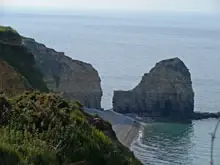
To reach the Pointe du Hoc Ranger Monument, now maintained by the American Battle Monuments Commission, follow the direction signs west along D 514 to the car park outside the monument (6 m).
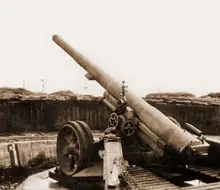
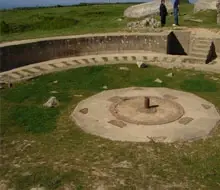
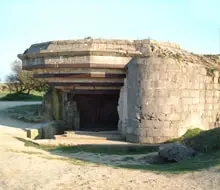
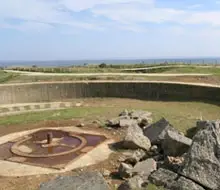
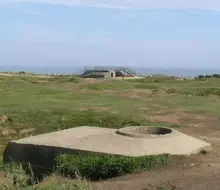
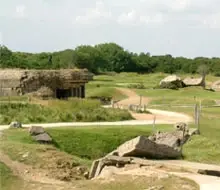
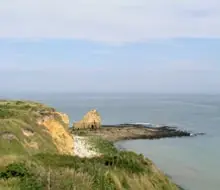
The Pointe du Hoc today retains much of its battlefield character because of the destruction left by the rain of bombs and shells the Allies unleashed to neutralize this rocky point. The much feared battery was bombed three times before D-Day, then hit from the air again that morning. 600 tones of bombs were dropped. The battleships Texas and Arkansas battered the area with their 14- and 12-inch guns just after dawn. The destroyer Satterlee saturated the position with her 5-inch guns in direct support of the Rangers.

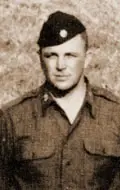
Col. James Earle Rudder.
This concentration of fire left craters and ruined casemates which over sixty years have yet to erase. From the barbed-wire fence along the cliff top, you can look down the hundred-foot cliff to the east beach where three companies of the 2d Ranger Battalion, commanded by Lieutenant Colonel James E. Rudder, landed on D Day. Their mission was to scale the cliff, then silence the six 155-mm GPF thought to threaten the landing operations on both American beaches.
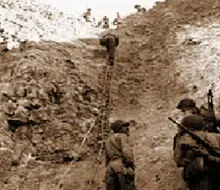
The Rangers came in forty minutes late in ten LCA's, trailed by four DUKW's and two supply boats. They lost one of each boat type on the run in. The LCA's were equipped with rocket-propelled grappling hooks which were fired as the boats grounded under the cliff. Despite small-arms fire, improvised mines, and grenades lobbed from above, the Rangers used their rope and aluminum ladders to scale the cliff within five minutes of landing. Ironically, they found the casemates empty of guns, which days before had been displaced further inland. Later that morning, a patrol found the 155s unguarded and spiked them. Colonel Rudder then set up a defensive perimeter and waited for reinforcements. «Located Pointe du Hoc», he managed to signal V Corps that afternoon, «mission accomplished need ammunition and reinforcement many casualties». Those reinforcements were to have come from Rangers of the 2d and 5th battalions waiting offshore.
Because Rudder's assault was late, the Rangers went to their next mission and landed on Omaha Beach. It took them two days to fight their way overland to Rudder's relief.
By then, his force had been reduced to about ninety effectives. Rudder received the Distinguished Service Cross for continuing to lead his men, although twice wounded. The monument, standing on a German blockhouse which you cannot enter, consists of a rough granite obelisk flanked by tablets inscribed in French and English.
«Rangers lead the way»
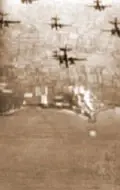
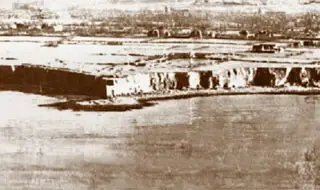

Here is the complete text of the speech delivered by President Ronald Reagan on the 40th anniversary of D-Day, June 6, 1984, near the Pointe du Hoc Memorial in Normandy.
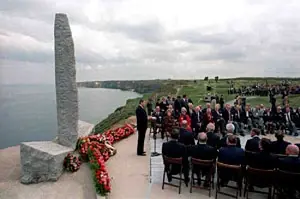
We stand today at a place of battle, one that 40 years ago saw and felt the worst of war. Men bled and died here for a few feet of - or inches of sand, as bullets and shellfire cut through their ranks. About them, General Omar Bradley later said, «Every man who set foot on Omaha Beach that day was a hero».
Some who survived the battle of June 6, 1944, are here today. Others who hoped to return never did.
«Someday, Lis, I'll go back», said Private First Class Peter Robert Zanatta, of the 37th Engineer Combat Battalion, and first assault wave to hit Omaha Beach. «I'll go back, and I'll see it all again. I'll see the beach, the barricades, and the graves».
Those words of Private Zanatta come to us from his daughter, Lisa Zanatta Henn, in a heart-rending story about the event her father spoke of so often. «In his words, the Normandy invasion would change his life forever», she said. She tells some of his stories of World War II but says of her father, «the story to end all stories was D-Day».
«He made me feel the fear of being on the boat waiting to land. I can smell the ocean and feel the sea sickness. I can see the looks on his fellow soldiers' faces - the fear, the anguish, the uncertainty of what lay ahead. And when they landed, I can feel the strength and courage of the men who took those first steps through the tide to what must have surely looked like instant death».
Private Zanatta's daughter wrote to me, «I don't know how or why I can feel this emptiness, this fear, or this determination, but I do. Maybe it's the bond I had with my father. All I know is that it brings tears to my eyes to think about my father as a 20-year old boy having to face that beach».
The anniversary of D-Day was always special to her family. And like all the families of those who went to war, she describes how she came to realize her own father's survival was a miracle: «So many men died. I know that my father watched many of his friends be killed. I know that he must have died inside a little each time. But his explanation to me was, 'You did what you had to do, and you kept on going».
When men like Private Zanatta and all our Allied forces stormed the beaches of Normandy 40 years ago they came not as conquerors, but as liberators. When these troops swept across the French countryside and into the forests of Belgium and Luxembourg they came not to take, but to return what had been wrongfully seized. When our forces marched into Germany they came not to prey on a brave and defeated people, but to nurture the seeds of democracy among those who yearned to be free again.
We salute them today. But, Mr. President [Francois Mitterand of France], we also salute those who, like yourself, were already engaging the enemy inside your beloved country-the French Resistance. Your valiant struggle for France did so much to cripple the enemy and spur the advance of the armies of liberation. The French Forces of the Interior will forever personify courage and national spirit. They will be a timeless inspiration to all who are free and to all who would be free.
Today, in their memory, and for all who fought here, we celebrate the triumph of democracy. We reaffirm the unity of democratic people who fought a war and then joined with the vanquished in a firm resolve to keep the peace.
From a terrible war we learned that unity made us invincible; now, in peace, that same unity makes us secure. We sought to bring all freedom-loving nations together in a community dedicated to the defence and preservation of our sacred values. Our alliance, forged in the crucible of war, tempered and shaped by the realities of the post-war world, has succeeded. In Europe, the threat has been contained, the peace has been kept.
Today, the living here assembled-officials, veterans, citizens-area tribute to what was achieved here 40 years ago. This land is secure. We are free. These things are worth fighting and dying for.
Lisa Zanatta Henn began her story by quoting her father, who promised that he would return to Normandy. She ended with a promise to her father, who died 8 years ago of cancer: «I'm going there, Dad, and I'll see the beaches and the barricades and the monuments. I'll see the graves, and I'll put flowers there just like you wanted to do. I'll never forget what you went through, Dad, nor will I let anyone else forget. And, Dad, I'll always be proud».
Through the words of his loving daughter, who is here with us today, a D-Day veteran has shown us the meaning of this day far better than any President can. It is enough for us to say about Private Zanatta and all the men of honor and courage who fought beside him four decades ago: We will always remember. We will always be proud. We will always be prepared, so we may be always free.
Thank you

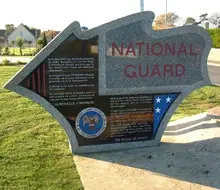
An impressive memorial to two French squadrons (Guyenne and Tunisia) of the RAF Bomber Command stands near the harbor's northeast corner. It was dedicated in 1988. These two French heavy bomber units participated in the D-Day bombing of the nearby Maisy gun battery.
The newly opened Ranger Museum, dedicated to telling the story of the 2d U. S. Ranger Battalion and its assault on the Pointe du Hoc, is located further east on the Quai Crampon. Open daily during the summer 0900-1800. Admission charge.
Rangers Museum
30 Quai Crampon
14450 Grandcamp-Maisy
Tel: 02 31 92 33 51
Rank and Organization: Technical Sergeant, U.S. Army, Company K 116th Infantry, 29th Infantry Division. Place and date: Grandcamp France, 8 June 1944. Entered Service at: Charlottesville, Va. Born. 10 April 1915, Esmont, Va. G.O. No.: 43, 30 May 1945.
Citation:
On 8 June 1944, the 3d Battalion of the 116th Infantry was advancing on the strongly held German defences at Grandcamp, France, when the leading elements were suddenly halted by decimating machinegun fire from a firmly entrenched enemy force on the high ground overlooking the town. After numerous attempts to neutralize the enemy position by supporting artillery and tank fire had proved ineffective, T/Sgt. Peregory, on his own initiative, advanced up the hill under withering fire, and worked his way to the crest where he discovered an entrenchment leading to the main enemy fortifications 200 yards away. Without hesitating, he leaped into the trench and moved toward the emplacement. Encountering a squad of enemy riflemen, he fearlessly attacked them with hand grenades and bayonet, killed 8 and forced 3 to surrender. Continuing along the trench, he single-handedly forced the surrender of 32 more riflemen, captured the machine gunners, and opened the way for the leading elements of the battalion to advance and secure its objective. The extraordinary gallantry and aggressiveness displayed by T/Sgt. Peregory are exemplary of the highest tradition of the armed forces.
The cemetery lies south of N 13. This site, originally an American cemetery, was given to the German government in 1948 after the American dead had been removed to the American cemetery overlooking Omaha Beach. La Cambe now contains over 21,222 German dead.
La Cambe stands in somber contrast to the American, British, and Canadian cemeteries in Normandy, with their open, garden and park-like appearances. I recommend that you spend sometime visiting this cemetery and its Visitors Centre.

«Darkly rises the mound
Over the graves of the soldiers
Darkly stands God's Command
Over the dead of the War.
Yet brightly glows the sky
Above the towering crosses
More brightly still shines their comfort:
The final word is God's»
Barrage balloon being man-handled at Camp Davis, NC.
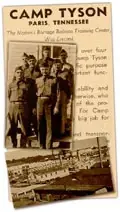
On August 15, 1941, the announcement was made that Routon, Tennessee had been chosen as the site for the Army's new barrage balloon training center (the original BBTC had been established temporarily at Camp Davis, North Carolina; the postcard shows a balloon being man-handled at Camp Davis). Tyson was to be the only Army post of its kind in America. Construction began on September 4, 1941. The barrage balloon was a new tool of defensive warfare and the camp was established for the express purpose of constructing barrage balloons and training personnel in their deployment and use, an assignment commissioned by the Secretary of War on April 14, 1941.
(National Archives and Records Administration Photo No. 80-252797, originally a U.S. Navy photo; available at NavSource.)
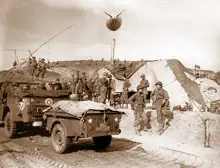
A balloon flown by the 320th protects the E-3 exit at Omaha Beach on D+2 (Easy Red sector)
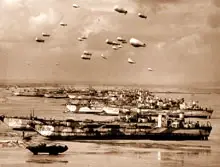
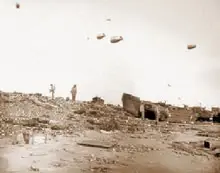
British LCT's line the Normandy shore, each with a barrage balloon designed to discourage enemy air attack. (From «Coast Guard at Normandy» by Scott T. Price.)
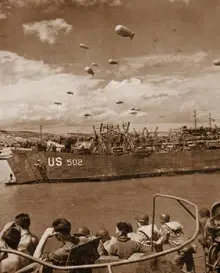
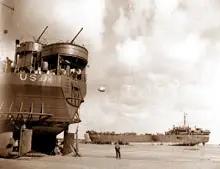
LST 502 beached on Omaha, June 1944. No less than 13 barrage balloons protect the immediate area. Note the LST's open door at left, with a crewman on the ramp. When the tide goes out, the LST will be high and dry and can begin unloading.
The location of the camp was chosen because it was considerably far away from regular air planes and balloon activities would not interfere with peacetime aviation. Much planning, including devising training and operational procedures, was accomplished at Camp Davis while waiting for the new camp to be completed. Antiaircraft defence planners tested and documented the complicated process of handling the winches and cables for the balloons, which could be flown up to altitudes of 10,000 feet.
Power was furnished by gasoline-powered motors which had to be maintained also, and atmospheric conditions had to be evaluated before releasing the balloons. All of the tactics and techniques involving the balloons and their equipment were developed from scratch in 1940-41, after which training manuals were created and training cadres formed. The Coast Artillery formed several «Barrage Battalions» in 1941 and they were deployed in conjunction with AAA guns to defend the oil refineries and storage facilities near Los Angeles in Southern California. However, the balloons were not ready to be fully deployed in time to avert the disastrous surprise attack by the Japanese at Pearl Harbor on December 7, 1941.
Paris and all of Henry County soon became jammed to capacity with workmen. At the peak of employment, a total of almost 8,000 persons were engaged in erecting the camp. Construction peaked at Christmas 1941 and then began to diminish until the camp was completed, on March 14, 1942. On that day, the camp was turned over to the U.S. Army.
The 320th Antiaircraft Balloon Battalion (VLA) (denoting Very Low Altitude) was the only Black combat unit to take part in the initial D-Day landing on the Normandy coast on June 6, 1944. The barrage balloons seen floating over the beaches of Normandy in June 1944 were the responsibility of this unique unit.
An arm of antiaircraft defence, barrage balloons had a very short lifespan. After the Luftwaffe had been effectively dispatched from European skies, the balloons soon became obsolete. Camp Tyson then became a staging area for troops going overseas, and also as a prisoner-of-war camp for German prisoners captured in North Africa.
«With all the men, tanks, trucks, airplanes, and the tons and tons of supplies being gathered for the invasion, if it hadn't been for the barrage balloons, Britain would have sunk»
It was hoped the barrage balloons would deter invasion by low-flying aircraft. The barrage balloon, filled with lighter-than-air gas, was attached to a steel cable that could be raised or lowered using a motorized winch. In forcing enemy planes to higher altitudes, surprise invasions became less likely and bombing accuracy was hampered as well. The balloons restricted the airspace available to rogue aircraft, channeling their flights into zones protected by ground-based artillery. The cables themselves presented a hazard to pilots, capable of shearing off a passing plane's wings and propellers. At one time, a charge was placed beneath the balloon that would blow when the wing of the plane slid to the top of the cable, with the release of the helium setting the plane on fire. Great Britain had used similar balloons during the last years of World War I and in the early days of World War II thousands of balloons dotted the British skies. LST-325 (left) and LST-388 unloading at Omaha Beach on June 12, 1944 while stranded at low tide during resupply operations. Note the propellers, rudders, and other underwater details of these LSTs, as well as single 40-mm guns and the «Danforth»-style kedge anchor at LST-325's stern. And, of course, the barrage balloon in the distance.
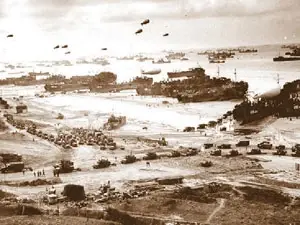
This famous photo shows Omaha Beach secured and dozens of ships unloading, thanks, in part, to the protective canopy of barrage balloons above. (From «Coast Guard at Normandy» by Scott T. Price.)
320th Antiaircraft Balloon Battalion (VLA, or Very Low Altitude) an all African American unit attached to the U.S. First Army brought in barrage balloons in LSTs and LCIs in the third wave at Omaha and set them up on the beach, to prevent Luftwaffe strafing during the early hours of the assault. (Barrage balloons actually caused some serious concern at the Normandy landings, especially in the early hours. Several batteries of long-range German artillery could see these large balloons tethered above ships from several miles inland and were able to bombard those ships that they could not see with a fair amount of accuracy. Many Navy crews cut their balloons loose when it became apparent that the Luftwaffe was not going to be a big factor that day, but the artillery was.) After the beaches were secured, hundreds of balloons were set aloft over ships and shore. All of the barrage balloons flying over Omaha were flown by the African-American troops of the 320th, a little-known fact about the invasion.
In fact, of the U.S. first Army's Omaha Beach assault forces on D-Day, less than 500 out of 29,714 troops were black. These were one section of the 3275th Quartermaster Service Company and the above-mentioned 320th Antiaircraft Balloon Battalion (VLA) (less one battery). Of the 31,912 U.S. troops landing on Utah Beach, approximately 1,200 were African-Americans and included troops of the remaining battery of the 320th Balloon Battalion, the 582d Engineer Dump Truck Company, the 385th Quartermaster Truck Company, and the 490th Port Battalion with its 226th, 227th, 228th, and 229th Port Companies.
One man in the 320th distinguished himself above many others that day. Corporal Waverly B. Woodson, Jr. was still a second-class citizen in terms of the rights he enjoyed as an African-American citizen of the United States. His diminished social and political status in the 1940s America was not reflected by his conduct in action. Serving as a medical corpsman with the 320th Barrage Balloon Battalion, Woodson rode an LST into Omaha Beach and suffered a shrapnel wound when the vessel struck a mine as it approached the landing site. Disembarking while under continuous mortar and machine gun fire, Woodson assisted in establishing an aid station on the beach and remained on continuous duty in treating casualties for the next 18 hours. He then assisted in retrieving and reviving three soldiers who had nearly drowned while leaving a landing craft which had slipped its anchor and drifted into deep water. Woodson was then hospitalized for treatment of the wound he had received the previous day. He was one of the over one million black GIs and WACs who loyally served in the armed forces in defence of their country during World War II.