One of the most disastrous drops (in a night filled with disasters) occurred in Sainte-Mère-Église. Around midnight, a stray incendiary bomb had set fire to the house of Monsieur Harion, located to the east of the square.
Wakened by the mayor and the tolling of the church bell, the townspeople turned out in large numbers to form a bucket brigade supervised by members of the German garrison. (The hand pump used that night still sits on the east side of the square.) While the house continued to burn, the drone of planes could be heard over the tolling bell. The fire-fighters, looking skyward, saw ghostly silhouettes drifting down on them. Two sticks from the 1st and 2d battalions had gotten their green jump light directly over the village. Illuminated by light from the burning house and tracers from German AA guns, the paratroopers were easy targets for the Germans below. Few survived.
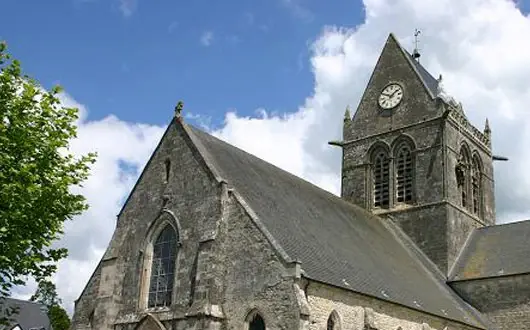
One who did was Private John Steele, whose parachute caught on the steeple of the church in front of you. The wounded paratrooper hung there limply for two hours, pretending to be dead, before the Germans took him prisoner.
The less fortunate hung from the trees all around the square where they had been shot. Once the fire in Monsieur Harion's house had burned itself out and the last of the paratroopers were killed or captured, the German garrison (a transportation company) quite inexplicably called it an evening and turned in.
A mile northeast of Sainte-Mère-Église, Lieutenant Colonel Edward Krause, commanding the 3d Battalion, assembled ninety men within an hour of landing and promptly ordered an advance on the village. Around dawn, the German garrison was again turned out, this time by the rattle of small-arms fire. Krause's men cleared the village in a rush, capturing thirty Germans and killing another eleven. With Sainte-Mère-Église in American hands, Krause ran a worn American flag to the top of the village flagpole, a flag that he had carried with him from Sicily.
D-Day ended with the Americans still in control of Sainte-Mère-Église, and further German attacks during the night failed to dislodge them. For their roles in the capture and defence of Sainte-Mère-Église, both Krause and Col. Vandervoort received the Distinguished Service Cross. All through 6 June, isolated groups of paratroopers were getting their first taste of hedgerow fighting within a few miles of Sainte-Mère-Église.
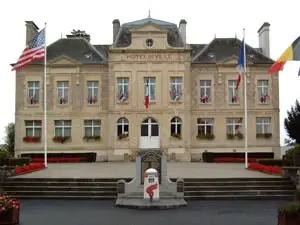
The Hôtel de Ville (Town Hall) is located just south of the square. In front stands a milestone marking «Kilometer O» on the «liberation route». Behind it is a stone honoring Generals Ridgway and Gavin. Inside the building is the American flag that Lieutenant Colonel Edward Krause raised over the liberated Sainte-Mère-Église. It had earlier flown over liberated Naples.
By the afternoon of the 6th, the paratroopers made contact with elements of the 4th Division moving inland from Utah Beach.

They had cut N 13 at Sainte-Mère-Église, thereby preventing the Germans from reinforcing the beach area. By their reduction of strong points at the beach exits, they greatly aided in the movement of the 4th Division off Utah Beach. Much hard fighting lay ahead to clear enemy resistance in the Carentan area, and forge a linkup between the two American beachheads. But it was apparent that Eisenhower's decision to go ahead with the night drop of the two American airborne divisions had been sound.
On one side of the square is the church (built between the eleventh and fifteenth centuries) on which Private John Steele landed. It contains two stained-glass windows commemorating the drop. There is a CD monument in front of the church. Next to it is a memorial to the 1944 mayor, Alexandre Renaud. The hand pump used to fight the fire on the night of 5-6 June still stands at the rear of the square behind the church.
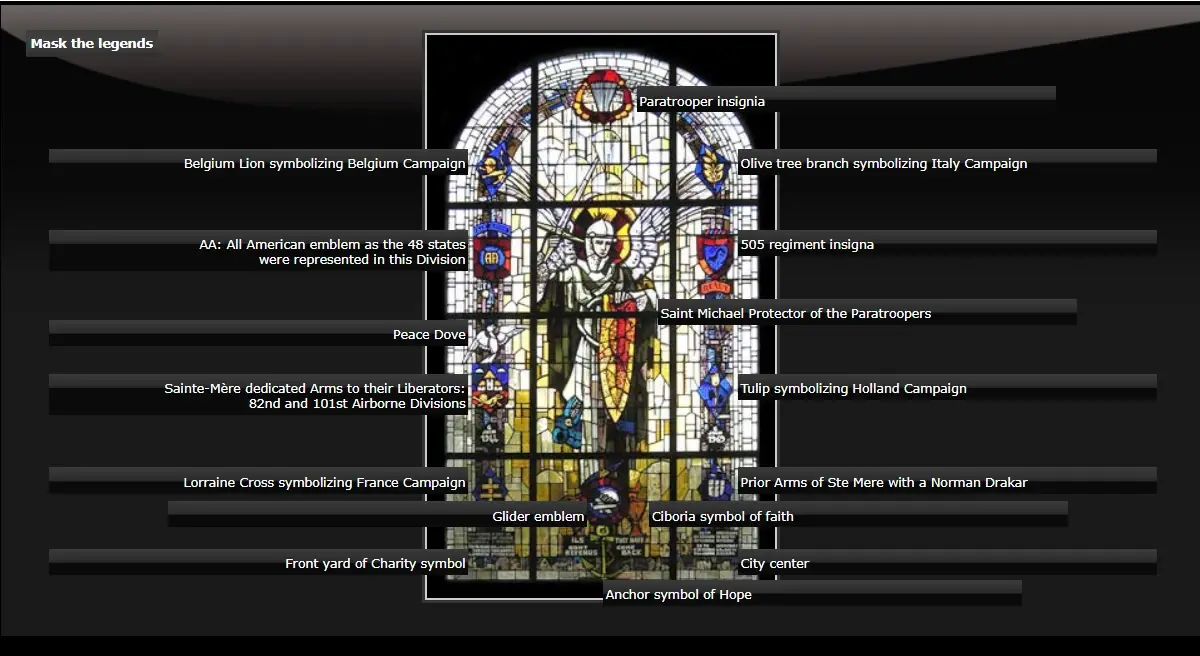
This stain glass has been offered by the 505th Regiment to celebrate the 25th Anniversary.

This is the first stain glass produced by Gabriel Loir from Chartres, regrouping around the Virgin Marie, Paratroopers and planes.

This organ was given by French Companies to commemorate the 50th Anniversary.
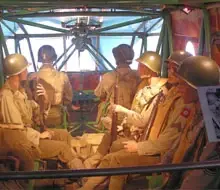
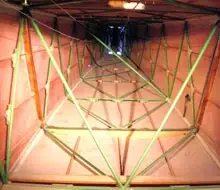
Inside of the glider displayed in the American Airborne Museum at Sainte-Mère-Église. I highly recommend the visit of this great Museum.
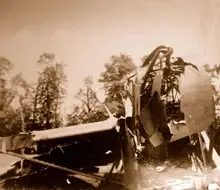
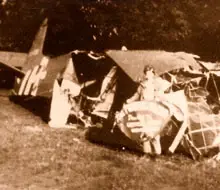
One of the most confused fights took place west of the village at La Fière Bridge, over the Merderet River. Uncoordinated groups from the 505th, 507th, and 508th regiments hold the position and finally went over the bridge on the 7th. The Monument Iron Mike is overlooking the site, its twin statutes is at Fort Benning. Alongside the road is General Gavin's fox hole. The photo of flooded marshland, a common occurrence that Germans exploited, shows the conditions as they were in 1944.
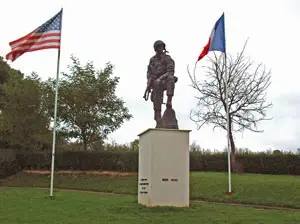
Iron Mike Statue
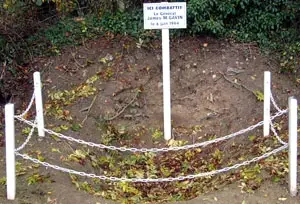
General Gavin's fox hole at La Fière.
West of the 101st Airborne the 82d Airborne Division had gained possession of the east bank of the Merderet River in the vicinity of Sainte-Mère-Église. Occupation of these positions, however, actually fell far short of the mission assigned to the division by plan. Broadly, its mission was to assist in sealing off the peninsula from the south by destroying bridges at Pont-l'Abbé and Beuzeville-la-Bastille and securing bridgeheads across the Merderet. Thereafter the 82d was to protect the southwest flank of the Corps by securing the line of the Douve River. It was therefore also charged with taking the offensive to the west in the direction of Saint-Sauveur-le-Vicomte.
The assignments were as follows. The 505th Parachute Infantry was to land east of the Merderet River, capture Sainte-Mère-Église, seize and secure the river crossings near La Fière and Chef-du-Pont, and secure a line in the north running through Neuville-au-Plain and tying in with the 101st Airborne Division in the vicinity of Bandienville or Beuzeville-au-Plain. The 507th and 508th Parachute Infantry Regiments were to land west of the river to consolidate the two bridgeheads o the west bank. More specifically, the 507th was to assist the 505th in securing the La Fière bridgehead and then establish a defensive line running southwest from Gourbesville to Renouf. The 508th was to destroy the crossings of the Douve at Beuzeville-la-Bastille and Pont-l'Abbé and extend the 507th's defensive line south from Renouf. Both regiments were to be prepared to assume the offensive westward and secure the line of the Douve River. All these forces were to land by parachute and were initially under the command of Brig. Gen. James A. Gavin, assistant division commander. General Ridgway, commanding the 82d Division, was to come in with certain glider elements just before dawn on D-Day. The remaining glider artillery and infantry were to follow over a period of thirty-six hours to support the 508th Parachute Infantry in destruction of the Douve bridges. There was also a seaborne force made up of organic and attached artillery, tank destroyers, and other special units under Brig. Gen. Reese M. Howell. The drop of the 82d Airborne Division was far from good. The regiments assigned to the zones west of the Merderet had the worst drop in the entire operation. The 507th Parachute Infantry was to land in Drop Zone T, north of Amfreville, but was scattered widely. The 508th Parachute Infantry was to land southwest of Amfreville and north of Picauville, and had a slightly better drop. But many of its sticks came down east of the Merderet, and for some days many of its men fought with the 101st Airborne Division. In contrast with the other two regiments, the 505th Parachute Infantry, landing northwest of Sainte-Mère-Église between the railroad and the main highway, had one of the best drops of any airborne unit. About 1,000 of the 2,200 men landed in the drop zone, and most of the others, although scattered to the north and east, were able to assemble rapidly. They were fortunate to come down in an area nearly devoid of enemy. Rapid assembly of the regiment enabled it to proceed expeditiously with its mission-one that during the day became more important defensively than the plan has envisaged at La Fière Causeway. The events of Sainte-Mère-Église assumed a greater significance in view of the critical situation which developed along the Merderet. There, more than anywhere else, the well-laid plans miscarried with a far-reaching impact Sacks of 2-pound plastic explosive, point detonated, used as antitank weapons.
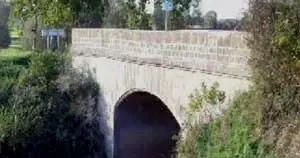
La Fière Merderet Bridge
Securing La Fière and Chef-du-Pont bridges from the east was the assigned mission of the 1st Battalion, both Parachute Infantry. Company A was to seize the one at La Fière. This company, along with the rest of the battalion, had an excellent drop and effected a remarkably rapid assembly, moving to its objective immediately.
On the other side of the river the 507th Parachute Infantry and the 508th Parachute Infantry, with the mission of securing the west bank of the river, probably depended more than any other units on a good drop pattern for success. Both regiments, however, were scattered and faced some of the most difficult problems of assembly of any of the airborne units.


Merderet River
The two regiments came in between 0230 and 0300, as scheduled. Pathfinders preceding them had in many cases found it impossible to mark the drop zones north of Amfreville and Picauville because of the presence of the enemy. Momentarily puzzled by the failure to see marker lights and by the realization that it was necessary to rely on alternative signals like the Eureka, pilots in some cases overshot the drop zones. Large numbers of paratroopers thus landed in the watery marshes along the Merderet. Aerial photos had indicated that the Merderet was a fairly narrow stream bordered with grassy swampland. But the photos were deceptive in that they did not reveal the wide flood areas created by the closing of the la Barquette lock. Grass had grown out of the water so thickly that from above this shallow lake looked like a prairie. Paratroops, heavily laden with equipment, found themselves in water several feet deep. The whole problem of assembly and recovery of equipment was therefore complicated. Both regiments were also widely dispersed. Part of the 508th Parachute Infantry dropped east of the Merderet and operated with the 101st Airborne Division. The 507th Parachute Infantry dropped generally east of its assigned zone, but personnel were found in widely separated places in the entire peninsula. Small groups held out against the enemy for several days, isolated from the rest of the division.
At first there was a noticeable gravitation to the La Fière bridge area, and ultimately elements of four regiments, including the 325th Glider Infantry, had a hand in the establishment of the bridgehead. This convergence on La Fière was due in part to the tendency of the groups landing in the Merderet marshes to collect at or move toward the railroad. The railroad embankment rose prominently from the marshland and was a convenient orientation feature. The men knew it was the only railroad in the Merderet valley and naturally used it as a guide. Probably the first group to do so was the one led by Capt. F. V. Schwartzwalder. His group of men from the 507th Parachute Infantry had landed along the swamp east of the Merderet and assembled on the railroad embankment. They moved down to the La Fière bridge and met their first opposition there at daylight. In an orchard near the group of houses east of the bridge, they were fired on by mortar and small arms. Several attempts to rush the houses netted only casualties. The engagement thus begun involved, in the course of the day, groups from all three parachute regiments. Company A, 505th Parachute Infantry, which had assembled almost to a man in the drop zone near Sainte-Mère-Église, was already engaged on the right of Captain Schwartzwalder's unit. Next on the scene were men of the 507th and 508th under Col. Roy Lindquist, Commanding Officer, 508th Parachute Infantry. Colonel Lindquist, after landing in the swamps northeast of Amfreville, moved to the railroad embankment, assembling a hundred men as he went along. On reaching the railroad, he was joined by thirty men of the 507th under Lt. John H. Wisner, regimental S-2. Lieutenant Wisner wished to reach the regimental assembly area in the vicinity of Amfreville. Colonel Lindquist's objective was Pont-l'Abbé. Both planned to follow the railroad as the clearest route south, and to cross the river at La Fière if the bridge was taken.
They arrived at dawn at the intersection of the railroad and the highway from Sainte-Mère-Église west, to find Company A, 505th Parachute Infantry, moving toward the bridge. The company was deployed to the north of the road and Colonel Lindquist decided to move up abreast. Lieutenant Wisner's men, leading off, were stopped by machine-gun fire 300 yards east of the bridge. At about the same point Company A, also pinned down by enemy fire, tried unsuccessfully to outflank the German positions from the right. About that time Lieutenant Wisner, reconnoitering to the north, ran across another group making its way to La Fière. This new group numbered about 300 men, principally from the 507th Parachute Infantry, who had assembled, like so many others, north of La Fière and had followed the railroad south. Part had been collected by General Gavin, and part by Lt. Col. Arthur Maloney and Lt. Col. Edwin J. Ostberg. General Gavin's initial intention, after assembly, was to move this force south against the west end of the La Fière bridge and causeway. However, fruitless efforts to retrieve a jeep and an antitank gun from the marshes delayed the move until daylight. With the light, enemy fire seemed to build up along the west bank. The original plan was therefore abandoned and the force proceeded east and thence south along the railroad embankment.
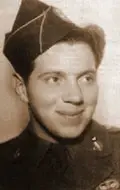
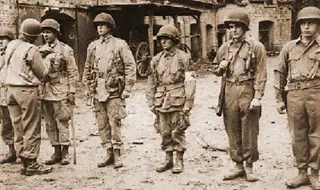
Marcus Heim in 1944. Note the Paratrooper Infantry Regiment Insignia of the 505th on the beret. Marcus Heim with some of his Comrades and Officers awarded by General Omar Bradley. Marcus is to the right, next to the left is Col. Vanndervoort with a walking stick.
When this force arrived at La Fière, the first American attempt to approach the bridge had been checked, but still it did not appear that the enemy was strong. Moreover, men of the 507th and 508th continued to drift into the position until by midmorning some 500 to 600 had gathered there. General Gavin therefore decided to commit part of the force elsewhere. Colonel Maloney was sent south with seventy-five men to reconnoiter another crossing. A little later General Gavin and Colonel Ostberg took another group of seventy-five men to try to cross the Merderet at the Chef-du-Pont bridge, which had been reported undefended. Colonel Lindquist took command of the assorted units remaining at La Fière. The principal organized groups, comprising about 400 men of all regiments, were Company B, 508th Parachute Infantry; Company G, 507th Parachute Infantry; and Company A, 505th Parachute Infantry. Company G, under Captain Schwartzwalder, in position on the extreme left, south of the road, had probed out the weakest portion of the enemy line but had not followed up the advantage. When Colonel Lindquist ordered an attack at noon by all forces, Company A, which had displaced to the north of the road, failed to get the order, but Lindquist's own force, attacking through the area where Company A had been held all morning, destroyed or captured the last of the enemy. As the fire fell away, Captain Schwartzwalder's men crossed the causeway and made contact near the west end with a patrol from the 2d Battalion, 507th Parachute Infantry (Lt. Col. Charles J. Timmes).
The 2d Battalion, 507th Parachute Infantry, had achieved an early assembly of fifty men under Colonel Timmes 1,000 yards east of Amfreville, near the battalion's planned drop zone. Soon after the initial assembly a patrol under Lt. Lewis Levy of Company D was sent to investigate the La Fière causeway and to clear it if possible. The patrol found a few men of the 507th already established in the village of Canquigny, though enemy infantry held the ground south and east. The forces joined but were unable to work their way to the causeway until the attack from the east bank carried across. The success of that attack cleared the west bank and brought eighty men into the bridgehead. Lieutenant Levy then established contact with the forces still on the east side and received assurance that the 1st Battalion, 505th Parachute Infantry, was coming across to take over the bridge.
The position seemed secure. Yet within the next hour the bridge was lost. The Germans countered quickly. Enemy artillery began to hit the vicinity of Canquigny, while small-arms fire built up to the south; tanks were heard approaching from the west. Before these signs of coming battle had become critical, Captain Schwartzwalder had decided that his primary mission was to go on toward Amfreville to join the 2d Battalion and, under prodding of the first enemy artillery bursts, had pulled out fast with his eighty men and some additional personnel of the 508th. As no other troops from the east bank crossed over, this move left the bridgehead in the hands of four officers (including Lieutenant Levy) and eight enlisted men. With grenades and rifles and one machine gun, this handful of men fought off the enemy and even succeeded in disabling two enemy tanks with Gammon grenades, but they finally had to withdraw northward to join the 2d Battalion of the 507th.
In the meantime, Company B, 508th Parachute Infantry, had been sent, belatedly, across the causeway. When it arrived on the west bank it met the enemy attack head on. Unable to organize or hold its ground, it was forced south along the river, and survivors swam back under fire to the east bank.
The bridge so handily won was thus lost through failure to consolidate rapidly the west bank position. The reason for the failure was in part that the groups participating in the action had only a vague idea of what neighboring units were doing. The hedgerow country virtually penned each unit in its separate field of action.
Not only had the bridge been lost, but the enemy counterattack had isolated the force under Colonel Timmes (now including Captain Schwartwalder's men) from the units at La Fière. Colonel Timmes' group had taken up a defensive position in an orchard near Amfreville and was caught and virtually immobilized by the enemy forces attacking toward the bridgehead. An attack south to La Fière was planned for that night but not attempted. The force numbered about 120 men; many were exhausted or casualties; and, in addition, friendly artillery fire began to fall in the causeway area. Colonel Timmes' force remained isolated in this position for two more days.
At La Fière, after the retreat of Company B, 508th Parachute Infantry, the position on the east bank was reorganized. Men of the 507th and 508th Regiments under Colonel Lindquist were relieved on the left and the remainder of the 1st Battalion, 505th, joined Company A in the line. Colonel Lindquist's men were placed in reserve west of the railroad. But the position was still far from satisfactory. The forward defences of the 1st Battalion, 505th, were exposed to heavy mortar and artillery fire, and the enemy, after his success in clearing the west bank, began to show unusual aggressiveness. Two German tanks attempted to exploit their success by crossing the causeway. Company A's road block covered by bazooka men stopped the attack, destroying both tanks. But it seemed probable that the Germans would try again. General Gavin came up to La Fière from Chef-du-Pont late in the afternoon and found the situation serious. Ammunition was low; medical aid was scarce. General Gavin sent orders to Colonel Maloney at Chef-du-Pont to bring all his force, less about a platoon, to La Fière at once.
Before Colonel Maloney arrived, the enemy attacked the east bank again in considerable strength, and the position of the 1st Battalion, 505th Parachute Infantry, was, in the opinion of its commander, becoming rapidly untenable. At about 2000 Colonel Maloney brought 200 men to La Fière and moved up to the 505th Parachute Infantry line. By dark the American defence was again fairly well stabilized and the enemy had ceased his attack across the causeway.
Locally the situation was secure. But there was still no news at 82d Airborne Division headquarters, located west of Sainte-Mère-Église, of the progress of the seaborne invasion. General Ridgway therefore took steps to provide for the possibility that the whole division might have to consolidate its defence in the vicinity of Sainte-Mère-Église. Colonel Lindquist was ordered to move his force, now numbering some 250 men, to a position from which he could prevent the enemy from cutting off La Fière units from Sainte-Mère-Église. This movement, however, was not accomplished until the next day.
While the chief concern of the 82d Airborne Division during D-Day was with the La Fière bridgehead, where the bulk of the assembled forces were committed and where the enemy put up his strongest resistance, another attempt to secure a crossing of the Merderet River had been made at the same time to the south of Chef-du-Pont and had fared slightly better. The initial attack at Chef-du-Pont had been undertaken by the seventy-five men under Colonel Ostberg. The enemy withdrew from the town and the eastern approaches to the bridge but dug in along the causeway and on the west bank. Though apparently not numerous, the Germans fought tenaciously. Colonel Ostberg's men were stopped at the bridge. The seventy-five reinforcements who arrived later under Colonel Maloney could do nothing to break the deadlock. At about 1700 the Chef-du-Pont force was stripped to a platoon in order to send reinforcements to the hard-pressed paratroopers at La Fière.
The remaining platoon of thirty-four men under Capt. Roy E. Creek almost at once were whittled down to twenty effectives by direct fire from an enemy field piece on the opposite bank. At the same time from seventy- five to one hundred Germans were observed forming on the east bank in some buildings to the left rear of Captain Creek's position. Captain Creek asked for reinforcements. Before they could arrive, immediate help was provided fortuitously by the landing within American lines of a glider carrying a 57-mm. antitank gun and ammunition. The gun was emplaced and fired to neutralize the enemy artillery piece. Nearly one hundred men came down from La Fière shortly thereafter and the enemy threat was removed. With the reinforcements a defensive position was organized to bring greater fire power to bear on the enemy. In a short time the east bank was cleared, and a platoon crossed the bridge and dug in on the other side without opposition. The bridge was secured, though the position remained enfiladed by enemy fire from the Carquebut area.
The capture of Sainte-Mère-Église, and the fights for the Merderet River crossings at La Fière and Chef-du-Pont, together constituted the principal efforts of the 82d Airborne Division on D-Day. But there were also a number of isolated groups of the division which organized themselves west of the Merderet and fought independently-in some cases for four or five days. These isolated groups contributed in some degree to the accomplishment of the division's missions, though they carried on what amounted to fights for survival rather than battles for planned objectives.
Col. George V. Millet, Jr., commanding the 507th Parachute Infantry, collected in the course of D-Day some seventy-five men northwest of Amfreville. But, though he was not more than 1,000 yards from the 2d Battalion, 507th (Colonel Timmes), he made no contact with this battalion or other friendly elements until D plus 4.
Farther south, elements of the 508th Parachute Infantry were having similar experiences. One group, initially led by Lt. Gerald P. Guillot and later by Capt. Jonathan Adams, had one skirmish after another with the enemy, and survived to join the regiment on D plus 5.
The largest force from the 508th Parachute Infantry to assemble west of the Merderet was commanded by Col. Thomas J. B. Shanley (Commanding Officer, 2d Battalion). Colonel Shanley landed near Picauville. He assembled a small group, not large enough to proceed, as he wished, on the mission against the Douve bridge at Pont-l'Abbé. Before noon he established radio contact with Lt. Norman McVicar, who had a force of about sixty men a mile to the northeast, and started out to join this force. He met a patrol from another force off to his left under Maj. Shields Warren, Jr. Junction between these three groups, however, was delayed by enemy pressure on the south, which forced Colonel Shanley's men to engage. It was mid-afternoon before they could free themselves even so far as to choose better ground and organize a defensive position. Before nightfall, however, the enemy had been cleared sufficiently to allow the Shanley, Warren, and McVicar forces to join. But in the meantime Colonel Shanley had learned that the German force which had been trying all afternoon to close in on him had the strength of a battalion, and that more of the enemy was dug in around Pont-l'Abbé. He therefore abandoned the idea of attacking toward the Douve bridge and decided to proceed to the regiment's assembly area, the high ground known as Hill 30, dominating the Chef-du-Pont causeway. At 2300 the entire force, organized into two companies, moved there and improvised an all-around defensive position.
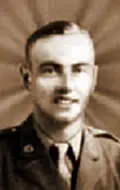
Charles N. DeGlopper
Rank and organization: Private First Class, U.S. Army, Co. C, 325th Glider Infantry, 82d Airborne Division. Place and date: Merderet River at La Fière, France, 9 June 1944. Entered service at: Grand Island, N.Y. Birth: Grand Island, N.Y. G.O. No.: 22, 28 February 1946.
He was a member of Company C, 325th Glider Infantry, on 9 June 1944 advancing with the forward platoon to secure a bridgehead across the Merderet River at La Fière, France. At dawn the platoon had penetrated an outer line of machineguns and riflemen, but in so doing had become cut off from the rest of the company. Vastly superior forces began a decimation of the stricken unit and put in motion a flanking maneuver which would have completely exposed the American platoon in a shallow roadside ditch where it had taken cover. Detecting this danger, Pfc. DeGlopper volunteered to support his comrades by fire from his automatic rifle while they attempted a withdrawal through a break in a hedgerow 40 yards to the rear. Scorning a concentration of enemy automatic weapons and rifle fire, he walked from the ditch onto the road in full view of the Germans, and sprayed the hostile positions with assault fire. He was wounded, but he continued firing. Struck again, he started to fall; and yet his grim determination and valiant fighting spirit could not be broken. Kneeling in the roadway, weakened by his grievous wounds, he levelled his heavy weapon against the enemy and fired burst after burst until killed outright. He was successful in drawing the enemy action away from his fellow soldiers, who continued the fight from a more advantageous position and established the first bridgehead over the Merderet. In the area where he made his intrepid stand his comrades later found the ground strewn with dead Germans and many machineguns and automatic weapons which he had knocked out of action. Pfc. DeGlopper's gallant sacrifice and unflinching heroism while facing unsurmountable odds were in great measure responsible for a highly important tactical victory in the Normandy Campaign.
«General Omar N. Bradley called the assault landing on Utah Beach «a piece of cake», and it was, compared to that on Omaha».
General Omar N. Bradley called the assault landing on Utah Beach «a piece of cake», and it was, compared to that on Omaha. The landing plan called for the 4th Infantry Division (Major General Raymond O. Barton) to land along 2,200 yards of sandy beach on a two-regiment front, two battalions abreast. Colonel James A. Van Fleet's 8th Infantry (including the 3d Battalion, 22d Infantry) was to land at 0630, followed by the 22d Infantry in eighty-five minutes and the 12th Infantry at 1030.
DD tanks were to lead the way in, preceded by an intense naval and air bombardment. Various engineer units were scheduled to land close behind the infantry to clear beach obstructions and to blow gaps in the low sea wall paralleling the beach.
The landing of the thirty-two DD tanks was delayed when one of the control ships was sunk by a mine. Four of the tanks were lost when the LCT carrying them sank before they could be launched. In contrast to the heavy losses off Omaha, twenty-eight DD's made it to the beach able to provide fire support for the infantry already ashore.
Rank and organization: brigadier general, U.S. Army. Place and date: Normandy invasion, 6 June 1944. Entered service at: Oyster Bay, N.Y. Birth: Oyster Bay, N.Y. G.O. No.: 77, 28 September 1944.
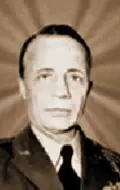
For gallantry and intrepidity at the risk of his life above and beyond the call of duty on 6 June 1944, in France. After 2 verbal requests to accompany the leading assault elements in the Normandy invasion had been denied, Brig. Gen. Roosevelt's written request for this mission was approved and he landed with the first wave of the forces assaulting the enemy-held beaches. He repeatedly led groups from the beach, over the seawall and established them inland. His valor, courage, and presence in the very front of the attack and his complete unconcern at being under heavy fire inspired the troops to heights of enthusiasm and self-sacrifice. Although the enemy had the beach under constant direct fire, Brig. Gen. Roosevelt moved from one locality to another, rallying men around him, directed and personally led them against the enemy. Under his seasoned, precise, calm, and unfaltering leadership, assault troops reduced beach strong points and rapidly moved inland with minimum casualties. He thus contributed substantially to the successful establishment of the beachhead in France.
The strong offshore current carried the first wave of infantry some 2,000 yards south, causing the boats to beach in front of the German strong point at La Grande Dune (a half-mile south of your present location). Fortunately, the defences there were much weaker than those on the intended beach, due in part to visual bombing by the medium bombers of the IX Bomber Command and naval fire support.
The point blank bombardment by the B-26's was a crucial factor in the success at Utah beach, in contrast to the pre-1st wave bombardment at Omaha.
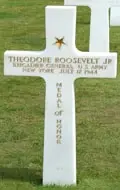
Roosevelt, Theodore, Jr., Grave
Brigadier General Theodore Roosevelt, assistant division commander, landed with the first wave, the only general officer to do so on D-Day. Shortly after coming ashore, Roosevelt, disregarding his personal safety, surveyed the beach before him and made two decisions that decisively influenced the course of the battle. Realizing that he and the first wave had landed a mile south of their assigned beach, he ordered the following waves to come in on this new beach. Emphasizing that decision for Colonel Eugene Caffey of the 1st Engineer Special Brigade, he said, «We're going to start the war from here». He then ordered the advance inland to begin immediately along the causeway leading to Beach Exit 2, directly to his front. For his heroism that morning, Roosevelt was awarded the Congressional Medal of Honor.
The 101st had just freed Carentan on June 12th and were expecting a German counter-attack which happens the next day, Enemy paratroopers of the 37th Regiment belong the 17th SS started the assault. They were commanded by LT. Col. Von der Heydte; fortunately their progression was stopped by the American paratroopers supported by the 2nd Armoured Division commanded by General Ross, at the end of the day the new front line was pushed south of Méautis. This is also the village were General Theodore Roosevelt died on July 12th as you will see on the plaque.
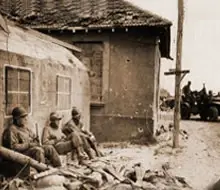
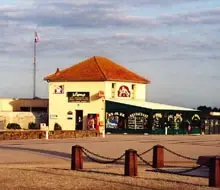
The 3d Battalion, 8th Infantry, quickly passed across the flooded area behind the beach to higher ground (along the road you have just driven to reach La Madeleine). The 2d Battalion moved along the beach to the south and opened up Exit 1 to Pouppeville and Sainte-Marie-du-Mont. Three battalions of the 22d Infantry moved north to clear opposition from Exit 4. Before dark, the 1st and 2d battalions of the 22d Infantry had linked up with the 502d Parachute Infantry west of Saint-Germain-de-Varreville. Late afternoon also found the 2d and 3d battalions, 8th Infantry, astride route N 13 at Les Forges, but they had failed to link up with the 505th Parachute Infantry holding Sainte-Mère-Église two miles to the north. By then, the first elements of the 90th Infantry Division had come ashore. The landing on Utah Beach was becoming the big success story of D-Day.
In addition to a D-Day museum, La Madeleine is the site of these monuments:
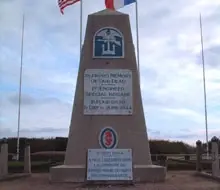
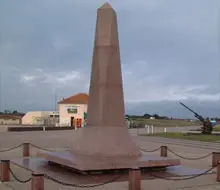
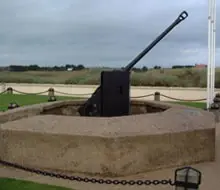
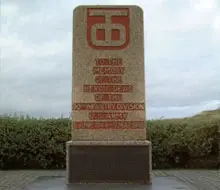
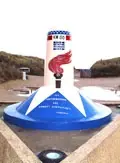
The first (designated 00) of the 1182 cylindrical milestones marking the «Voie de la Liberté», the route that the U.S. Third Army followed from Normandy to Bastogne. All bear forty-eight stars and a symbolic torch of liberty patterned after that held aloft by «Liberty» in New York harbor. They are similar to the stones which line La Voie Sacrée (the Sacred Way), the road from Bar-le-Duc to Verdun along which hundreds of thousands of French soldiers moved in 1916. A monument to the 1st Engineer Special Brigade, raised in 1945 atop a blockhouse of the W5 strongpoint. This massive blockhouse, captured on D-Day and used as the Brigade HQ, contains a memorial crypt (protected by a locked iron grill) commemorating the members of the Brigade who died on Utah Beach. Another plaque commemorates Maj. General Eugene Mead Caffey and the achievements of the Brigade he commanded. Other plaques in French and English commemorate the assault on Utah Beach.
An imposing stone plinth, unveiled by General J. Laughton Collins on 5 June 1984, commemorating «in humble tribute... its sons who lost their lives in the liberation of these beaches, June 6, 1944».
A stone plaque marking the presence of the heads of state of the United States, France, Great Britain, Luxembourg, Belgium, Norway, and the Netherlands for the 40th anniversary of D-Day.
A stone plaque commemorating General Dwight D. Eisenhower as Supreme Allied Commander.
Some fifty-nine road signs named after members of the 1st Engineer Special Brigade who died in the fighting on Utah Beach.