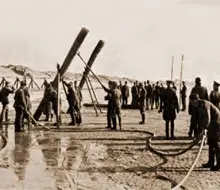

Omaha Beach was heavily protected by the Atlantic defences and excellent terrain for defence.
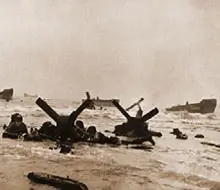
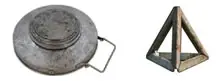
Moving out from the dunes toward the sea, the first obstacles encountered were called hedgehogs. They were three steel bars welded or bolded together at the centre tipping the edge in the air. Those were four to five feet long.
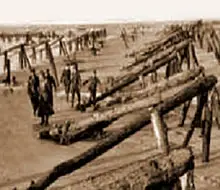
Mixed with the hedgehogs was tetrahedron. Those elements were concrete triangles sometimes five to six feet high. The third set of obstacles was logs set in the sand at a ninety to forty five degrees angle towards the sea.
Other logs (tree trunks) faced back toward the land forming a ramp with metal teeth to wreck the landing craft.
The last heavy element was the Belgium gate, a large metal structure to stop the traffic on the beach. Most of those elements were equipped with teller mines.
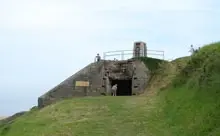
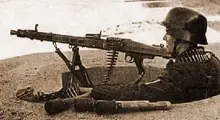
They had 8 concrete bunkers, 6 with 75 m/m guns and 2 with 88 m/m guns, 35 pillboxes with artillery or other automatic weapons, 18 antitank guns, 6 mortar pits, 35 rocket-launching sites, each with 4 rockets and at least 85 machine gun positions.
Also, 20 heavier guns, 105 m/m howitzer and 155 m/m were in land use to cover the beach. Some of those sites are still obvious today and can be visited but most of them were covered over after the war. These positions were called WN by the Germans (Widerstandnest).
Omaha was under the range of 20 of those WN from WN 56 to WN 76, each separate position containing from 7 to 35 men. To reinforce those structures, were set up on each beach exit (Stützpunkt) containing about 70 soldiers, many of those construction were linked with underground passages , tunnels or trenches.
On D-Day, the 2nd Bn of the 916th Infantry Regiment was close by Vierville and the 3rd Bn of the 726th in the area of Colleville. A German infantry Bn contained 708 men.
The 352nd Division Commander, Major Kraiss did not trust the 726th and assigned an additional Bn of the 916th as reserve near Colleville. Major Pluskat HQ was headquartered at Etreham.
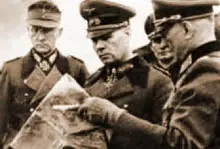
General Rommel (center) on his inspection tour of the beach defences in the 84th Army Corps Zone. General Marcks is seen standing to the left.
H-Hour was 6.30 am on June 6th 1944. The landing window had to consider the availabilities of landing craft, Navy and air support. Plus the combination of daylight, tide and moonlight. Low tide was at 05.30 am, sunrise was at 05.58 am. The D-Day planners decided to land at 06.30 for several reasons: LCA's could come closer to the bluff, minimizing the uncovered distance for the GIs, and all the obstacles would be exposed. The sunrise hour permitted the Navy and the Air Force to optimize their shelling and Bombardment.
Two Infantry Divisions landed on D-Day, each strong of 14men, 1st and 29th ID, attached were two Tank Bn (741st and 743rd) with 45 tanks each, two Engineers Special Brigades (5th and 6th) strong of 4.188 men each, 5th Ranger Bn strong of 550 men and half of 2nd Ranger Bn strong of 225 men.
The fist wave was composed of Infantry, Armor and Combat Engineers who had to face the enemy fire, 1,450 men were schedule to land at 06.30 am.
Each Coy contained 3 platoons (41 men) and a platoon of heavy weapons: 60m/m mortars and M 1919 Browning machine gun (36 men) and a HQ (6 men) which gives a total of 165 per Coy.
There were 4 Coy per Bn:
Coys D, H, M were the heavy weapons of each Bn. The heavy weapon Coy had longer range mortars such as 81 m/m, longer range calibre. Rich from Sicily experience the 16th Regiment split their heavy weapons coys in the other ones to reduce the number of men losses but didn't share that knowledge with the 116th Regiment who no combat experience. LCVP and LCA carried 31 men and one officer; there were 6 landing craft per Coy. The Coy HQ was the seventh one and would land with the second wave.
Each craft had men for infantry support, engineer task, as cutting the wire, de-mining and clearing the bunkers as well M-1 rifle, bazookas, flamthrowers, explosive loads, BAR and 60 m/m motars.
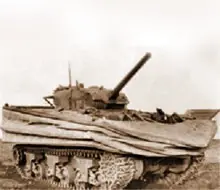
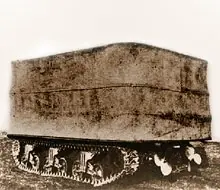
741st and 743rd tanks Bn had 90 tanks, each Bn had 32 DD (amphibious tanks), which were to be launched 6,000 yards off shore. On 32 tanks of the 741st Bn, 27 were sunk right away, 2 made the beach and the 3 last one landed from LCT's. In front of such a disaster the 743rd Bn decided to transport their tanks to shore. 743rd Bn reinforce 116th Regiment from Les Moulins to Le Ruquet (Easy Green) and to Vierville (Dog Green).
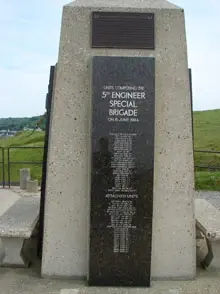
5th and 6th Special Engineer Brigade job was to clear the beach from obstacles: anti-personal and anti-vehicle mines, barber wire and opening the different exits.
5th SEB was composed of 37th, 336th and 348th Engineer Combat Bn and 6th Naval Beach Bn.
6th SEB was composed of 147th, 149th and 203rd Engineer Combat Bn and 7th Naval Beach Bn.
Engineer Combat Bn (634 men) was the base of beach Bn, it was added transportation assets, quartermaster units, ordnance ammunition Company, motor repair platoon, medical Coy, MP chemical decontamination, signal platoon and two surgical teams, A Combat Engineer Bn would support one Infantry Regiment. The SEB were organize in 16 assault teams, five of them reach the beach first, the sea current was the major problem; another 8 were delayed.
16 Bulldozers were to land with the first wave, only 6 did and 3 were immediately destroyed by enemy artillery. In despite of all the troubles they finally open 6 gaps totally and partially open another 3.
DD Tanks, were to be launched from off shore at 6,000 yards. These were scheduled to land before infantry that would arrive by craft at the end of low tide. Craft would drop their ramp down and troops would rush out and fighting their way inland. Tanks task was to support the infantry and silence the enemy fortifications. The SEB who were to land 3 minutes after the infantry would place explosive charges on the beach obstacles then clear the beach while the infantry was clearing the bluff. They would penetrate the enemy line all to Treviéres, final target on D-Day.
In military times are discussed from the moment an operation begins thus: D-Day for the invasion of France in 1944 was June 6th. H-Hour is the beginning hour and minute of an operation. For the 29th, 1st and 4th Infantry Divisions H-Hour was 06.30 am, for the paratroopers 82nd and 101st H-Hour was 01.30 am on D-Day June 6th 1944.
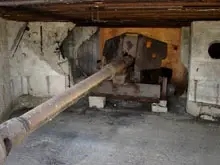
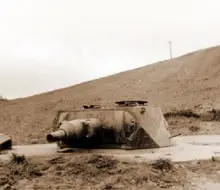
German 88 m/m left under National Guard Memorial WN 72.
Coy B, 743rd Tank Bn landed directly in front of the draw, D-1 Exit. They suffered heavily from artillery fire. The LCT carrying the commanding Coy was sunk and 4 other officers were killed or wounded, leaving one lieutenant in Coy B. 8 of 16 tanks landed and fired from the water edge; Coy A and C, 743rd Tank Bn landed east of Vierville-sur-Mer well spaced intervals without initial losses Dog white to Easy Green). Coy C, 2nd Ranger Bn landed on Charlie western end of Omaha at H+ 15. Ranger Coy consisted of 65 men. An antitank gun bracketed and hit Cpt Goranson's LCA, killing 12 men. Another 15 Rangers were KIA and WIA by a machine gun when they were getting out their craft. Rapidly they gathered at the cliff base and realize that they couldn't scale it from their position. 1st Lieutenant Moody with 3 others moved further west, three hundred yards, and discovered a crevice which they could climb using their bayonets for handholds. 1st Lieutenant William D. Moody had brought along four toggle ropes that he attached to stakes in a minefield just below the crest. With another Ranger they moved along the cliff until they were over Coy C. They shouted down to men below the rope location. At 07.30 am Coy C made it to the top and assault the fortified house on the cliff top, the house does not exist anymore. They had lost 35 men. From the top, Cpt Goranson saw a secton of Coy B 116th and send a man to guide them to the ropes. Their first objective was to secure the fortified house and the bunkers at Pointe de la Percée.
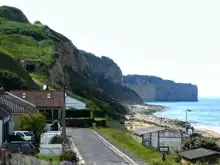
They never anticipated that it would take close to 10 hours to reach their first objective. They were assisted by the Coy B 116th. Their final target for the day was Pointe du Hoc and Pointe du Raz...
The three craft carrying HQ's Coy of 1st Bn, Command group and Beachmaster for Dog Green landed too far west under Charlie's cliff, they lost many officers and non-commissioned officers, including the commanding officer of the 58th Armored Field Artillery Bn. They lost about 60% of their group due to concentrated small weapons fire.
The survivors were pinned down at the base of the cliff by snipers from 07.10 am, keeping the commanding group separate from the other units. They had to use radio for inter-communication.
«Every man who set foot on Omaha Beach that day was a hero»
Coy A, 116th Infantry Regiment landed on the right spot facing Vierville draw, D-1 Exit, Dog Green at 06.30 am. One of the 6 LCA sank at one thousand yards off shore with 30 men.
In a desperate run for survival across the Killing zone of beach flats, survivors realized that to go forward would mean probable death. Many had to withdraw to the water and remain pinned behind obstacles. 115 of 175 men in the Company were lost in just minutes. Coy A consisted of 35 sons of Bedford Virginia. On June 6th 1944, it is calculated that Bedford lost more men per capita than any other town. 19 men were killed on D-Day, 11 are buried at the Cemetery. 23 were killed in ETO and 33 with Pacific Theatre.
Coy B/116 craft suffered a lot and beached at 07.00 am on almost a mile front line either side of target Dog Green, a section landed near where the Ranger Coy C landed and another one on Dog Green / Dog White border.
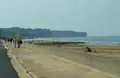
Coy C landed at 07.10 am a thousand yards away from Vierville, D-1, Exit Dog White, their mislanding turn to an advantage. One craft hit a mine and was delayed of 20 minutes, the other five did a great job and landed their men in water 6 feet deep, and most of the equipment was lost. Enemy fire was light, only 5 or 6 casualties, probably due to the smoke screen provided by burning grass.
Coy D was not as fortunate as Coy C, they were Heavy Weapons Company who landed at 07.10 am Dog Green. 3 craft were in bad position, 1 was finally abandon, a second one hit a mine or was shout by artillery, half of the men reach the sand. A third section was debarked 150 yards from the water edge...
«Two kinds of people are staying on this beach, the dead and those who are going to die now let's get the hell out of here»
Col. George A. Taylor
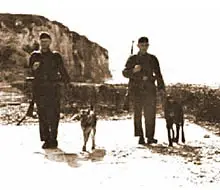
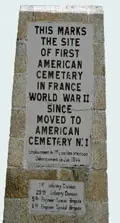
At 07.30 am 116th's Regimental Command party arrived with Col. Charles D.W. Canham and General Cota, on Dog White.
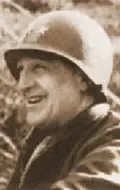
Brigadier General Cotta on Omaha.
Coy F/116 almost landed on target at 06.30 am in front of les Moulins, 3 sections to the east, unprotected by the smoke came under concentrated machine gun fire and were exposed during 45 minutes, they lost half of their boats sections.
Coy G/116 landed east of les Moulins Dog Red Exit D-3 at 06.30 am, 3 of 4 craft get through pretty easily. But the other sections were under heavy fire and lost 14 men before they reach the sand. Coy I/116 landed near Les Moulins strongpoint but received little fire. In some places it took four lengths of Bangalore torpedo and in others wire cutters were the only tool needed.
Coy K moved off of the beach slowly due to machinegun firing and thick minefields, they lost 15 to 20 men.
Coy L landed half way between D-2 and E-1 draws, enemy machinegun was light and ineffective.
Coy M, 3rd Bn Heavy Weapons Company landed close to E-1 Draw under enemy firing, 1 craft sunk. They sep up machinegun and heavy motors before they get to the bluff stop.
At 08.00 am losses were heavy for the 111th field Artillery Bn that mislanded in front of Les Moulins Lieutenant Mullins was KIA organizing his men, they lost 12 of their 13m/m guns attempting to get to shore.
This area, known as the W 62 strongpoint has been recently cleared and excavated but not finished, so that it is now possible to visualize the powerful German defences that faced the first waves. You can see from this position the entire 4.5 miles of Omaha Beach.
It is possible to reach the W 62 position by driving to a small lot east of the main parking area and walking down to the monuments.
A large section of the landing sector at Easy Red was situated between two stongpoints (WN 64 and WN 62). The Engineers here were able to open 4 gaps through the approach. This was important because on all of Omaha Beach, only a total of 5 gaps would be opened. The 37th and 149th Engineer Combat Battalions worked furiously to get these obstacles cleared, while Company E, 16th RCT was able to take WN 64 from the rear. Two destroyers had been instrumental in neutralizing strongpoints between Les Moulins to Fox Red and at least 5 destroyers had moved in to support the landing troops. The two red arrows point the positions of Franz Gockel and Heirich Severloh. Franz fired an estimated 15.000 rounds from 6.30 pm to noon.
First wave of the 1st Division had landed east of Easy Red, situation was correct with the subsequent waves; this unable tanks fo the 741st to support the assaulting infantry. Only five of the 32 DD tanks, of the 741st Tank Bn made shore as well deployed as per the plan at 6,000 yards to sea. Of Coy A with its conventional tanks 11 made shore to east of E-Exit, Le Ruquet draw and west of Colleville-sur-Mer E-3 exit, almost in front of actual cemetery.
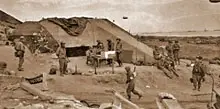
Le Ruquet
Coy A, B, and C 16th Infantry Regiment came on Easy Red from 07.40 am to 08.00 am, between E-1 and E-3 draws. Coy D's machine guns were dispersed to the other 3 coy and mortars to HQ Coy. Two sections of Coy A landed in front of the actual cemetery, the rest of them landed facing WN 62.
3 boat sections landed east of Easy Red, 1 section of Coy E/16th and 2 sections from Coy E/116th, about 60 men veered east and landed with elements of 1st Division Easy Red, two craft sank but men could swam to shore, the lost all their equipment.
Coy E/16th came western end of Fox Green scattered over a nearly 800 yard front line. Crossed bands of automatics fire and lost 105 men.
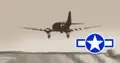
A-21C Airstrip
2nd Lt John Spaulding led elements of E/16th to the ruined house, then started to move up the bluff, until they were blocked in front of a minefield.
Coy G/16th landed at about 07.00 am with E/16th and E/116th they took 63 casualties, their advance was paralyzed by minefields, they call Coy A 1st Eng Cmbt bn and Coy C 37th Eng Cmbt Bn to open a gap through mines.
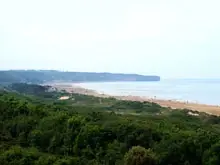
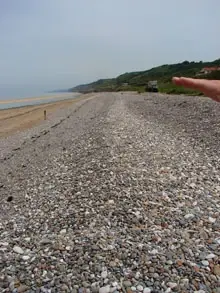
Coy I and L/16th were so delayed that they didn't played any role in the initial landing. Coy I was headed almost to Port-en-Bessin, they landed at 08.00 am on Fox Green. Coy L landed with 30 minutes delay after they lost 1 craft with 8 men 2 miles off shore. Third section on Coy L lost another 34 men on the beach.
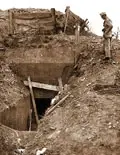
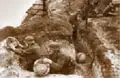
On Fox Green Coy I, K, and M landed among the confusion and mixture of the men already bunched together on that beach in two large groups. Coy K landed at 07.00 am, lost 53 men including 4 officers. Coy M came in scattered from 07.30 am to 08.00 am with 1 craft capsized and the other boats unloading in deep water under fire.
16th Regiment had learn through Sicily experience that landing were often confusing and decided to disperse its machine guns and other heavy weapons among theother line companies and battalions.
Assault on strong point and beach exit F-1 was lead by 1st Lt. Robert R. Cutler, Jr. who had assumed the commander of L Coy when the company commander 1st Lt. Montieth was killed. 1st Lt. Montieth was posthumously awarded the MOH for his actions on June 6th 1944.
On D-Day, the first ID, attacked over open ground and suffered 281 KIA, 803 WIA, 166 MIA total of 1.190 casualties.
The 29th ID also attacked across open ground and over the bluff and suffered 328 KIA, 381 WIA, 134 MIA total casualties 743.
The 5th and 6th Engineer Special Brigade suffered 456 casualties.
The 2nd and 5th Rangers Bn suffered 253 casualties.
«We too born to freedom and believing in freedom are willing to fight to maintain freedom - We and all others who believe as deeply as we do would rather die on our feet than live on our knees»

Rank and organization: Private, U.S. Army, 18th Infantry, 1st Infantry Division. Place and date: Near St. Laurent-sur-Mer, France, 6 June 1944. Entered service at: Albany, N.Y. Birth: Fulton, N.Y. G.O. No.: 78, 2 October 1944.
Citation: For gallantry and intrepidity at the risk of his life above and beyond the call of duty on 6 June 1944, in the vicinity of St. Laurent-sur-Mer, France. On the morning of D-day Pvt. Barrett, landing in the face of extremely heavy enemy fire, was forced to wade ashore through neck-deep water. Disregarding the personal danger, he returned to the surf again and again to assist his floundering comrades and save them from drowning. Refusing to remain pinned down by the intense barrage of small-arms and mortar fire poured at the landing points, Pvt. Barrett, working with fierce determination, saved many lives by carrying casualties to an evacuation boat lying offshore. In addition to his assigned mission as guide, he carried dispatches the length of the fire-swept beach; he assisted the wounded; he calmed men in shock; he arose as a leader in the stress of the occasion. His coolness and his dauntless daring courage while constantly risking his life during a period of many hours had an inestimable effect on his comrades and is in keeping with the highest traditions of the U.S. Army.
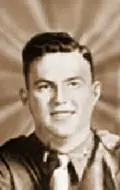
Rank and Organization: First Lieutenant, U.S. Army, 16th Infantry, 1st Infantry Division. Place and date: Near Colleville-sur-Mer, France, 6 June 1944. Entered Service at: Richmond, Va. Born: 1 July 1917, Low Moor, Va. G.O. No.: 20, 29 March 1945.
Citation: For conspicuous gallantry and intrepidity above and beyond the call of duty on 6 June 1944, near Colleville-sur-Mer, France. 1st Lt. Monteith landed with the initial assault waves on the coast of France under heavy enemy fire. Without regard to his own personal safety he continually moved up and down the beach reorganizing men for further assault. He then led the assault over a narrow protective ledge and across the flat, exposed terrain to the comparative safety of a cliff. Retracing his steps across the field to the beach, he moved over to where 2 tanks were buttoned up and blind under violent enemy artillery and machinegun fire. Completely exposed to the intense fire, 1st Lt. Monteith led the tanks on foot through a minefield and into firing positions. Under his direction several enemy positions were destroyed. He then rejoined his company and under his leadership his men captured an advantageous position on the hill. Supervising the defence of his newly won position against repeated vicious counterattacks, he continued to ignore his own personal safety, repeatedly crossing the 200 or 300 yards of open terrain under heavy fire to strengthen links in his defensive chain. When the enemy succeeded in completely surrounding 1st Lt. Monteith and his unit and while leading the fight out of the situation, 1st Lt. Monteith was killed by enemy fire. The courage, gallantry, and intrepid leadership displayed by 1st Lt. Monteith is worthy of emulation.
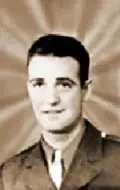
Rank and Organization Technician Fifth Grade, U.S. Army, 16th Infantry, 1st Infantry Division. Place and date: Near Colleville-sur-Mer, France, 6 June 1944. Entered service at: Burgettstown, Pa. Birth: McKees Rocks, Pa. G.O. No.: 1, 4 January 1945.
Citation: For conspicuous gallantry and intrepidity above and beyond the call of duty on 6 June 1944, near Colleville-sur-Mer, France. On D-day, Technician 5th Grade Pinder landed on the coast 100 yards off shore under devastating enemy machinegun and artillery fire which caused severe casualties among the boatload. Carrying a vitally important radio, he struggled towards shore in waist-deep water. Only a few yards from his craft he was hit by enemy fire and was gravely wounded. Technician 5th Grade Pinder never stopped. He made shore and delivered the radio. Refusing to take cover afforded, or to accept medical attention for his wounds, Technician 5th Grade Pinder, though terribly weakened by loss of blood and in fierce pain, on 3 occasions went into the fire-swept surf to salvage communication equipment. He recovered many vital parts and equipment, including another workable radio. On the 3rd trip he was again hit, suffering machinegun bullet wounds in the legs. Still this valiant soldier would not stop for rest or medical attention. Remaining exposed to heavy enemy fire, growing steadily weaker, he aided in establishing the vital radio communication on the beach. While so engaged this dauntless soldier was hit for the third time and killed. The indomitable courage and personal bravery of Technician 5th Grade Pinder was a magnificent inspiration to the men with whom he served.