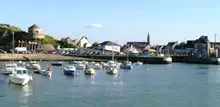
This picturesque village was the objective of the 47th Royal Marine Commando, which landed east of Le Hamel.
The 47th was hard hit coming ashore, losing four LCA's (with nine others damaged) on the run in. Unexpected resistance delayed its advance westward, and Port-en-Bessin was not liberated until the night of 7-8 June.
Damage to the port was extensive; cargo would not begin to come ashore until 14 June.

A monument commemorating the landing stands on the jetty forming the outer breakwater. It is easily spotted from the shore because of the array of Allied flags flying above it. A well-preserved seventeenth-century defence tower, designed by the Marquis de Vauban, stands at the landward end of the jetty. Below it is a German blockhouse bearing a plaque to the 47th Royal Marine Commando.
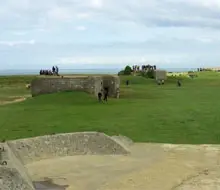
Drive to the end of the road, from there, you can view a wonderful panorama on Mulberry B. Now drive back to the 4 casemates installed by the Germans from December 1943 and just finished in June (althrough, the range finder was still in his wooden box). The Battery is in an ideal position, 215 feet above sea level and was well able to threaten the Invasion fleet. It consists of 4 Krupp 152mm, TbtsK C/36 (L/45) cannons from a de-commissioned destroyer, in type M272 Casemates with a range of 12.5 miles and a large, range-finding and observation post type M262 (No. 83). From May 28th and 29th, June 3rd, 4th and 5th, the site was bombed 5 times including the two heaviest raids in the week before D-Day totalising 1500 tons of bombs dropped on it. During the last night, 99 heavy bombers dropped their bombs inaccurately and killed 7 civilians.
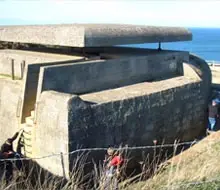
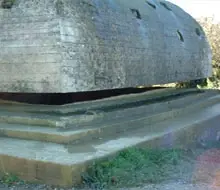
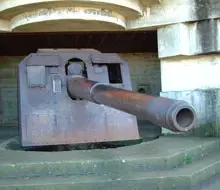
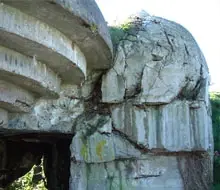
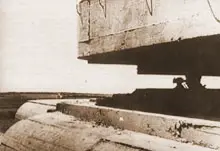
At 05.30 am Captain Weld commanding HMS AJAX engaged the battery with its 6'' guns, no reply from the German. At 05.37 the German gunners fired 10 salvos against USS EMMONS and then at 05.42 against USS ARKANSAS which faced Omaha, 10 miles off shore. ARKANSAS accompanied by FNFL GEORGES LEYGUES and HMS AJAX fired 20 shells of 12.2'' and 110 of 6''. HMS AJAX shot 114 shells of 6''. Battery seems to be silenced.

At 05.57 the Germans tried to sink the HMS BULOLO «the British Flagship» headquarter of the 50th Division. The accuracy of the battery forced the ship to weigh anchor.
At 06.05 position 1 and 2 engaged ARKANSAS once more and also the G. LEYGUES and FNFL MONTCALM; the ships joined HMS AJAX to secure the position, which seems to be reduced to silence at 06.20. But in the following 2 hours, sporadic fire occurred.
«Ajax» was joined by HMS «Argonaut» in shelling the battery which was put out of action at 08.45. It had taken 179, 6'' and 5.25'' shells from the two cruisers. Two of the casemates received direct hits through their embrasures...
The French and the British both claimed the defeat of the battery as their own...
The two remaining guns opened up again in the late afternoon but were silenced by the French cruiser, FFS «Georges Leygues». The 120 survivors of the battery, out of 184 crew, surrendered the next day to the British 231st Infantry Brigade. The battery had fired a total of 115 rounds.



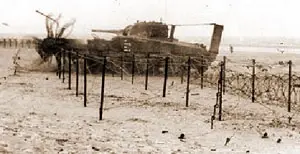
Sherman M4-D4 Crab flegeltank
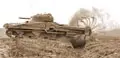
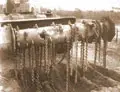
This tank saw its first action in North Africa; however D-day would be the first operation in which it would be used on a large scale. The idea for this tank cam forms the South African major A.S. du Toit. The crab was a normal Sherman tank with the one exception that it had a large drum in front of it with chains attached to the drum. The tank driver could spin the drum, so that the chains would bang on the ground in front of the tank. These chains would explode any mines that might be their on a safe distance in front of the tank. The tank could clear a safe passage through a minefield of 9 ft wide. On the back sides were 2 containers filled up with chalk powder in order to give the soldiers the limits of the cleared path.
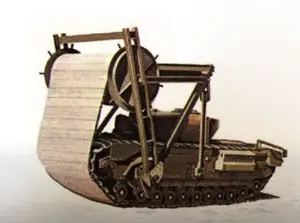
Churchill MK-III Bobbin
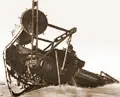
Special units of the British navy landed on the Normandy beached and took samples of sand with them. From this the Intelligence concluded that at least part of the beach would be too soft to support the heavy weight of tanks. The Bobbin was a Churchill tank that would lay a large wooden carpet on the beach. The carpet was 9 ft wide and 340 ft long. The carpet would also cover the barbed wire which would facilitate the infantry in crossing the barbed wire. After the whole carpet was laid, the tank could get rid of the drum that had carried the carpet, by blowing up small explosives. The Churchill tank could then be of further service as a normal tank.
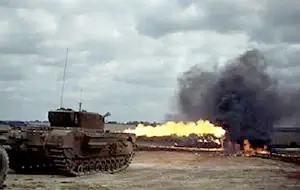
Churchill MK-VII Crocodile
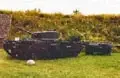
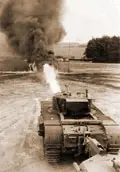
On this tank the machinegun was replaced by a flamethrower. 800 of them were produced. This canon was fuelled by a cart which the tank towed behind it. The cart was an armored 2 wheel trailer and contained 400 gallons plus 5 nitrogen bottles that supplied pressure. If the trailer was hit, there was a quick release available. The crocodile could produce a beam of flames up to 150 yards in length. This weapon would prove to be very effective against small bunkers and machine gun posts. One is exposed in the Bayeux museum front yard, next to a Sherman destroyer.
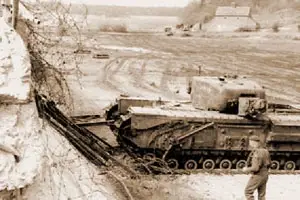
Churchill AVRE Goat Demolition
The tank was equipped with a 40-pound Petard-mortar. It had a range of two hundred yards. This tank could carry an SBG, a «Small Box Girder», this was a small bridge element in order to bypass tank walls and ditches. Instead of a SBG, huge bundles of wood were also carried by these tanks for the same purpose.
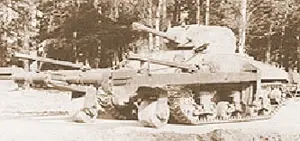
Churchill «Bangalore Torpedo» AVRE used to breach barbed-wire defences and minefields
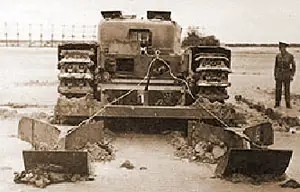
Churchill AVRE fitted with mine clearing with ploughs
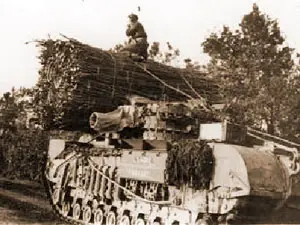
Churchill AVRE with fascine mounted
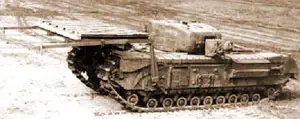
This is one of a number of devices, blessed with codenames such as Goat, Carrot and Onion which placed demolition charges against walls

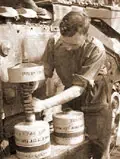
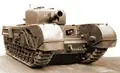
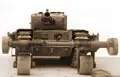
Canadian Indestructible Roller Device
It consisted of two arms attached to the side of the tank, each supporting a heavy roller. The roller was suspended in such a way it could jump in the air and rotate in an arc round the arm when a mine was detonated, thus reducing the chance of the rollers being blown off. Because of this construction, it did not have a limited life like the Crab on which chains which wore out or were blown off. It also had a higher speed, 5-7 mph and up to 15 on roads, and was therefore essentially a reconnaissance vehicle which could proceed at normal speeds.
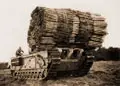
Fascines
Fascines consisted of bundles of brushwood and were developed for the crossing of ditches, craters and similar obstacles. They were carried on the front of AVRE on a specially designed cradle and could be jettisoned from inside the vehicle. The bundles were 6 ft or 8 ft in diameter and 11 ft wide. However, the original positioning when being transported completely obscured the driver's view and it was frequently necessary for another crewman to stand on the fascine and relay instructions to the driver.
Tests were carried out with a periscope, but a re-design of the fascine and its cradle improved the situation and this idea was dropped.
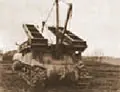
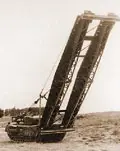
Small Box Girder Bridge
Most spectacular of all was the 30 foot long Small Box Girder Bridge, suspended from the nose of the tank to be dropped over an obstacle as required.
An important role for the AVRE in Normandy was as a carrier/launcher for the Small Box Girder (SBG) assault bridge. These bridges were placed against sea walls to enable them to be surmounted by armoured vehicles, or placed over shell or bomb craters and over anti-tank ditches and natural obstacles such as watercourses.
Sherman AVRE mounted with a folding Small Box Girder bridge Log Carpet. This comprised of a carpet of up to 100 logs, each 14 ft long, with an average diameter of 6 - 8 in, laid side by side and joined with wire rope passed through each log. The carpet was carried on a steel frame, mounted above the AVRE turret, and held in place with wire lashings at the forward end. After positioning the AVRE, small charges were fired to cut these cables and the first section of the carpet fell towards the ground. The weight of this pulled further logs off the frame in front of the AVRE and when the first few had reached ground level, the AVRE drove slowly forward over the logs until the entire length of the carpet had been laid. The length of carpet was up to about 80 ft.
The bridge specification was:
| Weight | 4 tons |
| Carrying capacity | 40 tons |
| Length | 34 ft |
| Maximum span | 30 ft |
| Maximum obstacle height | 15 ft |
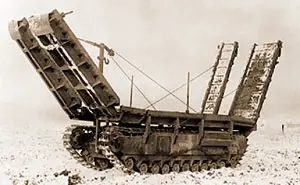
Churchill ARK
This was a turretless Churchill tank with ramps at either end and along the body to form a mobile bridge. The Mark 1 ARK had 2' wide track ways over the tracks for vehicles to drive along and the vehicle would lower ramps by a quick release, while the Mark 2 ARK was an improvised version and crossing vehicles drove directly on the Churchill's tracks. There were two versions of the Mark 2, with one the «UK Pattern» having wider track ways than the ARK MK 1 which were now 4ft wide and the «Italian Pattern» which was the «UK Pattern» tank, but used US ramps which were either 12' 3.5'' (MK 2) or 15' 1'' (MK 1) wide. These had no built-up track ways, with the vehicles tracks being used and these were produced by converting MK IIIs in Italy.
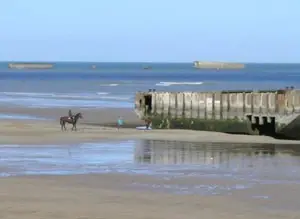
Arromanches was the site of the British Mulberry (Mulberry B), and today its remains dominate the seascape of this small port.
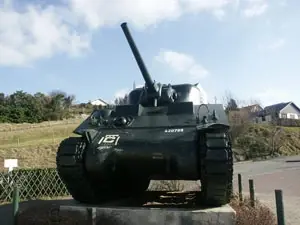
The artificial ports were the brainchild of Winston Churchill, who said he conceived the idea in 1917. Twenty-seven years later, two were actually constructed: Mulberry A at Omaha Beach (rendered unusable by the storm of 19-21 June) and Mulberry B at Arromanches. They were composed of several elements floating breakwaters (Bombardon) forming an outer protective circle, concrete caissons (Phoenix) and derelict ships sunk to form the perimeter of the harbor, pierheads which could rise and fall with the tide, and floating metal piers connecting the pierheads to the shore. All elements were constructed in England and towed across the Channel beginning on D-Day plus 1. Some 500,000 tons of supplies had been off-loaded through Mulberry B by the end of August. Whether or not the Mulberries were essential links in the supply chain is debatable, but as Chester Wilmot pointed out, the fact that they were to be built gave Neptune planners the assurance that, failing all else, forces ashore could be adequately supplied. That assurance was worth a great deal in early 1944. From the museum, it is possible to drive to the top of the bluffs east of town, where there is a Sherman tank, and a short distance further is a German radar station, next to an overlook platform that provides an excellent view of the port and the remains of Mulberry B. The visible bunkers from the cliff top were silenced by fire from HMS Belfast, which is now at rest in the Thames in London.
Each Mulberry harbor consisted of roughly 6 miles of flexible steel piers (Whales) that floated on steel or concrete floats (called Beetles). The pier end was great pier head, called Spuds pontoon that were jacked up and down along long legs which rested on the seabed. These structures were to be sheltered from the sea by lines of massive sunken caissons (called Phoenixes), lines of scuttled ships (called Gooseberries), and a line of floating breakwaters (called Bombardons). It was estimated that construction of the caissons alone required 330,000 cubic yards of concrete, 31,000 tons of steel, and 1.5 million yards of steel shuttering.
OREP
15 Rue de Largerie
14480 Cully
Tel: 02 31 08 31 08
info@orep-pub.com
«Piers for use on beaches: They must float up and down with the tide. The anchor problem must be mastered. Let me have the best solution worked out. Don't argue the matter. The difficulties will argue for themselves.»
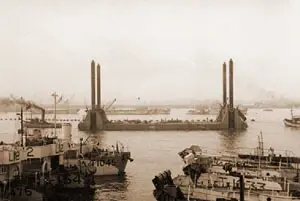
The Mulberry harbors were conceived after «Operation Jubilee» on the French port of Dieppe, August 19. 1942. The German defence of the coast of Western Europe was built on formidable defences around ports and port facilities. As Germans claims «Who holds the Ports, holds Europe» because of the strength of these defences, the Allies had to consider other means to push large quantities of supplies across the Chanel to the D-Day beaches in the early stages of the invasion. The British solution to solve the problem was to bring their own port with them. This was an original idea of Prime Minister Winston Churchill, who already imagined a similar project during WWI for the Dardanelles Operation, in May 1943; he wrote the following note: «Piers for use on beaches. They must float up and down with the tide. The anchor problem must be mastered... Let me have the best solution worked out. Don't argue the matter. The difficulties will argue for themselves».
All the components were constructed in secrecy in England and floated into position immediately after D-Day. Within 12 days both harbors were operational. They were intended to provide the primary means for the movement of goods from ship to shore until the port at Cherbourg was captured and opened. However, on June 19 a violent storm began, and by June 22 the American harbor had been destroyed. The British Mulberry closed on November 19.1944 after Antwerp was fully operational. Two and a half million men, half a million vehicles, and four million tons of supplies landed in Europe through the artificial harbor at Arromanches. Remains of the structure can be seen to this day.
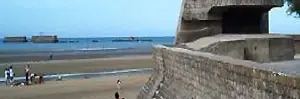
The commander of the invasion force for Gold was Lt. Gen. Miles Dempsey. The main assault unit was the British 50th Infantry Division, part of the British 2nd Army. The main regiments used in the attack were the Dorset shire, Hampshire, East Yorkshire and Devonshire. Along with these regiments was 47th Royal Marine Commandos, attached to the 50th Division. Against the attacking force were the German 716th Division and units of the 352nd Division. Many of the defenders were in exposed positions and vulnerable to Allied naval and aerial gunfire. Based in Bayeux was the mechanized unit of the 352nd Division and this was expected to rush to the front once an attack had started. The time for the landing at Gold Beach was set at 07.25. However, the British forces here experienced a major problem. Intelligence had provided the British with information that the beach was littered with defences On the morning of June 6th, a strong wind whipped up the water along the coast so that it was higher than planners had anticipated.
A major problem was that the seawater covered over the mines and other obstacles so that engineers could not go in and disarm them. The first landing craft landed military vehicles that were subsequently damaged by mines. Twenty armored cars were damaged this way. Such a situation could have been very dangerous but the German defenders had been neutralized by constant and accurate naval and aerial bombardment. By midday, a lot of the designated beach was in the hands of the British. By the early evening, 25,000 men of the 50th Division had been landed and the advance force of this division had moved six miles inland and had linked up with the Canadian forces that had landed at Juno beach. About 400 casualties had been incurred whilst securing the beach.
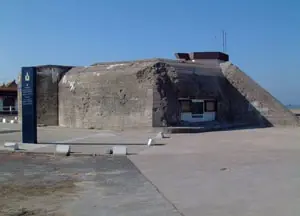
The monument is dedicated to the 231 Infantry Brigade of the 50th British Division. Three sections of the road running off toward the beach are named after the Brigade's three regiments Devonshire, 1st Dorset, and 1st Hampshire. Continue down to the beach at Le Hamel and park near the huge blockhouse WN 37.
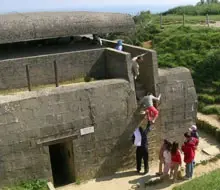
You are now at Le Hamel, on Jig sector, Gold Beach, which was assaulted by the 231st British Infantry Brigade (1st battalions of the Hampshire and Dorset regiments). The 1st Hampshire took the brunt of the fire from the 88-mm gun in this blockhouse. The attack was spearheaded by four Crabs which flailed their way through the minefields behind the beach. Three of the tanks were destroyed; the fourth made a wild charge through the village before it was knocked out According to the plaque on the blockhouse, the Germans manning this 88-mm accounted for a total of six British tanks. Although several German strong points held out through the afternoon, the Hampshires quickly worked their way around Le Hamel and began their advance inland.
The 1st Dorsets, landing further east, out of range of the fire from Le Hamel, had fewer difficulties. Their specialized armor (8th Armored Brigade) quickly opened three beach exits, and by afternoon they were fighting units of the German 352d Division for control of the Arromanches ridge.