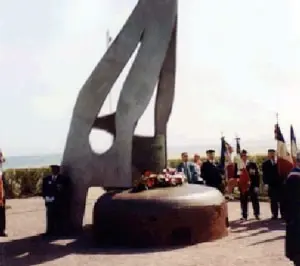
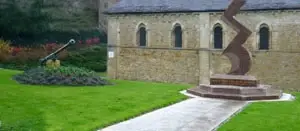
The turret now serves as the base for a modern metal sculpture resembling a flame. As you climb the dune to the turret there are small stone markers inscribed with the names of French commandos who fell on D Day.
Further east along the Ouistreham Riva-Bella sea front are the following points of interest: Two modern stained glass windows in the medieval church in Ouistreham that commemorate the landings, one dedicated to the 1st Special Service Brigade and the other to the memory of the 51st (Highland) Division.
A fifty-foot high observation and fire control tower at the corner of the Avenue de la Plage and the Boulevard du 6 June that was converted in 1988 into The Atlantic Wall Museum. Open daily during summer 09.30-19.00. Admission charge. Bunkers on the east jetty in Riva-Bella, one topped by a steel cupola said to have been brought from the Siegfried Line.
A monument in the center of a round-about on D 514, south of Ouistreham, with a plaque attached to its base commemorating the Anglo-French 4 Commando.
Concrete pyramids leading down to the beach from the Casino were used by German as beach obstacles. A different model was called dragoon's teeth.
Two plaques at No 47 Avenue Pasteur, commemorating the deaths of French commandos nearby.
Sword is the furthest east of the landing beaches, and was also the smallest, only wide enough for a brigade-sized landing force. The 3rd British Division was tasked with getting enough troops ashore to push inland quickly and seize Caen, and also link up with 6th Airborne Division Early on June 6th Naval Force «S», carrying the assault force and support units, moved into position off the mouth of the River Orne. It was here that the only notable German naval activity of the day occurred, when three E-boats emerged through the Allied smoke screen, fired a salvo of torpedoes, which sank the Norwegian destroyer Largs Svenner, and made off unscathed. It proved to be the only appearance of the Kriegsmarine that day, and the Allied bombardment force, including the battleships HMS Warspite and HMS Ramillies, proceeded to lay down the heaviest barrage of the day on the three-mile wide stretch of beach where the 8th British Brigade was to land. The assault force was made up of the 1st South Lancashire Battalion on the right, heading for Queen White Beach, and the 2nd East Yorks on the left, its target Queen Red Beach. The assault force was preceded by DD tanks of the 13th/18th Hussars, and demolition teams.
Disaster was narrowly avoided when the DD tanks ran into the path of some of the LCTs carrying the demolition teams. In the event, quick thinking and fast manoeuvring enabled 21 out of 25 DD tanks to reach shore safely, just ahead of the infantry, who began to disembark at about 7.30 am. On the right, the 1st South Lancs made rapid initial progress. Within two hours they had cleared three exits from Queen White, and pushed a mile and a half inland to take the village of Hermanville. Just beyond this lay the important landmark of Périers Ridge, but this was strongly held by troops of 21st Panzer Division, with support from 88mm guns, and the British advance stalled on the outskirts of Hermanville, where the South Lancs dug in. Meanwhile, on Queen Red, the East Yorks met determined resistance in clearing enemy strong points, and before this was eventually completed further problems had begun to present themselves. Owing to the prevailing wind, the tide came in both much faster and further than had been expected. As a result the engineers were unable to clear all of the beach obstacles, and follow-up waves of landing craft became severely congested as they tried to find a safe path to shore. To add to British problems, German artillery fire, zeroing in on the barrage balloons flying above the landing zone, was proving unpleasantly accurate.
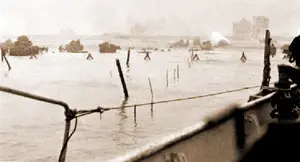
If the 3rd Division was to reach its planned objectives for the day, both speed and a willingness to take risks were essential. Unfortunately neither was apparent. The congestion was probably inevitable, but both commanders and troops displayed a lack of urgency (doctrine to clear all objectives not bypass them) which still further reduced chances of success. The 3rd Division had seen no action since Dunkirk, and their training had emphasized the initial landing at the expense of follow-up operations.
As a result, the troops, and their senior commanders, were so relieved at the relatively light casualties suffered in the first stages of the landing, that their reaction was to halt and consolidate what they had gained against probable counterattack rather than press quickly onwards to exploit it.
The problem was demonstrated not only by the South Lancs at Hermanville and Périers Ridge, but also by the Brigade reserve, the 1st Suffolk, which, despite light resistance, made heavy weather of capturing the village of Colleville and clearing the two nearby German strongpoints codenamed «Morris» and Hillman». It would be late in the day before any real progress was made here; not only had 3rd Brigade failed to link up with the Canadians to the west, they had also not made contact with 6th Airborne, under increasingly heavy pressure east of the Orne.
It was not until about 1.00 pm that the advance on Caen, the main objective of the day, began. The mission was assigned to 185 Brigade, consisting of three battalions - 2nd King's Shropshire Light Infantry (KSLI), which was to thrust down the main road from Hermanville to Caen, supported on the flanks by the 2nd Warwicks and 1st Norfolks. Unfortunately vital time had been lost, and ominous reports were coming in that air reconnaissance had sighted increasing numbers of German tanks north of Caen. If, as seemed probable, they belonged to the powerful 21st Panzer Division, the next few hours might well be critical for the success of the British and Canadian landings.
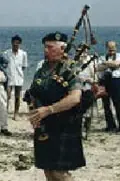
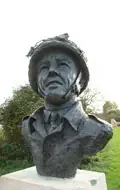
Bill was Lord Lovat's personal Piper, Commanding Commando 4, who ordered him to play «Highland Laddie» as they landed here at 07.45 on June 6.
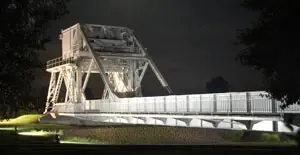

The task of capturing the bridges over both the Orne River and Canal fell to a selected force drawn from the 2d Battalion, Oxfordshire and Buckinghamshire Light Infantry, and the Royal Engineers, commanded by Major John Howard. The six gliders carrying this force were to land in the dark on the approaches to the bridges. In what was one of the great navigational feats of D-Day morning, three of the gliders crash-landed (the most explicit term describing a glider's reunion with the earth) within forty seven yards of the east end of the canal bridge. A lone German sentry who might have sounded the alarm did not do so because he assumed that an airplane had crashed nearby. His mistake was costly. While one of Howard's squads crossed the bridge in a rush, taking a single casualty, Lt. Den Brotheridge, the first British officer KIA. Others overran nearby pillboxes and trenches before the surprised Germans could reach their positions. Within 20 minutes, the bridge and its defences were in British hands.
The assault on the Orne River bridge went as smoothly, although one of the three gliders assigned to that operation missed the bridge area altogether, landing miles away in the flooded Dives valley. Only one of the remaining two gliders landed near the bridge. The twenty-odd men from that lone glider rushed the bridge despite the loss of surprise. Fortunately, the German guards did not know the odds; they scattered before the determined British charge.
Not only had the bridges been captured easily, but they were intact. Both structures had been wired for demolition, but the explosive charges had not been planted. Major Howard's men held their prizes throughout D-Day while German pressure mounted. Around 1200 hours, some two and a half minutes after they were to have been reinforced, the beleaguered defenders were startled by the distant sound of bagpipes. The 6 Commando of the 1st Special Service Brigade, led by Brigadier Lord Lovat, had arrived with piper Bill Millin. The two forces joined ranks to the tune of «Blue Bonnets over the Border» and the crack of small-arms fire. Although both bridges would not be truly secure until units of the 3d British Division arrived late in the afternoon, the skirl of Millin's pipes had assured the men of Howard's command that the seaborne invasion was ashore.
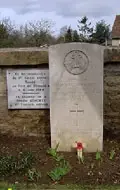
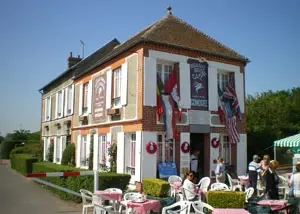
Lt. Den Brotheridge, British Airborne Forces, was killed by a friendly shot on D-Day, capturing Pegasus Bridge. He lies in the civil cemetery of Ranville church. Note the tribute from the owners of Cafe Gondree the first home in France to be liberated on D-Day.
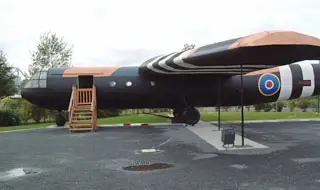
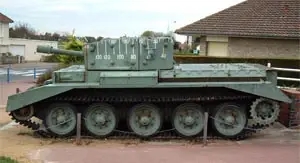
A Centaur version of the British Cruiser Mark VIII tank mounting a 95-mm gun. This tank belonged to the 5th Independent Battery, Royal Marine Armoured Support Regiment, which landed at La Brèche d'Hermanville. Three such regiments were organized a few months before D-Day to provide additional fire support to the first waves of infantry. This Centaur IV was recovered in 1975.
A British Commonwealth cemetery at Ranville is a mile and half from the Pegasus Bridge. 2,563 British Commonwealth soldiers are buried there, including Lieutenant Den Brotheridge, who was killed in the attack on the bridge. The round-about in front of the cemetery is named the Place General Sir Richard Gale, after the commander of the 6th British Airborne Division. A plaque directly opposite the cemetery commemorates the events of D Day in Ranville.
Three memorials in Amfreville commemorating the 4 and 6 commandos and the 1st Special Service Brigade of which they were a part.
A plaque marking a stop on the Pegasus Trail Battlefield Tour. These markers follow the route of the 6th Airborne Division.
Pegasus Bridge as a site is especially rich in D-Day memorabilia. In addition to the original bridge itself (complete with painted-over bullet marks and a mortar impact in the bridge counterweight), the following monuments, memorials, and artefacts are found nearby:
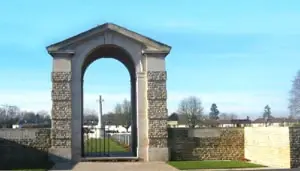
Ranville is best reached by taking the D513 north-eastwards out of Caen, and after about 9 kilometres turning left at Herouvillette. Go north for one kilometre and then turn left into Ranville village. The War Cemetery is on Rue des Airbornes.
The Allied offensive in north-western Europe began with the Normandy landings of 6 June 1944. Ranville was the first village to be liberated in France when the bridge over the Caen Canal was captured intact in the early hours of 6 June by troops of the 6th Airborne Division, who were landed nearby by parachute and glider.
Many of the division's casualties are buried in Ranville War Cemetery and the adjoining churchyard. The Cemetery contains 2,235 Commonwealth burials of the Second World War, 97 of them unidentified. There are also 330 German graves and a few graves of other nationalities.
| British | 2,151 |
| Canadian | 76 |
| Australian | 1 |
| New Zealand | 1 |
| Belgium | 1 |
| French | 5 |
| Polish | 1 |
| Unknown Allied | 1 |
| German | 322 |
| Totally Unidentified | 1 |
Brothers buried side by side:
Private E.S. Corteil 9th Bn Parachute Regiment:
Private R.J. Johns 13th Bn Parachute Regiment:
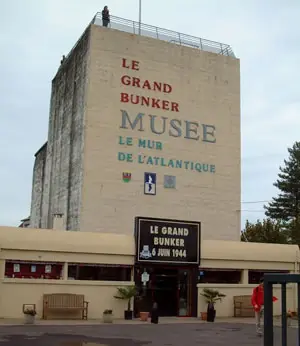
Located behind the beach and next to the Ferry terminal, the Atlantic Wall Museum was a German headquarters which was in charge of the batteries covering the entrance of the river Orne and the canal.
The 52ft high concrete tower has been fully restored to make it look how it was on the 6th of June 1944.
You will discover six floors with all its inner rooms, which have been recreated down to the last detail: generator room, gas filters room, casemate with machine gun protecting the entrance, dormitory, medical store, sick bay, armoury, ammunition store, radio transmission room, telephone switchboard, observation post equipped with a powerful range-finder and on the top floor a 360° view over Sword Beach.
Many photographs and documents concerning the construction of the Atlantic wall, the artillery, the beach defences, observation, etc. are displayed. Souvenir of the assault and shock troops specially trained for Overlord Operation to attack the Atlantic Wall, and the everyday life of the German Army.
The capture of the Grand Bunker On June 9, lead by the actions of lieutenant Bob Orrell of Royal Engineers, 91Field Company R.E., 3rd Beach Group, 3rd Canadian Div., 2nd British Army, is an amazing story.
He was given orders to clear the large Bunker. Accompanied by three men, he placed two explosive charges one after the other to blow up the armour front door. It took them four hours to break it open! Two officers and fifty men then surrendered and the complete liberation of Ouistreham was achieved.
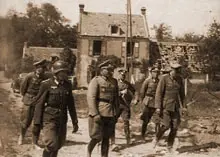
Generaloberst Dollmann (centre) inspects the Merville Battery on the 25th May 1944. On the far right is Oberleutnant Raimund Steiner, the commander of the Battery. At the time that the 9th Battalion attacked, Steiner was at an observation post on the beach.
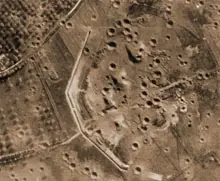
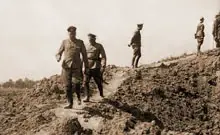
General Marcks inspecting bomb damage inflicted on the Merville Battery, on the 23rd May 1944.
According to Allied intelligence, this battery contained four casemated 6” guns sighted so that they could fire on ships standing off Sword Beach. Neptune planners were obviously worried about the damage these guns might inflict the invasion fleet. The task of neutralizing the Merville Battery was given to the seven-hundred-man 9th Battalion, 6th Airborne Division, commanded by Lieutenant Colonel Terence Otway.
The plan Otway and his men had been rehearsing for months was daring. Otway's main force would parachute in some distance from the battery, gather their special equipments including flamethrowers, Bangalore torpedoes, and anti-tank guns then assemble just outside the battery's defences.

This force, divided into eleven teams, would lay the Bangalores under the perimeter wire, clear and mark the minefields, then take up covering positions to watch for the arrival of two tow planes with their gliders. On seeing Otway's signal (a star shell fired from a mortar), the glider pilots were to land inside the battery's perimeter. The garrison of some two hundred men would then be overrun by this combined assault from air and ground. Otway was to signal the fall of the battery with a flare before 0530, or ships of the bombardment force would take it under fire.
This carefully rehearsed plan began to unravel before the first paratrooper touched ground. Instead of dropping in their assigned drop zone, Otway's men were scattered over a few miles corridor. Some sticks took days to rejoin their outfit; of others no trace was ever found. Otway could assemble only 150 of his men by the time the attack was to begin. Most of the special equipment carried in by two of the battalion's gliders was likewise lost, including the mortar signal rounds.
The frustrated men on the ground could only look skyward as the two assault gliders swooped low across the battery, and then, receiving no signal, landed outside the battery's perimeter. Otway gave no sign of the dismay he must have felt at that moment, for no sooner had the gliders come down and while the defenders' attention was still on the skies, he ordered the wire blown and his assault teams to attack through the gaps.
The fight was over in ten minutes. Although half of the British force was dead or wounded, the Merville Battery had been silenced. Ironically, the much feared 150-mm canons turned out to be less formidable 75-mm guns.
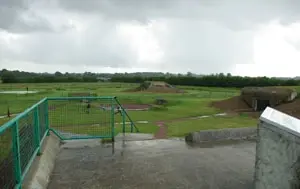
The Comité du Débarquement has placed an excellent information sign at the entrance to the battery.
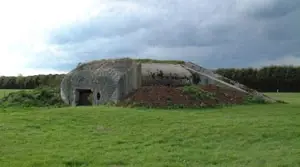
Casemate Number 1 now houses a great museum.

The Hillman Strongpoint was part of the inland defences on Sword Beach sector, where 3rd Division landed on D-Day. Staffed by 150 men of the 736th Grenadier Regiment, the site was also their headquarters. It covered an area 600 x 400 yards, had 12 emplacements, with anti-tank guns and machine-guns (largely in Tobruk Pits).
Hillman was attacked on 6th June 1944 at 01.00 pm by the 1st Suffolk Regiment, supported by C Squadron 13/18 Hussars, A Squadron Staffs Yeomanry, two batteries from 33rd and 76th Field Regiments Royal Artillery, 246th Field Company RE (Royal Engineers) and a machine-gun platoon from 2nd Middlesex Regiment.
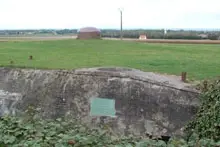
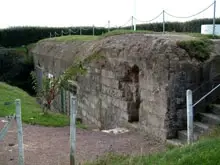
Hillman was outflanked to the north, where high grass allowed an approach to the minefield area surrounding the bunkers and barbed wire. This was cleared by the RE, and a path made through the wire by Bangalore Torpedoes. A Company of 1st Suffolks then charged through the gap, and entered the bunker area, but came under such heavy fire that they lost the company commander (Captain R.G.Ryley) and had to pull out. Sherman tanks from 13/18 Hussars then came up, and a second assault carried the position. However, in the process two tanks from 13/18 Hussars were knocked out and the Suffolks lost two officers killed, along with five men and 24 men wounded.
Hillman surrended at 22.00 pm with 50 prisoners. However, it was not until the 7th, at dawn, that the rest of the garnison, about 80 grenadiers, actually surrended..
Pte J.R.Hunter of the 1st Suffolks was awarded a Distinguished Conduct Medal (DCM) for bravery in this action. He became known in the unit as «Bunker Hunter DCM» for his exploits in the capture of Hillman.
By the middle of the morning the South Lancashire had taken Hermanville, the East Yorkshire were clearing the defences south of Ouistreham and the Suffolks, having taken Colleville, were attacking two strong-points a mile or so to the south, known to the Allies as «Morris» and «Hillman». The former, containing four field guns, was taken easily since the area had suffered heavily bombing and shelling, its garrison of 67 came out with their hands up as soon as the attack opened. But Hillman was another story as you now know. The 185th Brigade Group had landed nearly up to time and the infantry was assembled in woods half a mile inland by about eleven o'clock. The brigade was to be the spearhead of the division's attack inland; it was to advance with all speed and if possible capture Caen and the ground immediately south of it that day. The advance was to be led by a mobile column of the 2nd King's Shropshire Light Infantry, riding on tanks of the Staffordshire Yeomanry and supported by the 7th Field Regiment, R.A.; but at noon the infantry's heavy weapons and vehicles were still not clear of the congestion on the shore and the tanks that had succeeded in getting through were being held up by a minefield. Leaving these to overtake them as quickly as possible, the infantry started marching south «en route» to Caen at about 0.30 pm and by 2.00 pm they had climbed the Périers rise. The leading Yeomanry had overtaken them but enemy guns in woods to their right knocked out five tanks of the Staffordshire and four flails of the Westminster Dragoons and a company of the infantry were sent off to join the Yeomanry in taking the position. The rest of the column moved on towards Beuville and Biéville while a squadron of the Staffordshire occupied a commanding position at Point 61.
The main body of the 185th Brigade (the 2nd Royal Warwickshire and the 1st Royal Norfolk) did not advance till some hours had elapsed. At 03.00 pm the Norfolks were ordered to secure high ground on the left of the Shropshire Light Infantry and, believing that Saint-Aubin-d'Arquenay was occupied by the enemy (though in fact the 1st Special Service Brigade had passed through it at noon), they struck across country between it and the still uncaptured Hillman. Moving through a large field which the strong-point could command, about half the battalion lost direction in the high standing corn covered by the Hillman machine guns; in a very short time they had some 150 casualties. The rest of the battalion pressed on and overcoming the few enemies in front of them they were established on high ground between Beuville and Bénouville by 07.00 pm. There they were halted for the night. The 2nd Warwickshire was not ordered forward until later in the afternoon and did not reach Saint-Aubin till about 06.00 pm. By then events were beginning to inevitably alter the plan and the ultimate objectives for the day would remain beyond reach for agonizing days or weeks.
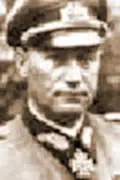
At intervals throughout the morning air reconnaissance indicated that the 21st Panzer Division was moving up on Caen and as early as 11.00 am General Dempsey had asked the air forces to attack troop movements into Caen from the south and south-east. From then on German movement towards Caen was attacked from the air almost continuously. Early in the afternoon it was learnt that the 21st Panzer Division's reconnaissance unit was probing foward and other reports pointed to the fact that the division would be committed north and north-west of Caen that evening. The divisional commander, Major-General Feuchtinger, has since stated that once over the Orne his armoured regiment with 90 tanks and two battalions of infantry attacked northwards.
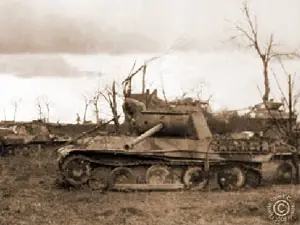
The situation of the 3rd Division at about 04.00 pm was as follows: The 8th Brigade was well established in Hermanville, Colleville and Ouistreham, with one of its battalions, the 2nd East Yorkshire, closing on the battery position known as «Daimler», south of Ouistreham, and the 1st Suffolk about to renew its attack on Hillman strong-point. Just clear of the beach the 9th Brigade was assembling but was not yet ready to debouch into the 4 mile gap of country between Hermanville and the Canadian sector. The 185th Brigade's main body (the Norfolk and Warwickshire battalions) was moving in the direction of Caen along the west bank of the canal. Ahead of them the Shropshire Light Infantry and accompanying troops had reached Beuville and Biéville on the direct road to Caen; the infantry's 6-pounder anti-tank guns had caught up and were disposed to cover the advance and they had near them some 17-pounder self-propelled guns of the 20th Anti-tank Regiment. One squadron of the Staffordshire Yeomanry was with them, another was supporting the Suffolk attack on Hillman, and a third was disposed on the Périers Ridge commanding the brigade's right flank.
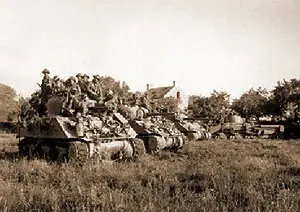
Soon after four o'clock a troop of the Staffordshire Yeomanry scouting ahead reported enemy tanks advancing from Caen. The squadron with the Suffolk at Hillman strong-point was hastily moved to Biéville and had just taken up position to the west when about 40 enemy tanks, moving very fast, attacked. Two were knocked out by the Yeomanry and two by the Shropshire anti-tank guns and the enemy turned away into the woods. They were pursued by the Yeomanry and by field-gun fire, and when they showed again some more were destroyed. They swung off again and were joined by others, and making a wide detour they came in towards the Périers Ridge. There they met the squadron of the Staffordshire posted at Point 61 for just such an occasion. 3 more were knocked out and again they pulled off. Approximately, 13 were knocked out (the other loss was a self-propelled gun), but they had already been persistently harassed by aircraft while they were south of Caen. On the western outskirts of the town 8 Typhoons of the Second Tactical Air Force had dive-bombed tanks moving up to join the fight and had left 2 in flames and 4 others smoking. Feuchtinger has since said that his division started the day with 124 tanks and by nightfall had only 70 left. In view of his figures, British records were modest.
Once the enemy's attacks near Biéville were driven off a company of the Shropshire led off again down the road to Caen, but their way was blocked by enemy holding strongly the Lebisey woods athwart the road. Dusk was encroaching and with the necessity to guard their right flank against renewed attack by the German armour it was decided to halt for the night, holding Biéville and Beuville. Caen was about 3 miles away.
Of the 185th Brigade the Warwickshire had found that le Port just north of the Bénouville bridge still contained a few of the enemy. Shortly before 09.00 am as they prepared to attack, two columns of transport aircraft of 38 and 46 Groups, towing gliders, came in low from the Channel, strongly escorted by fighters. One column of about 100 released their gliders over Colleville to land near the canal north of Bénouville; the other column of about 140 went on to Ranville for the gliders to land on the nearby zone N. This mass fly-in, which was seen by both sides, greatly cheered British troops but had an opposite effect on the German commanders. Their 7th Army telephone log records a statement that «Attack by 21st Panzer Division rendered useless by heavily concentrated airborne troops», and their report to Rommel said that it had «been halted by renewed air landings». According to other German statements, a few forward tanks had reached the coast near Lion by seven o'clock and others were trying to slip past the British guns on Périers Ridge when the sight of large airborne reinforcements to their rear led the panzer division to call off its counter-attack, and to withdraw to a line running eastwards from Cambes to the canal, that is between the Shropshire positions and Caen.
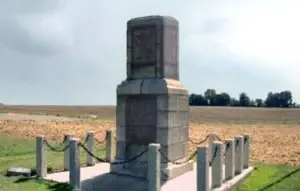
Hill 112 was an unimpressive stretch of country covered with wheat two or three feet high, and with a few wooded copses and several villages on its slopes. From this elevation the valleys of the Odon and Orne could be seen, and the Germans said, «He who controls Hill 112 controls Normandy».
Certainly they clung to it desperately, and when they were driven off counter-attacked at once to regain possession. Following the failure of Operation Epsom, the 9th and 10th SS Panzer Divisions regained the hill on 29th June, and between then and 23rd July, when they were driven from Maltot, the area around Hill 112 changed hands many times and thousands of Allied and German troops were killed or wounded on its bloody slopes.
The 43rd (Wessex) Division alone lost more than 2,000 men in the first 36 hours of the operation to regain Hill 112. It was reported that the Odon River was dammed with corpses. The attack began before dawn on 10th July with an impressive artillery barrage. By 06:30 hours 129th Brigade (comprising 4th Bn. and 5th Bn. Wiltshire Regt. and 4 Bn. Somerset Light Infantry), had advanced through the waist-high wheat sprinkled with poppies. They reached their objectives at the crest of the hill, although for several hours fierce close-quarter battles continued in the wheat where SS troops manned concealed machine-gun nests and refused to surrender even when wounded.
The task of 130th Brigade was to capture the villages of Eterville and Maltot, after which 214th Brigade was to exploit with an armoured brigade to the Orne. From a firm base provided by 5th Dorsets, the 4th Dorsets launched a successful attack on Eterville, and at 08:15 hours 7th Bn. Royal Hampshire Regt. attacked Maltot, initiating what has been called «a battle of shattering intensity even by the standard of Normandy». SS panzer troops supported by dug-in and concealed Tiger tanks held an almost impregnable position, and even when the Royal Hampshires were reinforced by 4th Dorsets no progress could be made. Among the many casualties were five company commanders. From Eterville 5th Bn. Dorsetshire Regt and 7th Bn. Somerset Light Infantry held off savage counter-attacks, as did 5th Bn. Wiltshire Regt. and 4th Bn. Somerset Light Infantry during the day. By 15:00 hours it was clear that a fresh attack on Hill 112 was needed, but of the 214th, the reserve brigade, two battalions had already been committed, leaving only 5th Bn Duke of Cornwall's Light Infantry (DCLI).
So with 4th Somerset LI as a firm base 5th DCLI launched an attack at 22:30 hours with two companies up front. The crest of the hill was reached and the battalion consolidated in a wood, which was later called «Cornwall Wood», just in time to meet savage counter-attacks from the 9th SS Panzer Division. In fighting that continued all night, 10 counter-attacks were beaten off, but when battalion commander was killed and most of the officers and NCO's killed or wounded, the remnants of the DCLI withdrew. The CO of 4th Somerset LI formed the survivors into two companies and sent them back to the wood for what has been called «the death struggle of 5th DCLI» The final overwhelming attack left about 75 survivors, approximately 10 percent of the original strength of the battalion. After the battle, all battalions of the 43rd Division required reinforcements, which, in effect, produced new battalions. Within two weeks 5th DCLI was back at full strength and in action on Hill 112, and 4th Somerset LI required reinforcements of 19 officers and 479 other ranks.
The enemy suffered equally with the 9th SS Panzer Division, also suffering very heavy causalities that during the battle for Hill 112, with its infantry companies being reduced to five or six men each. On 29th July when Maltot was at last captured by 4th and 5th Wiltshires, and it was found that the dead of the Dorsets and Royal. Hampshires, who had fallen on 10th July, were still lying in heaps around partly dug slit trenches and in streets and fields.
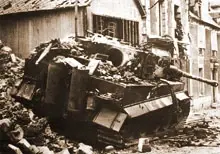
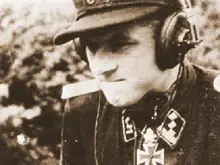
Place l'Hôtel de Ville in Villers-Bocage. A destroyed Tiger. Beside it the wreck of a Panzer IV of the 2nd Battalion of the 130th Panzer Lehr Regiment.
The Battle of Villers-Bocage June 13 was a clash between British and German forces. Elements of the 7th Armored Division approached the town of Villers-Bocage coming from Tilly. Michael Wittmann had a small force of six tanks nearby. In one of the most aggressive small-unit actions of the war, he charged his vehicle into the British column, splitting it and then engaging the British forces at very short range before passing along and across the British line into the village. The other tanks of his small unit added to the heavy British losses.
The 1st US Division push strongly towards Caumont-l'Éventé against the 352nd German Inf Division, their retreat exposed the West flank of the Panzer Lehr Division. This gap opportunity gave General Montgomery the idea of the Perch Operation. He decided to use the 7th Armored Division (the Desert Rats) to encircle the Panzer Lehr with a surprised attack from the rear. Villers-Bocage lay in the path of this movement, sitting at the hub of a road net that led northeast towards Caen; if the town (and the high ground nearby at Point 213) could be taken and held, British armor would be able to push northeast behind the German front, with a possible exploitation to Caen. The British were unaware that elements of the 2nd Heavy Tank Company of the Schwere SS-Panzer Ableitung 101 led by M. Wittmann had received orders to take and hold point 213, which was above the crossroads at Villers-Bocage. After having reached it during the night to avoid detection by Allied aircraft, Wittmann's force of 5 Tiger tanks and a Mark IV were sited approximately 150 yards south of RN 175. The British force sent to take Villers-Bocage and Point 213 consisted of a reinforced tank squadron and an infantry company of a Motor battalion; approximately 200 armored vehicles.
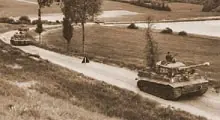
Led by Wittmann's Tiger Nr. 205, Tigers of the Second Company head towards the area surrounding the town of Villers-Bocage, 13 June 1944.
Later joined by:
Villers-Bocage and Hill 213 were unoccupied as the battle opened and both sides raced to take the high ground, and thus the tactical advantage. While the British forces arrived in the town of Villers-Bocage first, Wittman's force gained Hill 213 and could observe the British movements. The British in the town suffered from poor tactical deployment and were initially crowded by cheering civilians happy about their apparent liberation. The four tanks of the squadron's command group parked and the crews dismounted. The men and vehicles of the battle group did not form an all-around defence as doctrine demanded, security was poor and no proper reconnaissance of Hill 213 was done. A combined tank and infantry force was finally sent out of the village to take Hill 213. Wittmann watched the column of the 4th County of London Yeomanry leave Villers-Bocage and advance on his tanks on Hill 213, nose to tail through a sunken road. The lead squadron halted on the road without deploying into a defensive position, allowing the halftracks and carriers of the accompanying infantry to pass. In the face of unreconnoitred terrain, this was a great mistake. Wittmann saw his opportunity and decided to attack with one tank between Hill 213 and Villers-Bocage, cutting off «A» Squadron of the 4th CLY and ordered his accompanying two operational tanks to hold their position. Wittmann counted on the effect of surprise to inflict the greatest possible losses on the British while waiting for reinforcements. Describing his actions Wittmann later said, «I had not been able to gather my company. I had to act very quickly because I must suppose that the enemy has already located us and intended to destroy us at the starting position. I left with my tank. I ordered the two other tanks to move back at once but to hold the terrain».
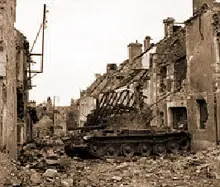
Destroyed Cromwell tanks in the Ruins of Villers-Bocage.
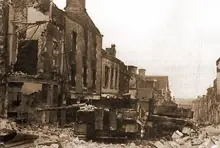
Rear view of the first Tiger destroyed during the battle in the afternoon of 13 June 1944 in Villers-Bocage.
At 0900 Wittmann's Tiger attacked. A few minutes later, in the direction of Caen, he destroyed 3 tanks; a Sherman Firefly and a Cromwell tank on the right and another tank on the left, proceeding to Villers without pause and attacking the lightly armored vehicles of The Rifle Brigade. During this engagement, he destroyed nine half-track vehicles, four Carden Loyd Carriers, two other carriers, and two 6 pounders anti-tank guns, then destroyed 3 Stuart light tanks and one half-track vehicle. Entering Villers-Bocage alone, he destroyed 3 of the four Cromwells in position at the top of the Lemonnier Farm. He followed Clémenceau Street where his tank destroyed two Sherman command tanks of the 5th Royal Horse Artillery before knocking out another scout car and half-track. As Wittmann arrived at the Jeanne d'Arc Square, he ended up opposite the Sherman Firefly of Sergeant Lockwood of «B» Squadron. The Firefly, whose 17 pounder was the only Allied main tank gun capable of defeating the frontal armor of a Tiger in most circumstances, fired four shells at Wittman. One hit the hull of the Tiger, which returned fire and knocked down a section of wall on the Sherman. Wittmann then made a half-turn, his tank lightly damaged, and returned down Clémenceau Street. A Cromwell tank, commanded by Captain Dyas, fired two 75 mm shells and failed to harm the Tiger. Wittmann subsequently put the Cromwell out of action with one shot. As Wittmann proceeded on the road leaving Villers-Bocage, his left track was hit by a 6-pdr shell, forcing him to stop on the street in front of the Huet-Godefroy store. Wittman engaged targets in range. Thinking that the Tiger might be salvaged and repaired later, Wittmann and crew abandoned the tank without destroying it, leaving the area on foot but without weapons. They ended up joining the headquarters of the Panzer Lehr Division, nearly 5 miles away. Consequently, 15 Panzer IV's of 2nd Battalion of the 130th regiment left Orbois in the direction of Villers-Bocage under the command of Captain Helmut Ritgen with the aim of blocking the exits to the North. Before reaching their objective, they came under the fire of British anti-tank guns and their advance was blocked. Fritz Bayerlein, commander of Panzer Lehr, ordered the Panzer IVs to fall back and regroup at Villers-Bocage. The tanks took the direction of the castle of Parfouru Sur Odon, where, after repairs were made to the 14 survivors, they attacked under the command of Hannes Philipsen; four tanks from the south and ten by Clémenceau Street. Each of the two groups lost two tanks. Wittmann was then brought back in his Schwimmwagen to Hill 213, where he joined with Karl Mobius, commander of the 1st Company and discussed the second attack that the 101st Abteilung was about to deliver. The tanks of the 1st Company entered the city along the Évrecy Road and joined those of Panzer Lehr at the marketplace in order to coordinate their offensive. The forces were distributed so as to occupy the city from the Pasteur Street towards the Jeanne d'Arc Square, on Saint-Germain Street, on Emile Samson and towards the crossroads of Jeanne Bacon Street and Joffre Boulevard. However, British resistance was by now organized as the Germans had lost surprise. One 6-pounder anti-tank gun of the 1/7th Queen's, placed in Jeanne Bacon Street, managed to score hits on three Tigers of which only one could be repaired.
The British units had suffered considerably in the initial attack but had held the town with its vital crossroads. The Germans broke contact, but later managed to execute several strong counterattacks on Villers and the hold of the 7th Armored Division elements was tenuous. Support for the British was available from several sources. An accompanying US artillery forward observer called in very heavy and accurate artillery fire to break up one German attack. Several uncommitted infantry brigades were available and could have been used to reinforce Villers-Bocage, but the British commander on the scene did not request help. The Division commander George Erskine, could have requested these brigades, but did not. Neither the Corps commander, Gerard Bucknall, nor the Second Army commander Dempsey reinforced the units at Villers-Bocage. At 16.00, the acting commanding officer of the 4th CLY ordered a retreat of his forces from the town. The withdrawal from Villers-Bocage ended British hopes of unhinging the German front south of Caen. Historians feel that a great opportunity had been lost through poor execution of the plan. Dempsey later remarked that «the whole handling of that battle was a disgrace». Both Erskine and Bucknall were relieved of command in early August, after another failure to capture Villers-Bocage and Aunay during Operation Bluecoat. Brigadier Hinde and the Commander, Royal Artillery of 7th Armoured Division were also removed.
The British losses in the battle were:
German propaganda throughout the Second World War tended to elevate individual fighters to «hero» status. The events at Villers-Bocage were thus ascribed almost entirely to Wittmann who was given credit for 27 of the 30 destroyed British tanks as armored vehicles. Postwar, hobbyist interest in Wittmann has not waned. It must be pointed out that Wittmann's Tiger tank greatly outclassed the British vehicles he faced in firepower and armor. However, it is also true that in the close quarters of this battle, the British 17 pounder was capable of defeating the armor on Wittmann's tank. Even the towed 7 pounder and 3'' guns on the Cromwells and Shermans could, with ideal conditions. It can be concluded that the real reason for Wittmann's success was not so much technical superiority or individual skill, but poorly executed tactics and battle procedure on the part of the 7th Armored Division.
From Bayeux take D 6, stop to Jerusalem Cemetery, then continue to Tilly-sur-Seulles. From June 8 to June 19, 1944 fighting raged near that village between the 30th British Army Corps and the German Panzer Lehr Division. The British forces were able to break through on the evening of June 18 and after severe German counterattacks, Major General Fritz Bayerlein ordered a retreat. The area around Tilly-sur-Seulles had changed hands 23 times; finally on June 19 the 50th British Infantry Division was able to take and hold the area. During the fighting 76 civilians from the nearby village had been killed, one tenth of the population of Tilly-sur-Seulles.
Gebirgsiäger and German Panzer-Lehr-Division had 190 tanks at the start of the battle, of which 66 remained after the battle. In addition to the lost tanks, the Germans lost 5,500 men. Today there is a British military cemetery in Tilly-sur-Seulles, as well as a museum that gives information about the battle.
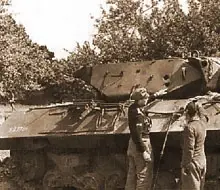
An M10 tank destroyed knocked out in the Villers-Bocage area, being examined by a junior officer from an Army (Heer) tank unit.
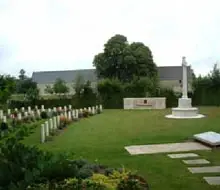
Jerusalem Cemetery: the smallest British Cemetery in France. 46 British soldiers and 1 Czech soldier are buried there, killed at Chouain the first day.
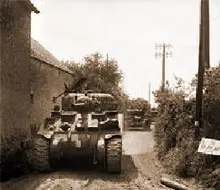
A Sherman of the Royal Armored Support Group on the way to Tilly-sur-Seulles on June 13.
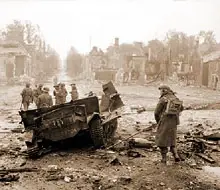
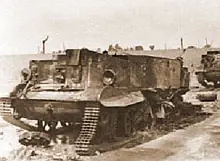
The remains of a universal carrier blown up by a mine in Tilly-sur-Seulles, 19 June 1944. Note the massive destruction at the back.