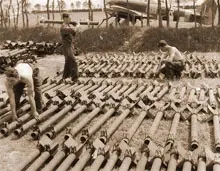
Armourers prepare rocket projectiles for use on Typhoons at Airfield B5 (121 Wing, 83 Group) near Le Fresne-Camilly, Normandy.
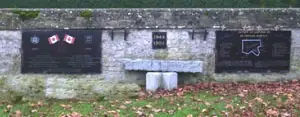
B.5 - Le Fresne-Camilly - 1700 metres long, 40 metres wide, Sommerfeldt wire-mesh completed 15 June (129 Wing (184), 121 Wing (174,175,245) and 222 Squadron).

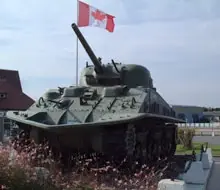
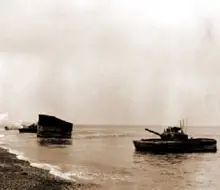
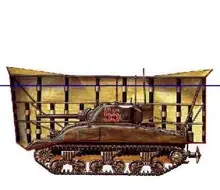
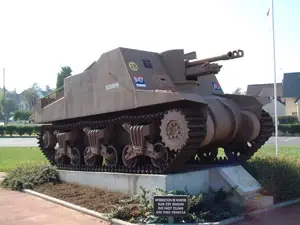
This Sherman, belonging to the 1st Canadian Hussars, is one of the five (out of nineteen) that sank on the run in. It was recovered in 1971. Note the lip extending around the entire hull to which the canvas dam was attached. The DD's making it ashore provided vital fire support for Company A of the Regina Rifles, which encountered heavy fire both from German resistance nests in the harbor area and from artillery positioned further inland.
Flanking the beach exit is a memorial plaque to the officers and men of the Regina Rifles who were casualties during the war. Nearby are plaques commemorating the 1st Canadian Scottish Regiment. Across you still have a 50 mm German anti tank gun.
Some three hundred yards east along the Avenue de La Combattante is a memorial to the Royal Winnipeg Rifles. Next stop will be Bernières-sur-Mer.
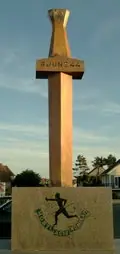
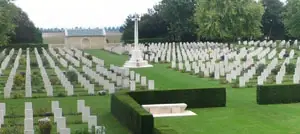
2 049 soldiers were buried in this cemetery: 2 044 Canadians, 4 British and 1 French.
This site gathers graves of two temporary cemeteries established in 1944 in Bény-sur-Mer and Reviers.
Two maple lines lead from the centre to the remembrance stone. In the building on the left, at the entrance, a plaque is dedicated to The Cameron Highlanders of Ottawa Regiment, to the men who fell during D-day and the campaign in Europe.
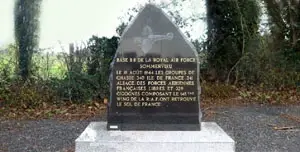
This memorial remembers that airfield B8 of the Royal Air Force was built at this place on August 1944. The 145th Wing of Free French Airforce landed here for the first time on 19 August 1944.
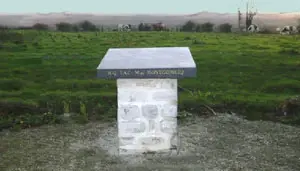
In August, Lt. General Bernard Montgomary moved his Tactical HQ at Blay, only 20 km south-west of Port-en-Bessin.
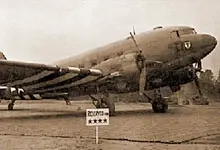
This C-47 is parked on Pierced Steel Plank (PSP) «hardstanding» at what the original Signal Corps caption indicates is «an advanced fighter base near the front line» in Normandy.
This unspecified airstrip's purpose was «to accommodate the personal planes of four-star generals» and, upon close inspection, the aircraft bears the insignia of both the 21st Army Group and the British 2nd Army on its nose.
The picture is dated July 19, during the period that Field Marshal Bernard Montgomery's HQ was situated at Blay, close to ALG A-9 at Le Molay (just north of Le Molay-Littry), which had been completed on July 8, although some construction equipment is still visible in the background below the left engine.
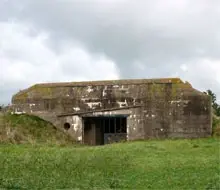
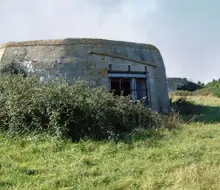
The casemates standing in the center of the field are Mare-Fontaine Battery. This battery of 105 mm guns was overrun on D-Day by the Green Howard's, after having been first bombed, then shelled by HMS Belfast.
The German battery in the hamlet of La Marefontaine Farm which was not housed in a concrete pillbox, did not have a view of the sea or the beaches for targeting purposes; it relied on a firing command post equipped with a rangefinder. As was the case with the batteries at Pavillon Farm in Crepon and Bény-sur-Mer, where the guns also lacked fortified protection, the battery at La Marefontaine was linked to a firing command post located in the Maromme Woods on the Meuvaines heights, facing the sea (known as WN 35b).
This position had a clear view of the sea. The coastal defences were linked by means of telephone lines enabling all sites to communicate with each other.
This type of fortification was equipped with four 2.5 inches howitzers from Czechoslovakia, with a range of 5.6 miles, sufficient to cover the beach.
The site received hits from more than 250 projectiles in under two hours and capitulated under the assault mounted by the flam-throwing tanks of the troop 13 of the 141st RAC (Royal Armored Corps Rgt).
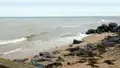
La Rivière marks the eastern end of Gold Beach.
At the crossroads marked by a bistro, there is a monument to the 2d Battalion of the Hertfordshire Regiment. Further east, in front of Ver-sur-Mer, the 69th Brigade was advancing more rapidly.
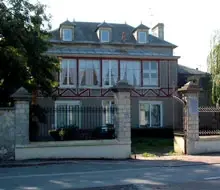
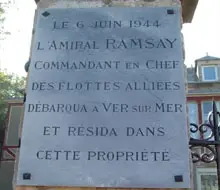
The main obstacle, in the shape of the fortified hamlet of La Rivière, was removed mid-morning, after a tank knocked out the 88-mm gun installed in a blockhouse on the sea wall that had been keeping its attackers at bay.
The two heavy batteries located in the commune at Mont Fleury and La Marefontaine, which had been put out of action by aerial and naval bombardments, were captured in quick succession.
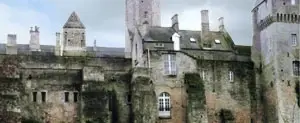
Creully was liberated on 6 June 1944 by the Royal Winnipeg Rifles.
The Canadian soldiers moved up to the bridge on the river Seulles, north of Creully, strongly defended by the Germans.
The other bridge, east of Creully, was even more defended. However, D company was able to seize and cross the bridge, an act for which Lieutenant Jack Mitchell was awarded the Military Cross.

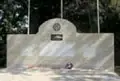
The château later housed the BBC, having landed on Nan White at 9.30.
The room which was occupied by the BBC is in the rather Gothic looking tower to the extreme right of the castle.
The field on the right is where troops and the BBC reporters and engineers set up camp.
To the left of the door is a plaque proudly declaring «Studio BBC».
It rather curiously gives the dates as June 6th to July 21st 1944 - although it is very unlikely that the BBC actually arrived at the studio on June 6th.
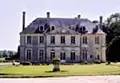
Field Marshal Bernard L. Montgomery landed with his HQ staff in Normandy shortly after D-day and occupied the Château Creullet, a Parisian summer residence.
The British had moved quickly inland on D-day over-running the Château's German occupants in a short and decisive fire fight in the garden woods to the right.
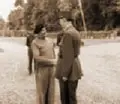
Montgomery preferred to live in his truck caravan captured from a German general in North Africa than in the Château itself from June 8th to June 22nd. On June 12, Prime Minister Winston Churchill and Minister of War Marshal Smutz visited him and on June 16th King George VI. On June 14, General de Gaulle met Montgomery in Creullet and on June 15th he welcomed General D. Eisenhower. The English newspaper reporters, accompanying the King, were so explicit about Montgomery's location that German officers in Lisbon reading the English papers passed the information back through channels bringing German artillery fire down on the Château grounds. Montgomery's HQ moved to Blay, south of Bayeux. Close by is the Creully Castle with its dominating tower from where Edward R. Morrow and Howard Marshall broadcast the battle news back to the States and the UK, respectively.
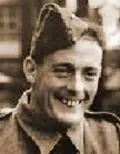
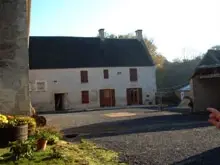
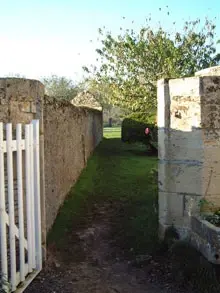
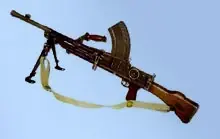
Stanley Hollis, 5th Green Howards, entered the village on June 6th early afternoon. A 10 year old kid, today's owner, runs to meet the soldiers and claims: «Germans! Germans are in the backyard of the farm». With 10 comrades, Stan squeezes in between the walls of the farm and observes a 2.5 inch Czechoslovakian gun. He decides to crawl in the apple orchard armed of a Piat with his men in close fire support on his right flank. The gun barrel points the sky. When he is 50 yards away from his target, he aims the canon but the rocket fails. The situation then turns rapidly disastrous as he had not paid enough attention and had not noticed 3 other guns in position with two MG in cover on both sides. The Germans engage firing and killing 8 men. Hollis runs back as fast as he can to the garden wall shelter. The gun pointing to the sky fires and hits the top of the barn. Hollis, still standing behind the wall, realizes that two of his men are still alive. He rushes picking up a Bren gun with several magazines, then jumps out his sheltered area and fires like the devil at the canons, screaming at the two soldiers to crawl in his direction.
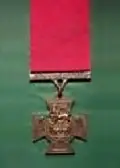
This is how he was awarded the only Victoria Cross discerned on D-Day.
In fact, this position was an unknown WN which had been set up in May 1944; this is why the defence was not indicated on «Top Secret Defences» maps. The most amazing fact is that if the British forces had known about it, they would have levelled the village.

I joined the Green Howards two or three months before the war started as a private soldier, and having never ridden a motorbike in my life, I was promptly made a dispatch rider. When we came back from Dunkirk I was made a Sergeant. We went to the Middle East and I was made a Sergeant Major in 1941. We went to Sicily, where I was wounded and sent back to Philippeville in North Africa and when I got better I was posted to The 6th Battalion, The Green Howards.
We did our training for the invasion up at Inverary in Scotland. We knew exactly how to do it and what to do. We had done it once before in Sicily, but this was very good additional training. It was miserable. It was January and February and cold. However, we got over it and we came down to the south coast to prepare for the invasion. We were put behind the wire in Winchester and briefed and told exactly what we were going to do and how we were going to do it. We were shown aerial photographs - yards and yards of them - of the whole beach area that concerned us. Quite clearly shown up were our objectives... We had a very good picture of what we were going to see when we got here. Reveille on the morning we arrived off the beaches. I suppose it would be about six miles off the beaches. We were on a ship called «The Empire Lance». Reveille would be about half past two, three o'clock in the morning, and after having had our breakfast - those of us that wanted it - we spent the rest of our time until we got into the landing craft loading the landing craft with ammunition that had to be carried up by the men to the high water mark and dropped here and left for the follow up troops to use. Made sure all our weapons were working right and the Company Commander came to me - Major Lofthouse - who was also a very good friend of mine. We had been through a lot of the war together. We had a good working relationship and he gave me a square box. He said, «Give one of these to each of the men Sergeant Major». So I opened it and it was a box of French letters. «Well», I said, «what is to do? What are we going to do? Are we going to fight them or f*** them?». They were for the Bren guns, anyway, and they did work. They did work very well, because in fact we landed waist deep in water.
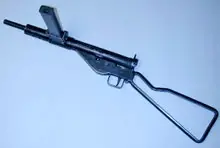
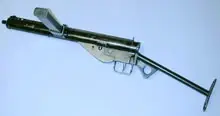
Well, we had to go down the scrambling nets into the landing craft and the sea was rough and the landing craft coming up and down. It was a bit awkward getting down with our equipment. We had big Bren pouches sticking out and rifle butts and Sten gun butts, and I can remember going down these nets and thinking to myself, «there must be easier ways of making a living than this». However, we got in the landing craft, about eighteen or twenty men to a boat, and at this stage I would like to mention that one or two of those passengers that Colonel Hastings talked about could quite willingly have had my place in the boat. However, we cast off from the boat, from the ship, and we cruised round and round in circles until the whole company was afloat, and then we set off in line abreast for the shore. A Company on the right - five boats, B Company five boats abreast on this side and we came in.
These things did four or five knots and it took us about an hour, an hour and a quarter, to get in. After we had been in the landing craft for about half an hour everything in the world opened up from behind us. Twenty-five pounders firing off loading platforms. Floating platforms firing thousands of rockets in one salvo, and cruisers, destroyers, everything opened up here. This lot was saturated by these little mortar bombs and I think they must have done a wonderful job in blowing a lot of these mines up in this minefield behind us. When we got to the shore, the front of the landing craft. I was stood in the front and I saw (a) shelter. There was, in fact, a railway running along here then and that was a waiting room or something for this railway and I thought it was a pillbox. As we were coming in I lifted a stripped Lewis off the floor of the landing craft and I belted this thing with a full pan of ammunition and the bullet marks were there up until last year. It was then that I received the most painful wound I had in the whole war. I lifted the Lewis off - the gun of the landing craft - and it was white hot and I got a bloody great blister right across my hand there. It was as big as my finger and very painful. Well, as I say, we landed about waist deep in water and the man in front of me, Sergeant Hill; he had been a very good soldier all through the war. A real fighting man. He jumped out first and he jumped into a shell hole under the water. The landing craft went over and, of course, he couldn't come up with all the stuff he was carrying. The landing craft went over him and the propellers cut him to bits.
On reaching the high water mark we lost one of our very important officers. We lost the beach-master. He was the man that was supposed to say «Right. You go that way, you go that way». So he was out of action. By this time shells and mortars were dropping. We had no small arms casualties yet. The plan was for me, the Sergeant Major, to have two two inch mortars from each Platoon and two Bren guns from each Platoon, dash along the beach about a hundred yards and then straight up to the high water mark and lay down with my troop and drop smoke bombs over on the far corner of the minefield, and also open up with the Brens onto these hedges behind us to keep their heads down. If anyone was there, there were chaps coming through the minefield. As we were coming over the beach this tank blew up and there was a scare patch on it - some sort of a door - blew off and it bowled along the beach like a hump right through the company. It never touched anyone because if it had it would have been curtains.
At the same time the one and only German aircraft I ever saw from here to being wounded later on came along the beach and he opened fire just above us, and I think it would be the East Yorks that got the benefit of it. But that was the only aircraft of the enemy I saw.. Well, we dashed over the beach. A lot of the boys had been seasick and they were only too glad to get out of those boats. We ran up to the top here and along this ridge with the grass on, there was just rolled wire. Well, an Irishman was alongside me, and believe it or not, there were two or three birds sat on this wire and this Irishman, Mullally, he said to me, «no bloody wonder they are there Sergeant Major. There is no room in the air for them», and he was killed a few minutes later going up that road Well, up to now things had gone pretty well and we had expected far heavier casualties than we had had. Now I think we have covered this and we walked along to the next stop. The minefield extended in depth to quite a lot. From the beaches to the bottom hedge was the depth of the minefield. The Platoon of D Company was led through by the Assault Pioneers of the Battalion. They went ahead with their «hoover» things and laid the white tape behind them and we trod on the tape.
Two platoons came over the minefield to advance over this field just beyond the hedge over the Meuvaines Ridge to the Mont Fleury gun battery just at the other side of these bushes. The other Platoon of the company, the Company Headquarters, with me came up this road. When we got through this hedge we started getting small arms casualties. This is where that man Mullally was killed. We knew the fire was coming up from here somewhere but we didn't know exactly where. When we got to where these crossroads are now - this was just a track then - the fire was, of course, a lot closer and we were getting more casualties. So then we got down and we crawled. We crawled up this hill and when we got here - just about this exact place - Major Lofthouse and I came forward to see what we could see, and we were laid down here and we saw the firing was coming over from where Colonel Perkins is now. And Major Lofthouse said to me, he said, «there is a pillbox there, Sergeant Major». Well, when he said that, I saw it. It was very well camouflaged and I saw these guns moving around in the slits. So I got my Sten gun and I rushed at it from here, just spraying it hosepipe fashion. They fired back at me and they missed.
I don't know whether they were more panic stricken than me, but they must have been, and I got on top of it and I threw a grenade through the slit and it must have sickened them. I went round the back and went inside and there were two dead, quite a lot of prisoners. They were quite willing to forget all about the war. The communicating trenches from that pillbox to another one further along, and I could never understand, until a couple of years ago, how I got so many prisoners. I got eighteen or twenty prisoners. But we found out later that this was the command post for the Mont Fleury gun battery, which is just over the brow of the hill and this explains where all these chaps came from. Well, we didn't bother with escorts for prisoners, we just pointed the way back down the beach and they were quite happy to go by themselves and if you walk up to the pillbox you will see that it's still there. Well, as we came over this field here to advance to this Mont Fleury gun position, and it was at the top of that field that I looked back and I had been firmly convinced that The Green Howards were the only people fighting this bloody war. But when I looked back I couldn't see any water at all and it was then I realised that somebody else was helping us and all, and it gave us a great feeling of confidence.
Anyway we advanced over to these things here and as we came, as we appeared, in sight the Germans ran out of them - the back of the pillboxes. Ran out and over that wall into the wood. Well, D Company had got behind this mound, came over here. Colonel Hastings had come to see us in these things and saw that we had got them so everything was going alright. It's now about half past nine in the morning. We got behind this mound. These chaps were starting to shoot at us from behind that wall and I saw a man running along the top of the wall, and I borrowed a rifle off one of the chaps and I took a shot at him and to my amazement I hit him. I had never been known as a good shot. If I fell down I couldn't hit the floor, sort of thing, but I knocked that man off the wall and at the same time I got hit in the face. Not a lot of damage. A lot of blood. It looked a lot worse than it was, and we went over there. The firing had ceased then. We went over there and we found a man had - a German soldier - had been just that minute killed so I assume it was the one I had knocked off the wall. The Company then advanced, the whole Company advanced round the edge of that wall into the next village, and really that is about all there is to tell here.