On D-Day, Canada landed 14,000 troops of the 3rd Canadian Infantry Division on Juno Beach. D-Day for Canada also involved the Royal Canadian Air Force which bombed and attacked key enemy targets, while the Royal Canadian Navy contributed 109 vessels and 10,000 sailors to the massive armada of 7,000 Allied vessels. On D-Day, Canada's assault troops landed on Juno Beach and stormed ashore in the face of fierce opposition from German strongholds and mined beach obstacles. The soldiers raced across the wide-open beaches swept with machine gun fire, and stormed the gun positions. In fierce hand-to-hand fighting, they fought their way into the towns of Bernières, Courseulles and Saint-Aubin and then advanced inland, securing a critical bridgehead for the allied invasion. The victory was a turning point in World War II and led to the liberation of Europe and the defeat of Nazi Germany.
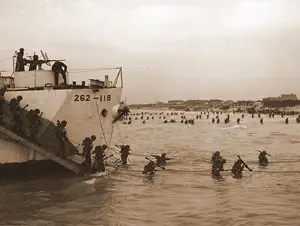
Fourteen thousand young Canadians stormed Juno Beach on D-Day. Their courage, determination and self-sacrifice were the immediate reasons for the success in those critical hours. The fighting they endured was fierce and frightening. The price they paid was high - the battles for the beachhead cost 340 Canadian lives and another 574 wounded.
Juno beach was five miles wide and stretched on either side of the small fishing port of Courseulles-sur-Mer, France. Two smaller villages, Bernières and Saint-Aubin, lay to the east of Courseulles. The coastline had been fortified by the occupying Germans and bristled with guns, concrete emplacements, pillboxes, fields of barbed wire and mines.
The 3rd Canadian Infantry Division reinforced by the 2nd Canadian Armoured Brigade landed in two brigade groups:
Each Brigade group was comprised of 3 infantry battalions (regiments), and supported by an armored regiment, 2 artillery field regiments, combat engineer companies and extra units such as Armored Vehicles, Royal Engineers (AVRE's). The Fort Garry Horse tanks (10th Armored Regiment) supported the 7th brigade landing on the left and the1st Hussars tanks (6th Armored Regiment) supported the landing on the right.
The 9th Brigade consisting of the Highland Light Infantry, Stormont Dundas and Glengarry Highlanders, and North Nova Scotia Highlanders regiments landed from 11.33 to 11.50 in 17 minutes and advanced through the lead brigades. The Sherbrooke Fusiliers tanks (27th Armored Regiment) provided tank support.
Although a total of 14,000 Canadians stormed Juno Beach on D-Day, there were not more than three thousand young Canadians in the first wave - all ranks. The initial assault was the responsibility of four regiments with two additional companies supporting the flanks:
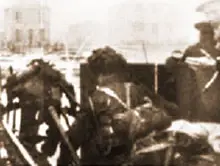
The first wave of Canadian infantry was brought into shore by LCA's landing at 7:55. When the ramps lowered the troops disembarked and waded ashore. The soldiers hit the beaches and began the deadliest run of their lives. As they worked their way through the obstacles and minefields they came into the killing zones of the German gun positions. The assault troops raced across the beaches through the curtain of machine gun fire, rushed the pillboxes and eliminated the German strong-points with Sten-guns, small arms fire and grenades. The first wave took heavy casualties on the beaches. DD tanks arrived on the beaches and fired on the pillboxes, decimating the remaining strong-points. In bitter hand-to-hand fighting the Canadians cleared the enemy gun positions and fought their way into the towns.
All morning long the battle raged along the precious strip of coast. The Regina Rifles and Royal Winnipeg Rifles fought their way through Courseulles and Graye-sur-Mer. The North Shore Regiment captured Saint-Aubin while the Queen's Own Rifles took the town of Bernières. Tanks and infantry struck inland all that day and pressed on through villages, fields and groves of trees defended by determined Germans.
Facing formidable gun emplacements, machine gun nests and snipers, the brave Canadian soldiers did not hesitate in their advance. Determined officers led their well trained platoons to take out the enemy strongholds. Countless times the soldiers showed acts of valor by engaging the enemy in vicious close quarter fighting. Soldiers lost their close friends in the fighting and somehow found the courage to keep going. Through the terror of the battle the disciplined soldiers pushed on to overcome the enemy positions. The fierce battles were won by the bravery of the individual Canadian soldiers and the collective actions of their regimental units.
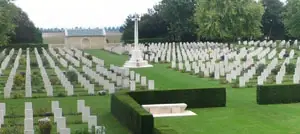
2 049 soldiers were buried in this cemetery: 2 044 Canadians, 4 British and 1 French.
This site gathers graves of two temporary cemeteries established in 1944 in Bény-sur-Mer and Reviers.
Two maple lines lead from the centre to the remembrance stone. In the building on the left, at the entrance, a plaque is dedicated to The Cameron Highlanders of Ottawa Regiment, to the men who fell during D-day and the campaign in Europe.
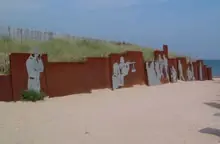
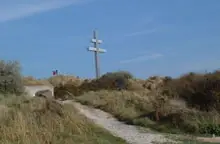
Here, Prime Minister Churchill, with Generals Jan Christian Smuts and Alan Brooke, landed on 12 June for a tour of the beachhead. Four days later, George VI also came ashore here. A monument commemorates these events, as well as the assault landing.
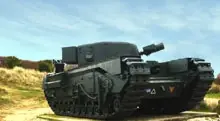
The tank is a Churchill AVRE, which laid buried in the sand until its recovery in 1976. Keep driving along the street, then park your car close to the Lorraine Cross, erected there to commemorate the landing spot of Gen. de Gaulle, who was on board La Combattante. Walk down the beach, through the breach, along side Cosy's Bunker, on the west side of the Seulles River which contained a 75 mm field gun and a very large anti-tank gun. A story of unimaginable courage took place near this pillbox. It concerned Corporal «Bull» Klos. Royal Winnipeg Rifles history: «Rushing the enemy, «B» Company encountered heavy enemy fire. Corporal Klos, badly shot in the stomach and legs while leaving the assault boat, made his way forward to an enemy machine-gun nest. He managed to kill two Nazis before he was mortally felled. His hands still gripped about the throat of his victim produced a chilling sight!».

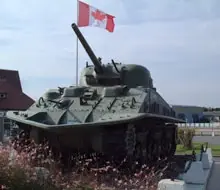
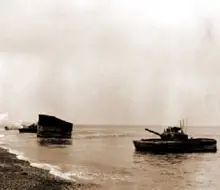
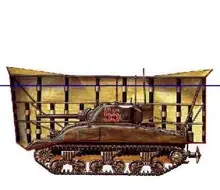
This Sherman, belonging to the 1st Canadian Hussars, is one of the five (out of nineteen) that sank on the run in. It was recovered in 1971. Note the lip extending around the entire hull to which the canvas dam was attached. The DD's making it ashore provided vital fire support for Company A of the Regina Rifles, which encountered heavy fire both from German resistance nests in the harbor area and from artillery positioned further inland.
Flanking the beach exit is a memorial plaque to the officers and men of the Regina Rifles who were casualties during the war. Nearby are plaques commemorating the 1st Canadian Scottish Regiment. Across you still have a 50 mm German anti tank gun.
Some three hundred yards east along the Avenue de La Combattante is a memorial to the Royal Winnipeg Rifles. Next stop will be Bernières-sur-Mer.
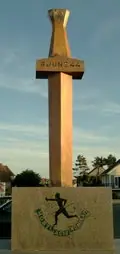
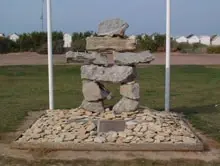
Park near the Inuksuk, right after the tourist office.
You are now facing the Nan White sector of Juno Beach, where the Queen's Own Rifles and La Chaudière regiment landed. The QOR was to land behind DD tanks, but the high seas breaking over the offshore reef meant that the tanks had to be brought into the beach well behind the infantry.
As it was, the LCA's carrying the assault companies of the QOR were a half-hour late reaching the beach and some two hundred yards east of their designated landing area.
The boats dropped their ramps among the beach obstacles. As many as one-fourth were damaged or sunk upon landing or when attempting to withdraw through the obstacle belt.
One company of the QOR took sixty-five casualties crossing the hundred yards of sand to the sea wall. Nevertheless, supported by fire from a flak ship just off the beach, the Canadians quickly overran the German resistance nests. When the Regiment de la Chaudière landed fifteen minutes later, much of the earlier fire had been suppressed.
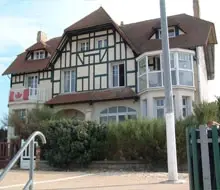
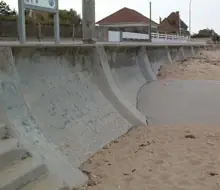
Walk to the promenade to La Cassine Villa site's where Memorials are, from there walk along the seawall link by the anti-tank wall. 300 yards further, on your left hand side, is the famous house which cost 100 lives to the QOR.
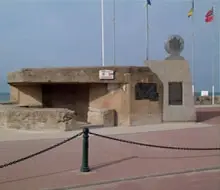
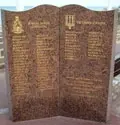
Saint-Aubin was the landing site of the 48th Royal Marine Commando. The next morning they moved east to Langrune, where they joined with the 41st Commando.
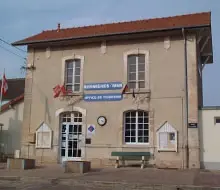
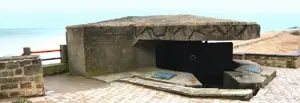
Near a blockhouse on the sea wall is a memorial to the North Shore (New Brunswick) Regiment and the 48th Royal Marine Commando. Some one hundred yards further on, by the tourist office, is a monument to the Fort Garry Horse.
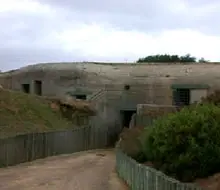
In the evening of 6 June 1944, the Allied Forces had succeeded in gaining a foothold on the beaches of Normandy, and they had established several bridgeheads.
In some places along the coast, local German strong points still resisted. Between Juno Beach and Sword Beach, the defences of Douvres-la-Délivrande kept in check all the Canadian attacks. Douvres-la-Délivrande was an important radar station for air detection; it was defended by many concrete works, armed with guns, machine-guns, and surrounded by minefields. The Germans held the position until 17 June after British/Canadian forces decided on containment of the position.
When a massive attack was launched; the 41st Royal Marine Commando supported by the special armoured, drove the 230 German defenders of the garrison to surrender.
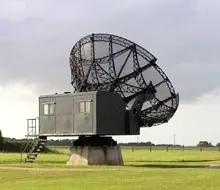
The Würzburg radar was the primary ground-based gun laying radar for both the Luftwaffe and the German Army during WWII. Initial development took place before the war, entering service in 1940. Eventually over 4,000 Würzburgs of various models were produced. It took its name from the city of Würtzburg for no other reason than the project leader liked geographical names.
| Country of origin: | Germany |
| Introduced: | 1941 |
| Number built: | circa 1500 |
| Range: | up to 70 km (44 mi) |
| Diameter: | 7.5 m (24 ft 7 in) |
| Azimuth: | 0-360º |
| Elevation: | 0-90º |
| Precision: | ±15 m (49 ft 2½ in) |
The No. 48 (Royal Marine) Commando was given the task of securing the left flank of the Canadian assault.
They were to land on «Nan Red» sector behind the 8th Brigade and capture Langrune-sur-Mer and as Far East as the divisional boundary. The No. 48 Commando landed at 8.43 am, opposite and immediately east of the Saint-Aubin strongpoint. They suffered heavily from the strong-point's fire and then met stiff opposition in Langrune-sur-Mer.
The No. 41 Commando which landed at Lion-sur-Mer on the 3rd British Infantry Division front, also met difficult enemy resistance. No. 41 Commando was unable to immediately capture Lion-sur-Mer nor capture Le Petit-Enfer to the west. This prevented the units from joining the divisional fronts. It wasn't until June 8th that these towns were captured.
Finally the Commandos helped the Canadians to secure the Radar sites.

As the Allies prepared for their invasion of France in early June 1944, members of 12th SS Panzer (Hitlerjugend) Divison were deployed near Caen.
The impressionable young minds of the Hitler Youth had been subjected to a powerful regime of training that had sought to overcome their immaturity, exploit their idealism and youthful enthusiasm, and politically indoctrinate them in Nazi ideology.
The entire division, except for officers and NCOs, consisted entirely of boys aged 17 and 18. They were led and taught by veterans of the 1st SS Panzer Divison (Leibenstandarte) of the Eastern Front - all die-hard Nazis embittered by the vicious fighting in the east. For four weeks prior to D-Day the 12th SS Division, at full strength with between 20,000 and 21,000 all ranks and 214 tanks, was busy preparing for an anticipated Allied attack. Among the senior officers present was SS Colonel Kurt Meyer.
Kurt Meyer was a battle-hardened, fanatical Nazi. A devout supporter of Hitler, he had joined Hitler's Bodyguard (Leibstandarte) in 1933 and all his subsequent service was with the SS. He had fought in Poland, France and Holland with the Adolf Hitler Division, and as regimental commander had played a key role in the Greek campaign. The intensity and brutality of the fighting on the Eastern Front needs no introduction and Meyer had helped to spearhead the German drive into Russia. Here he had displayed feats of fearlessness that would later mark his exploits in Normandy.
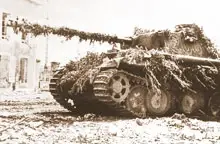
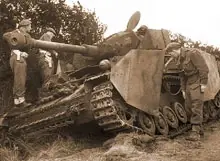
During his three years in Russia he had plunged deep into the Caucasus, and during his retreat was completely encircled by his opponent three times, on each occasion fighting his way out with only a handful of survivors. Meyer was not only willing, but apparently sought out ways of putting his life in peril by dashing into danger areas on his motorcycle; the multiple wounds he sustained during the war were ample proof of this.
While Meyer had proven to be a great tactician, he was also accused of unpalatable behaviour, such as burning villages and murdering women, children, and Soviet soldiers during the brutal fighting around Kharkov in 1943. He had been assigned to the 12th SS Panzer Division in the spring of 1943 and was Commander of the 25th SS Panzer Grenadier Regiment in early June 1944. He would take over as divisional commander on 13 June, following the death of Brigadefuehrer Witt.
The Canadians first came into contact with the 12th SS in the days following the Normandy landings. On D-Day+1, SS Lieutenant Colonel Karl-Heinz Milius threw his 3rd battalion at the Canadians during the battle for Authie.
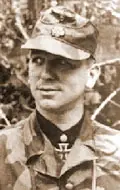
The North Nova Scotia Regiment and Cameron Highlanders thwarted this German counterattack, stopping the grenadiers in their tracks and bloodying the 12th SS Panzer division for the first time. The twenty-three Canadians captured by the Germans in Authie suffered a horrific fate that foreshadowed future atrocities at the hands of the SS troops. At the main intersection (at the southern end of the village) Canadian soldiers were disarmed, told to remove their helmets, and shot at close range. The young German troops further insulted the Canadian lives they had taken. In one incident, some German soldiers propped up the corpse of a murdered Canadian, placed an old hat on his head, and stuffed a cigarette box into his mouth. In another situation, eight of the lifeless Canadian bodies were unceremoniously dragged onto the street where they were repeatly mutilated by passing tanks, trucks and armoured vehicles. Appalled French onlookers later testified that SS troops whooped like drunken pirates at their handiwork.
Other Canadians were captured and taken to the Abbaye d'Ardenne, the headquarters of the German division where Meyer had watched the battle unfold. In the abbey garden eleven Canadians were interrogated and then killed on 7 June, each Canadian prisoner shaking hands with his comrades before being executed. At noon the next day seven more Canadians were shot at the Abbaye; their murders coincided with the execution of Canadian POWs on the Caen-Fountenay Road. The following evening Canadian prisoners were taken to the 12th SS's 2nd Battalion headquarters to meet their death. On the now tranquil grounds of the Château d'Audrieu, Canadian POWs were interrogated and duly executed, first in threes and later in more efficient larger numbers. These large-scale incidents represent 120 of 156 murders committed by the Hitlerjugend during the first ten days of the Normandy Campaign. Other murders took place on a smaller scale at locations like Bretteville-l'Orgueilleuse, Norrey and Le Mesnil-Patry. News of the murders began to filter back to the Canadian ranks in Normandy, but there was little immediate proof of the atrocities.
In response to reports of atrocities from escaped Allied prisoners of war and liberated French civilians, the Allied headquarters staff formed organizations to look into allegations of criminal activity beginning in the summer of 1944. Field Marshall Bernard Montgomery ordered two courts of inquiry while the Allied Supreme Commander, General Dwight D. Eisenhower, established a Standing Court of Inquiry under the Supreme Headquarters Allied Expeditionary Force (SHAEF) which began its work in August 1944. Investigations into murders yielded disturbing information.
There was evidence of one hundred and fifty Americans who had been captured and murdered near Malmedy by 1st Panzer Division. Furthermore, the Allies began to realize the magnitude of the crimes committed by the 12th SS against Canadians. Between September 1944 and May 1945, for example, the bodies of the men killed at the Abbaye d'Ardenne were found in five shallow, unmarked graves.
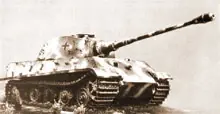
At the end of the war, Canadian War Crimes Investigation Units (CWCIUs) were established to investigate alleged incidents of war crimes in Europe and the Far East. Number 1 CWCIU was led by Lieutenant-Colonel B.J.S. (Bruce) Macdonald, a lawyer and former Commanding Officer of the Essex Scottish Regiment. Macdonald had already participated in the SHAEF Court of Inquiry in which he had interviewed hundreds of German prisoners in North American POW camps and gathered information of alleged atrocities committed by Meyer's 25th Panzier Grenadier Regiment. Warrants were issued for the arrest of Kurt Meyer. «Panzermeyer» was before the Courts by December 1945. Meyer had been captured by the Americans in September 1944, but had concealed his identity for over a month by wearing a Wehrmacht uniform. Once identified as an SS officer, he was transferred to England for questioning and held there at a POW camp. Under the authority of War Times Regulations (Canada) P.C. 5831, a Canadian Military Court was established at Aurich, Germany. It was here that Meyer was to be sent to stand trial, under the Convening Authority of Major-General Chris Vokes, the General Officer Commanding (GOC) 3rd Canadian Infantry Division of the Canadian Army Occupation Force.
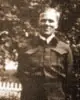
Soldat James Alvin Moss.
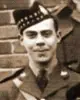
Lieutenant Freddie Williams.
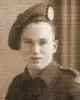
Soldat Walter George Doherty.
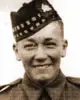
Caporal George Pollard.
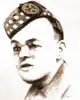
Soldat Hugh Aller MacDonald.
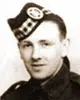
Soldat Hollis Leslie McKeil.
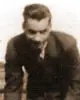
Soldat Reginald Keeping.
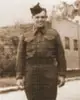
Soldat Georges Edward Millard.
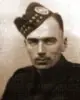
Soldat Ivan Lee Crowe.
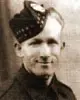
Soldat George Richard McNaughton.
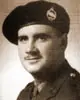
Lieutenant Thomas Alfred Lee Windsor.
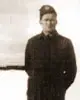
Soldat Harold George Philip.
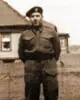
Soldat George Vicent Gill.
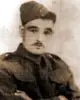
Soldat Charles Doucette.
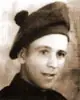
Caporal Fah MacIntyre.
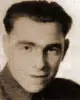
Soldat Roger Lockhead.