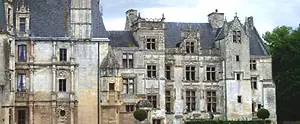
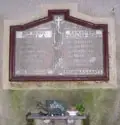
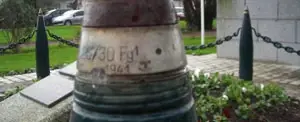
This plaque is to commemorate the soldiers who were killed by a German mortar shell. 70% of the allied losses were due to enemy mortar shells. Read Lt. Dickin and not Dicken.
At 6.00 pm, B and C Coy of the Reginas, accompanied by B Squadron, were ordered to move forward to Fontaine-Henry.
C Coy was instructed to by-pass Fontaine-Henry, and go forward to Le Fresne-Camilly, the Battalion's intermediate objective. Onto Le Fresne-Camilly, at about 6.30 pm, B Squadron Commander reported that an 88mm gun had knocked out six of his ten tanks. Radio communication between B and C Coys had broken down. At 7.00 pm, B coy successfully entered Fontaine-Henry, and at 7.30 pm C Coy reported that it had reached Le Fresne-Camilly and had cleared it. Reviers was liberated by C Coy commanded by Major Tubb.

This is the entrance of a huge cave, where 150 Nazi soldiers regrouped; the Canadian Scottish encircled the position, the Canadian officer went to meet them and explain that they had two choices: surrender or be killed, they surrended.
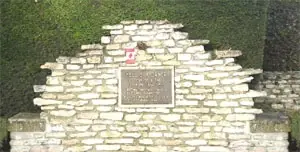
B16 Airfield, Villons-les-Buissons
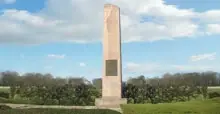
Norwegian Monument, Villons-les-Buissons
In the evening of D-day the North Nova Scotia Highlanders stopped in Villons-les-Buissons.
On June 7th at 5.00 am, the Canadians moved on with reconnaissance tanks at the head of the column.
The 9th Brigade was assigned to capture Carpiquet Airfield.
The Canadians overran the Germans; they fought house to house and pushed them back out of Les Buissons. Then they settled down toward Buron.
The onsite combat lasted 4 weeks; they were under the mortar shelling of the 12th SS- 26th Regiment commanded by Hubert Meyer. Villons was also the departure position to assault Buron then was renamed Hell's Corner.
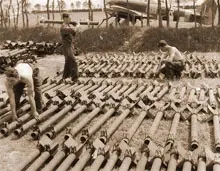
Armourers prepare rocket projectiles for use on Typhoons at Airfield B5 (121 Wing, 83 Group) near Le Fresne-Camilly, Normandy.
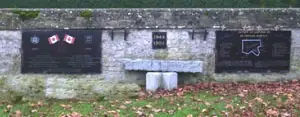
B.5 - Le Fresne-Camilly - 1700 metres long, 40 metres wide, Sommerfeldt wire-mesh completed 15 June (129 Wing (184), 121 Wing (174,175,245) and 222 Squadron).
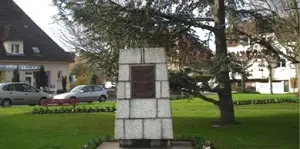
On 7 June 1944, Authie was liberated by the North Nova Scotia Highlander, then taken back by grenadiers of the 12th SS Panzer-Division.
After their counter offensive the SS assassinated 37 Canadian prisoners from the town and some who were captured along the road to Abbaye d'Ardenne. They played with a dead Canadian body; put a cigarette in his mouth and a nazi helmet on his head.
One wounded Canadian soldier was laying on a table in a house dining room, when a SS entered the home and killed him. Also, when the Canadians were in the village they gave cigarettes to civilians, when the SS realized that some of the locals had allied cigarettes, they arrested them and executed 7 men.
A fortunate one had a hole in his trouser pocket and could drop the cigarette that hole saved his life. When the SS moved away from Authie they drove their vehicles over the Canadian prisoners' bodies. The front stabilized with no movement for a month with 160 casualties and 7 Shermans destroyed. Operation Windsor was to capture Carpiquet town and airfield.
Authie Memorial, with the plaque dedicated to the 7 civilians executed by the Hitlerjungend.
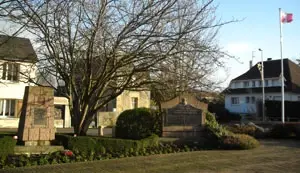
On 8 July 1944, the Ist British Corps launched the «Operation Charnwood», the objectives were the German positions north and north-west of Caen.
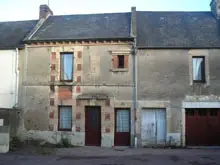

Buron had already been a place of fierce fighting on 7 June, where the Canadians had been badly mauled.
On 8 July, artillery preparation was heavy, 80,000 shells were fired within five days in the Caen sector. At dawn the Canadians of the Highland Light Infantry, of the 3rd Infantry Division, spanned an anti tank ditch in front of Buron, they fought hand to hand with the SS grenadiere. At 4.30 pm a shell fell on the Canadian staff and caused several casualties. In the evening the Canadians counted their losses: 262 men.
The following day the attack was renewed and Buron was finally taken to the SS around 10.00 pm, the town was strewn with dead Canadian and German bodies.
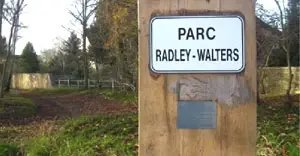
This is Radley-Walter's park; he landed on June 6th with Sherbrooke Regiment. He destroyed 18 German tanks and was awarded the Distinguished Service Order.
The owner of the Château's park was a German collaborator and disappeared in June. Also 100 yards away you can still see an old house crumbled with shrapnel impacts.
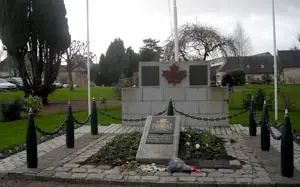
Early on June 7th the 7th Canadian Brigade reached RN 13, Regina Rifles stepped in Bretteville-l'Orgueilleuse and Norrey-en-Bessin without fighting. Royal Winnipeg Rifles Regiment were west of Putot-en-Bessin. On the 8th, 12th SS Panzer-Division was driven out Norrey. In Putot the Winnipeg were overwhelmed. Canadian Scottish Regiment counters attack Putot and secures it. In the evening the kampfgruppe Meyer-Wunsche attacked Bretteville; Canadian anti-tanks destroy several panzers.

At Bretteville main road (N13) 2 Panthers engage fighting just before the church, Joe Lapointe fired with his Piat 2 rockets, the head tank reversed and hit a pile of anti-tank mines stored along the road. The tank was rendered useless but the occupants, still alive tried to escape and then were killed by Sergeant Allen Kennedy signal platoon who passed away in 1996/97. The second tank totally panicked and fired all around, until it fired a direct hit in the front tank turret.
On 11 June, the Winnipegs counter-attacked with support of The First Hussars tanks, but don't break the German defences. Then the front line was stabilized for two weeks. Take few minutes to enter the church, on the nave left side there is a magnificent plaque dedicated to the 6th Canadian Armored Division, 1st Hussards, Regina...
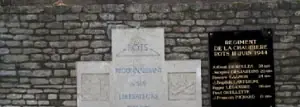
Memorial
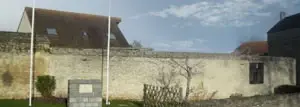
46th RMC Memorial
La Chaudière Regiment and Fort Garry Horse were facing Kurt Meyer tanks in the lower part of the village.
In the meantime the 46th Royal Commando was facing the 1st Coy of the 26th Hitlerjungend regiment. The town was liberated on June 12; the Nazis left 122 killed on the ground. The combat was so terrible that they found two soldiers, one Canadian and one SS impaled to each other with their bayonet.
He was in charge, every morning of bringing bread to his camp. He was buying it from the local baker who had a beautiful young daughter, who he fell in love with. He told her that after the war he would come back to marry her. But a few days before the war was over, he stepped on a mine and lost his two legs.
From the hospital he wrote to his love, explaining to her that they won't be able to get married as he lost his legs. The young women replied, that was not a problem and she went to Canada to marry him.
They use to come almost every year to the Ceremonies; he passed away 6 weeks before the 60th Anniversary.
Sergeant Rosaire Gagnon is very well known since he landed at Bernières-sur-Mer, you can see his photo along the wall of the Queens Own's House.
He is standing up insulting a British MP who arrested the local civilians living along the beach and suspected to be collaborators. After his intervention the French were liberated.
In the Château at Rots, Colonel Matheson held an officers' mess dinner while shells from Carpiquet and Abbey of Ardenne bounced off the walls.
Utilizing their army rations, the officers dined off fine dinnerware belonging to the recently abandoned Château.
Although the food was poor, the wine from the cellars was good.
Only half the officers of the Battalion were able to attend; the others had to stay on duty in case of an attack.
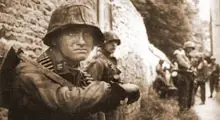
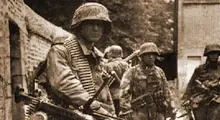
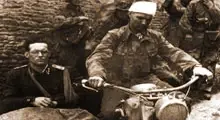
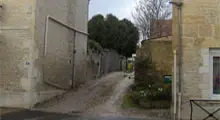


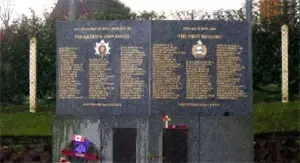

On June 11th Queen's Own Rifles and First Hussars launched an attack against Le Mesnil position, without reconnaissance and without artillery support, this operation turn to be a disaster, Canadian prisoners were once more executed by the 12 Hitlerjugend Division.
The village was finally liberated by the British during «Operation Epsom».
A nice piece of art, sculpted on the gate side of the farm at the end of the village, representing a British soldier.
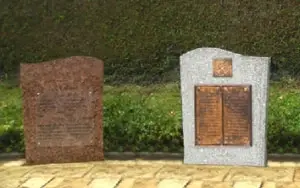
On June 7th elements of Royal Winnipeg Rifles Regiment took over Putot-en-Bessin and established their position along side the railroad.
The next day A Coy move toward Brouay bridge, facing the 26th Regiment of the 12 SS Hitlerjungend. 5th, 6th and 7th Coys of II Pz Grenadiere Abteilung launched their attack, went down town and encircled 3 of the 4 RWR Coys. Running out of ammunitions they use an artificial smoke screen to cover their withdraw. From the west two tanks of the 24th Lancers participated containing the enemy in the village. Then 1st Bn Canadian Scottish Regiment, reinforced with the 1st Hussars tanks, the Cameron Highlanders of Ottawa and the 12th and the 13th Regiment RCA regain the village on June 10th.
The Germans lost 98 men and the Canadian lost 256 men including 105 KIA and 45 prisoners murdered at Château Audrieu.

On June 7th, at 05.00 am Matheson held his own Bn orders group in which he gave instructions for the advance to the Battalion's final objective, line «OAK», the high ground on the Caen-Bayeux road at Bretteville-l'Orgueilleuse.
At 06.30 am Battalion shook itself out for the advance to its final objective.
At 07.15 am the companies moved off, with A and C Coy's on the right, B and D Coy's on the left. C Coy advance by road through Camilly, Bray, and Bretteville to Norrey-en-Bessin. A Coy was to follow and occupy Bretteville. B Coy moved forward on the left through Thaon, Cairon, and Rots. D Coy was to follow and occupy the road, rail road, and river crossing south of Rots.
At 07.30 am, HQ Bn moved off. A and C Coy's moved into Bretteville-l'Orgueilleuse, which the Germans had hastily vacated and HQ Bn arrived there at noon. B and D Coy's came up by 02.00 pm after some heavy fighting. At Bretteville, the civilian population gave the troops a very friendly reception and the Battalion took up a defensive position around the village where things remained quiet during the afternoon.
The companies dug in to be ready for an expected counter-attack which could come either from the east, from Caen or from the left front from Carpiquet. With the occupation of Bretteville, the Regina Rifles became the first and only units of the invasion forces to reach and hold its final D-Day objective.
During the night of June 7th, C Coy, under Major Stu Tubb, at Norrey-en-Bessin, held the most advanced and precarious position of any of the Allied troops. The Bgde commander wanted the company withdrawn, but Matheson protested that he would just have to retake the position later. C Coy remained.
In the morning of June 8th, D Coy manoeuvred to the right flank to the northwest of Norrey, to Cardonville Farm, which was until then, occupied by some of the Winnipeg Rifles. This tactic was to tighten up the Battalion's defensive position and to fill in the gap between C Coy and the position of the Royal Winnipeg Rifles. B Coy also moved to positions on the east side of Bretteville. Major Eric Syme took command of B Coy and Captain Gordon Brown took over D Coy.

In 1944, a linen factory existed on this site.
On 8th and 9th June, D Coy of the Royal Regina Rifle organized a resistance position against the attack of the 12 SS Hitlerjungend Division. Supported by the guns of the 13th Artillery Regiment the men of D Coy commanded by Gordon Brown force the SS in withdraw towards Le Mesnil-Patry.
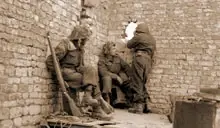
Today the so called «Cardonville Farm» across the railroad is named Adelard Farm and was the SS position, Cardonville Farm was then the linen factory, so do not get confused.
Three RRR soldiers are observing:

Departure line
Marcelet Hamlet is the departure line of 5 Canadian Regiments: North Shore New Brunswick, Royal Winnipeg Rifles Queen's Own Rifles, La Chaudière and the Fort Garry Horse Armoured.
They regrouped 450 field Artillery guns and were supported by the navy shelling of HMS Rodney against 150 Hitlerjungend SS soldiers and 10 buried Panther tanks.
The battle lasted 2 days. On July 4th General Dempsey launches Operation Windsor with the first target being Carpiquet Airfield...
Carpiquet Airfield was one of the German strong points supposed to have been taken by 9th Bgde on D-Day or the day after. However, it did not fall and remained a serious obstacle to the break-out.
On July 4th, as a prelude to the attack on Caen, «Operation Windsor» was launched, in which troops from 8th Bgde, including the Queen's Own Rifles and the Royal Winnipeg Rifles detached from 7th Bgde for that operation, stormed Carpiquet and took it. The Reginas provided the fire support. When Matheson went forward to get a better view from «C» Coy's position, a dud German artillery round caved in his trench, but he survived.

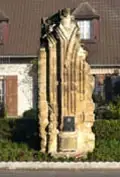
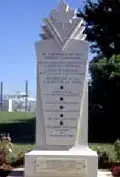
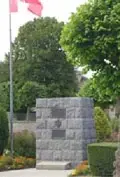
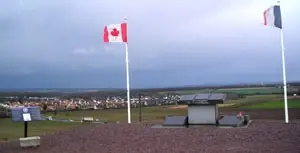
Next to Bourgeubus Ridge, Verrières Ridge was another dominating feature of which German possession ensured the British and Canadians in Normandy would be pinned against the sea.
On 25 July, 5th Brigade assaults on this feature proved costly for the Calgary Highlanders, and especially for the Black Watch who lost over 300 men in the course of a few hours, making their attack the costliest single day of battle for a single Bn, not counting Dieppe.
Note that a great number of soldiers of Black Watch Bn were Americans volunteers wearing Canadian uniforms.