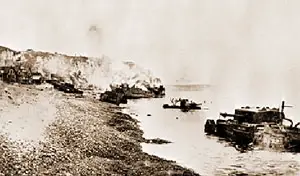
In August 1942, the Allies launched a raid on Dieppe in northern France. Dieppe was to prove a bloodbath for the Allies but important lessons were learned for the 1944 D-Day invasion.
Dieppe was selected for an Allied landing in April 1942. Winston Churchill approved the raid for a number of reasons:
The Dieppe raid was the largest combined operation that had taken place up to that point in the war. It was to be a sea borne raid that had fighter cover from British airbases. There was never a plan to keep Allied troops permanently in their place in Dieppe had the landing succeeded. The plan was for the Allies to launch an attack, create havoc among the German defences in the Dieppe sector and then withdraw - all within the space of about nine hours, the time the tide would allow ships to come close into the shoreline. Such a raid needed perfect planning and the element of surprise if it was to succeed.
Dieppe was very well defended by the Germans who realised its value as a port. The beach area was just than a mile long with two headlands at each end. The eastern headland was called «Bismarck» while the western headland was code-named «Hindenburg». «Bismarck» was heavily fortified and riddled with tunnels made an aerial attack out of the question. The biggest problem «Bismarck» posed was the fact that the Allies did not know how well it was armed. It was known that guns were in place at «Bismarck» but no-one in the Allies ranks knew about the number or calibre of the buns there. «Hindenburg» was less well defended but combined with the fire power of «Bismarck»; it still posed a major problem for the Allies.
August 18th was the last day that the tides would suit the Allies. On August 17th, 24 landing ships had taken on board their cargo - new Churchill tanks. Sixty fighter squadrons had been put on standby along with seven fighter-bomber and bomber squadrons. Air cover was to come mostly from Spitfire fighter planes. The heaviest gun carried at sea were the 4 inch guns of the destroyers that accompanied the flotilla. On the night of August 18th, 252 ships loaded with troops and equipment sailed from four south coast ports. They sailed behind mine sweepers and in near radio silence. At 03.00 on August 19th, they arrived seemingly undetected 8 miles off of Dieppe.
The bulk of the land attack was carried out by men from the 2nd Canadian Division supported by 1,000 men from the Royal Marine Commandos and some 50 US Rangers - the first Americans to land and fight in German-occupied Europe. The whole area to be attacked was divided into nine different sectors.
| Force | Beach | Target |
|---|---|---|
| No 3 Commando | Yellow Beach 1 | Berneval / Goebbels Battery |
| No 3 Commando | Yellow Beach 2 | Belleville-sur-Mer |
| Royal Regiment of Canada | Blue Beach | Puys / Rommel Battery |
| Essex Scottish Regiment | Red Beach | Dieppe |
| Royal Hamilton Light Infantry | White Beach | Dieppe |
| South Saskatchewan Regt. | Green Beach | Pourville |
| Queen's Own Cameron Highlanders | Green Beach | Pourville |
| No 4 Commando | Orange 1 Beach | Vasterival |
| No 4 Commando | Orange Beach 2 | Quiberville / Hess Battery |
The raid started perfectly. 5,000 men were in their landing craft by 03.30 and five minutes later were heading for their target beach. Then problems occurred. The landing craft carrying the troops were meant to be lined up behind gun-boats. The landing craft for the Royal Regiment of Canada lined up behind the wrong gun-boat, which for the Royal Regiment of Canada would have taken them to the wrong beach. It took twenty minutes in darkness to sort out the problem. Then the gun-boat leading in No 3 Commando to Berneval unexpectedly came across five armed German trawlers. The ensuing fire-fight left the gun-boat beyond use and it left the 20 landing craft carrying the commandos unprotected. As it was, these twenty landing craft had skill fully dispersed in the darkness. However, it would have been impossible for the Germans on the coast not to have heard the gunfire. Any attack on the Germans at Berneval would, therefore, lack surprise. However, one landing craft did land unnoticed and its 20 occupants took out the Goebbels battery based there to such an extent that it failed to fire an effective shot during the time when the landings took place in Dieppe. However, this was the only success of the Dieppe raid.
Elsewhere, the gunfire had warned the Germans of an attack. The various other beach landings were a disaster. The Royal Regiment of Canada, landing at Blue Beach, was cut down by German machine gun fire. The regiment, delayed by 20 minutes by the gun-boat muddle, landed in daylight and paid an appalling price. Of the 27 officers and 516 men landed at Blue Beach, just 3 officers and 57 men got off.
A similar picture was seen on Red, White and Green Beaches. The Allies were unable to provide those attempting to land with sufficient cover. Air power was hampered by the fact that the whole beach area was covered in a deliberately laid smoke screen. However, the smoke meant that pilots could not support the ground troops adequately. The destroyers at sea experienced a similar problem. When four destroyers (Calpe, Fernie, Berkeley and Albrighton) went in dangerously close to the shore line, their four inch guns were no match for the multitude of guns the Germans had access to.
The tanks that had been loaded for the attack were of little use. Where they got ashore and were not destroyed by the Germans anti-tank fire, the shingle on the beach meant that movement was difficult at best, impossible at worst. Canadian Royal Engineers tried their best to help out the stricken tanks but in murderous circumstances. 314 Canadian Royal Engineers were landed at Dieppe; 189 were killed or wounded on landing - an attrition rate of 60%. Of the 24 tank landing craft, 10 managed to land their tanks - 28 tanks in total. All the tanks were lost, even though some did manage to leave the beach and get into Dieppe town centre - where they were destroyed.
One serious problem - amongst many - faced the by the force commanders, based on HMS Calpe, was the lack of any decent intelligence coming back from the beaches. So many commanders on the beach were killed, that any intelligible information rarely came back. Therefore, for some time, Major-General H F Roberts, commander of the land forces, and Captain J Hughes-Hallett, commander of the naval forces, knew little of what was going on. As late as 08.00, Roberts ordered in more commandos to re-enforce the attack on White Beach.
By 09.00, it had become obvious what was going on and a withdrawal was ordered. While the men had practiced for a planned withdrawal, what occurred at Dieppe itself was basically getting as many men off as was possible in as short a time as was possible. By early afternoon, those who had survived the attack were on their way back to Britain. The return journey was free from any incident as the Germans did not seem interested in pursuing the Allies, though fighter cover was strong.
The raid on Dieppe cost many lives. Out of the 6,000 men who had taken part in the landings, 4,384 were killed, wounded or missing - a loss of 73%. All the equipment landed on shore was lost. The Royal Navy had lost 550 men and 34 ships. The RAF, in what was the largest single-day air battle of the war, flew 2,617 sorties and lost 106 planes, while the Luftwaffe lost 170 planes
What was learned from Dieppe? Clearly, the lack of any flexibility in Operation Jubilee was a vital lesson learned. Any future major beach landing had to have flexibility built into the plan. Secondly, the sea based fire power against coastal based gun emplacements was very ineffective at Dieppe. Neither «Bismarck» nor «Hindenburg» were destroyed and the gunfire that came from both, led to many deaths on the beaches at Dieppe. At D-Day, this lesson was learned when the coastal gun emplacements of the Germans were heavily attacked before the beach landings took place.
The Dieppe Raid of 18-19 August 1942 was the first large scale daylight assault on a strongly held objective on the Continent since the Allied withdrawal of 1940. The objectives of the raid were the destruction the Dieppe defences and neighbouring radar and aerodrome installations, the raiding of a German divisional headquarters close by and the capture of prisoners. The largely Canadian military force undertook the main assault on Dieppe itself, with flanking assaults by Commando units and additional Canadian battalions to the east and west of the town intended to neutralise batteries that commanded the direct approach. Support was provided by more than 250 naval vessels and 69 air squadrons. Only the assaulting parties on the extreme flanks came within reasonable reach of their ambitious objectives and casualties were very heavy, with more than 3,600 of the military force of 6,100 killed, wounded, missing or captured. Naval casualties numbered 550. Many of those who died in the raid are buried at Dieppe Canadian War Cemetery, where 948 Commonwealth servicemen of the Second World War are now buried or commemorated. Other casualties of the raid are at Rouen, where some of the wounded were taken to hospital.
Albert was the main town behind the lines for the Allies nearest to the 1916 Somme battlefields. It lies on the main D929 road that runs east to Bapaume across the Somme battlefields, and west to Amiens in the other direction (although the D929 now diverts to the south around Albert, the original road still runs through it).
For a town at the heart of the British activities in this region, there are surprisingly few Great War sights to see in Albert. Devastated during the war and rebuilt afterwards, it has to be said that it is not as attractive a city as Ypres. As a base for battlefield touring both accommodation and restaurants are fairly limited. However, it is an important location on the battlefield, and this page describes what there is to be seen.
In terms of the history of the war, Albert came to be associated with the British when their troops took over the lines here in the summer of 1915.
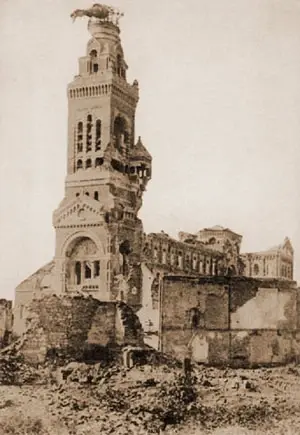
After the war, Albert was «adopted» by Birmingham. In the centre of Albert is one of the most famous icons for the British in the Great War - the Golden Virgin on top of the Basilica. The golden statue of the Madonna holding aloft her child was visible from far away, and of course was an excellent target for enemy artillery. It was damaged fairly early on, in January 1915, and the statue was knocked from its perch but stayed leaning at an angle before being secured by the French in that position.
A superstition grew up that the war would end only when the statue finally fell.
It remained, somewhat improbably, in the same position all the time that Albert was in French and then British hands.
The Germans advanced into Albert during their Spring Offensive in 1918, and well aware that the tower could be used as an excellent observation point by the Germans, it was British artillery that then deliberately targeted it and the statue finally fell.
Albert was retaken by the British (the 8th East Surreys) four months later, but it was another three months after this until the Armistice.
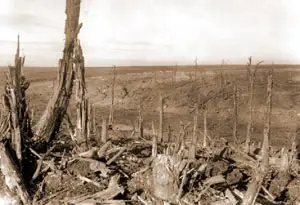
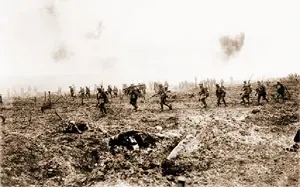
The village of Beaumont-Hamel was one of the fortress villages located just behind the German lines on the 1st of July 1916.
This position commanded the valley over which the attacking troops had to cross. The British attack on this part of the line was undertaken on that day by the 29th Division, part of VIII Corps, and there is a great deal more to see in the nearby Newfoundland Memorial Park, which has another page on this website devoted to it and which can be found to the south-west of the village. The first objective on the 1st of July was a line just beyond the village, with the third objective an ambitious further mile and three-quarters beyond that.
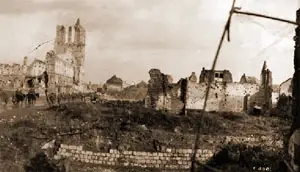
This park, located near Beaumont-Hamel, is one of only a few sites on the Western Front where the ground remains largely untouched from when the First World War ended. The main entrance to the Newfoundland Memorial Park can be found on the D73 road between Hamel and Auchonvillers. During my last visit, in autumn 2005, improvements were being made to this road, but it was still passable. The road was known during the Great War as St. John's Road.
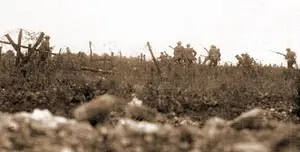
Wiltshire Regiment attack near Thiepval. Q1142: Photograph courtesy of the Imperial War Museum, London.
Thiepval was one of the fortress villages that were held by the Germans on the Somme front in 1916.
The village was destroyed by the bombardment, except for one part of the chateau (the ruins of which contained machine gun nests). The houses in the village, although flattened, had deep cellars where the Germans held out, and their machine gun posts were not destroyed by the bombardment. X Corps was the attacking formation here on the 1st of July, 1916. In front of, and to the south of the village, the 32nd Division attacked. After the War ended, Thiepval was chosen as the location for the Memorial to the Missing to commemorate those who died in the Somme sector before the 20th of March 1918 and have no known grave. This is the largest and most imposing of the Memorials to the Missing, and visiting here is a moving and sobering experience.
Those who died in the Somme after 20th March 1918 are commemorated at Pozières. The 36th Division attacked just to the north of the village.
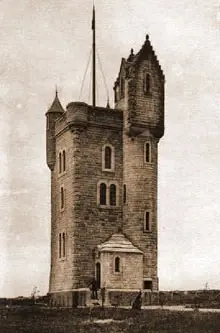
The Ulster Tower is a memorial to the men of the 36th (Ulster) Division. It is located very near to the famous Schwaben Redoubt (Feste Schwaben) which the Division attacked on July 1st, 1916. The Schwaben Redoubt was a little to the north-east of where the tower stands, and was a triangle of trenches with a frontage of 300 yards, a fearsome German strongpoint with commanding views.
The front lines were at the edge of Thiepval Wood which lies to the south-west of the road between the Thiepval memorial and the Ulster Tower. Troops of the 109th Brigade crossed about 400 yards of No Man's Land, and kept on going. They entered the Schwaben Redoubt, and advanced on towards Stuff Redoubt, gaining in all around a mile, though not without losses. To their left, the 108th Brigade were succesful in advancing near Thiepval, but less so nearer the River Ancre.
The 107th Brigade supported them, but although the men of the 36th Division held out for the day the Germans mounted counterattacks, and as their stocks of bombs and ammunition dwindled many fell back, with small parties remaining in the German front lines. The casualties suffered by the 36th Division on the 1st of July were over 5,000 in total - almost half of their strength.
The tower is a copy of Helen's Tower in County Down, where men of the 36th Division trained. The tower (plus a small cafe nearby) is staffed by members of the Somme Association which is based in Belfast, and is a friendly and welcoming place to stop on a battlefield tour.
This page covers Vimy Ridge itself; the memorial, the tunnels, cemeteries and other sites within the preserved battlefield area. However, there are also many sites of interest, many also particularly relevant to Canadians, in the villages and area around Vimy Ridge. A separate page covers the area around Vimy.
The attack at Vimy Ridge which was undertaken by the Canadian Corps (of the First Army) on Easter Monday, the 9th of April, 1917, is often seen as the first unequivocal success gained by the British (in this case Canadian) forces during the course of trench warfare. The Battle of Messines two months later sometimes takes this accolade, but this is a somewhat unfair reflection on the achievements at Vimy. The Germans had held the heights at Vimy Ridge since the trench lines settled in late 1914, and the French (who then held this part of the line) had failed in attempts to take it in May and September of 1915. The sector was taken over by the British early in 1916.
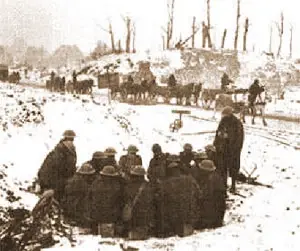
Canadian troops passing the ruins of the Cloth Hall. Image from Library and Archives Canada.
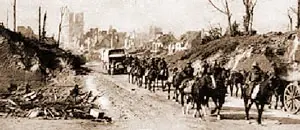
From October 1914 British and Commonwealth troops began to march.
The city of Ypres, at the heart of the Salient, was involved early in the First World War. The British were associated with Ypres throughout the war, and involved in all four battles which bear the name of the town. During the war, the town was almost constantly under bombardment, and was reduced to ruins.
After the War there was a proposal to preserve the ruins of the town as a memorial to the British and Empire soldiers who had fought and died in the salient. This was then modified to preservation of just the ruined Cloth Hall and cathedral. However, the town was eventually fully rebuilt, including the Cloth Hall and cathedral and today, standing in the town, you would hardly believe that most buildings are at most 80 or so years old.
By the time Sir William Pulteney and Beatrix Brice published a battlefield guide in 1925 they recorded: «We step from the train to a brightly new and very complete town.
We make our way through the streets to the Central Place, and here a square of hotels, shops, houses stare with strange incongruity to a mutilated thing rising stark and jagged against the sky». This was the ruins of the Cloth Hall, still not then rebuilt.
In Flanders stands the ancient town of Ypres. Once a centre of the Flanders wool trade, it became one of the most important European city-states of the 13th Century. In 1260, Ypres had a population of some 40,000 - more than the population today. The same time another great city, Oxford in England, had a population of only 4,200.
The area has been fought over, through the centuries by the Dutch, the French, the Spanish - no wonder that the area was called «The Cockpit of Europe». But it was the Great War which resulted in the destruction of the town, and the loss of its priceless mediaeval architecture.
The Menin Gate Memorial is perhaps the most visited Great War Memorial on the Western Front.
(The only other serious contender is the Newfoundland Memorial Park near Beaumont-Hamel, on the Somme.)
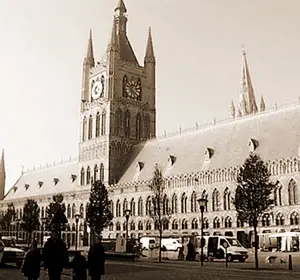
The truly gigantic cloth hall overlooks the Market Square, the political and economic heart of Ypres. This most beautiful and imposing medieval cloth hall of Flanders was carefully rebuilt after its destruction in the Great War. In the past the building was used as a covered market hall for the famous cloth of Ypres, the product on which the success of the city's economy was based.
The eastern wing and the belfry tower were built as from 1260, the western wing and the side wing followed in 1286. By 1304 the cloth hall was completed. The main façade is 125 m long. On both ends two slender little towers can be seen. In the middle arises the imposing belfry tower with a height of 70 m and a carillon with 49 bells. From the top, when the weather is nice you can have a beautiful view over the surrounding area.
Several statues decorate the facade of the cloth hall. A lot of the original statues did not survive the war. There are also statues of King Albert I and his wife Queen Elisabeth who opened the reconstructed belfry tower in 1934. In and around the cloth hall a lot of remaining old statues and parts of the original building can be seen.
After the destruction of Ypres in the First World War, the town hall was meticulously reconstructed from 1934 until 1958 by the architects Coomans and Pauwels, who followed as closely as possible the original plan. Inside the Cloth Hall is now the Flanders Fields Museum.
By September 1944, the Second World War had almost reached a conclusion. The Allied armies had rapidly pushed the disorganised Germans almost completely out of France and Belgium, and it was here that the front line stood, several miles short of the Dutch border.
This rapid advance had caused the Allies crippling supply problems and, despite their best efforts, all the armies did not have the resources to keep advancing at their present pace. Given the view that the Germans were almost on the point of collapse, it was agreed that a single army should be given priority of the supplies to enact a plan that would deal the final blow and win the war before the end of 1944. This honour fell to Field Marshal Montgomery and his 2nd British Army.
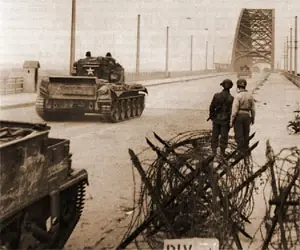
Montgomery proposed a highly ambitious plan to fly three Divisions of glider and parachute troops (35,000 men) and land them in various parts of Holland to capture no less than five key bridges. British tanks would simultaneously break through the front line and link up with the Airborne Divisions one by one to properly securing these bridges. Once they were all taken, there would then be no further river obstacles between the British and Germany, and a quick conclusion to the war would surely follow. The plan, the largest airborne assault in the history of warfare, was codenamed Operation Market Garden. D-Day was set for Sunday, 17th September.
Two of the Airborne Divisions selected to capture the bridges were American. The 101st were to take two bridges around Eindhoven, while the 82nd would take a further two at Nijmegen. It was estimated that they would be relieved by British ground troops after only a matter of hours, and one or two days respectively. The final bridge at Arnhem, the ultimate goal of Market Garden, was entrusted to General Roy Urquhart and his 1st British Airborne Division with the 1st Polish Independent Parachute Brigade under command. Urquhart and his 10,000 men were to be dropped 60 miles into enemy territory, and it would be 3 days before British tanks reinforced them.
Overwhelming though this colossal assault was, it was also equally flawed. Airborne troops are only lightly armed and their survival depends upon taking the enemy by surprise and reaching objectives before they have time to react with heavy weapons. However, so cocksure were the Allies in their view that the Germans were already beaten; numerous grave errors were made which doomed Market Garden to failure before a shot had been fired. Principally, there were not enough transport planes to fly all three Divisions to their targets in one go. Instead they had to be flown to Holland in three lifts, with only one lift per day.
As a result, only half of the 1st Airborne were flown to Arnhem on the first day. Also, due to the unsuitability of the ground in the area, they were dropped a massive 8 miles from the bridge. It was not anticipated that this would prove a problem as immediate opposition was believed to be light, however by a complete fluke, two elite German SS Panzer Divisions had recently been billeted in and around the town. These units were well trained, fresh from battle, and were equipped with tanks.
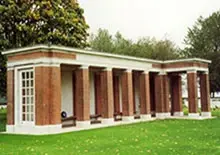
During the Second World War, many thousands of men and women from all countries of the British Commonwealth and Empire lost their lives in trying to repel the German invasion of the Netherlands and Belgium in 1940. In the ensuing struggle to liberate the occupied countries, some 11,000 of these have their graves in Belgium and nearly 20,000 lie in the Netherlands. There are 1,068 who have no known grave. Of these, 103 are Canadians. The Groesbeek Memorial stands in Groesbeek Canadian War Cemetery about ten kilometres southeast of the Dutch town of Nijmegen. It commemorates, by name, those members of the Commonwealth land forces who died during the campaign in Northwest Europe between the time of crossing the Seine at the end of August 1944 and the end of the war in Europe. The Memorial consists of twin colonnaded buildings, which face each other across the surfed forecourt of the Groesbeek Canadian War Cemetery, between the entrance and the Stone of Remembrance. The names of the men commemorated are inscribed in panels of Portland stone built into the rear walls.
Within each building are inscribed the words:
«These walls bear the names of the soldiers of the British Commonwealth and Empire who fell in the advance from the river Seine through the low countries and into Germany but to whom the fortune of war denied a known and honoured grave August 1944 - 5th May 1945».
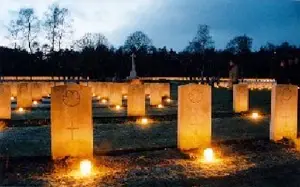
Even until autumn 1945 one could find crosses scattered all over the country in the Eastern and Northern parts of the Netherlands, marking the places where soldiers had been killed and buried. The crosses stood in gardens, pastures or just at the side of the road, in an area that has been cleared of five years of oppression. For that reason the soldiers had given the greatest sacrifice, their lives. One day, while passing Holten, it occurred to Lt. General G.G. Simonds, commander of the 2nd Canadian Army that the Holterberg area might be a suitable place for a Canadian War Cemetery. The soldiers who were killed in the spring of 1945 during the liberation of the Eastern and Northern parts of the Netherlands and the taking of the North German town Oldenburg could be buried here. Some officers made contact with Mr. W.H. Enklaar mayor of Holten at the time. Mr. Enklaar immediately did everything possible to realize a cemetery. In a later stage negotiations were carried on by the Ministry of War. The result was that the grounds were given to the Canadian Government. It is still Canadian territory. The Cemetery was constructed and carried out by Canadian soldiers who were waiting for their repatriation. They flattened and terraced the site. The first people buried were all Canadian soldiers, killed in the area of Holten. Their graves are in the first plot of the new cemetery, left of the entrance. Nearly 1400 fallen comrades were to follow. Until summer 1946 the bodies of Canadians killed in the Netherlands and Northern Germany were buried here.
Afterwards the planned area, 14 acres, turned out to be too large, so the front part was laid out as a beautiful heather garden. Until 1970 both cemetery and garden were kept by Mr. Reeves, an Englishman. He served in the Royal Hampshire Regiment. Now the work is done by Mr. Krieger. Among the rustling pines of the Holterberg lies the cemetery quietly with its hundreds of graves. Most of the men here were volunteers who gave their lives for our freedom. Every year on May 4th a service of remembrance is held on the cemetery. Veterans staying in Holten or elsewhere in the country attend the ceremony. School children of the highest groups of the Primary School participate in the ceremony. Every 5 years Dutch and Canadian authorities are also present. For some years the local school children put candles on the graves of the Canadian soldiers buried on the cemetery on Christmas Eve. This idea was begun by Mrs. Van Dam, born in Finland and living in Holten. This is a custom introduced from her native country. More than 1,500 candle lights give the cemetery an impressive look. The 1355 Canadians who are buried in Holten nearly all died during the last stages of the war in Holland and during the advance of the Canadian 2nd Corps into Germany.
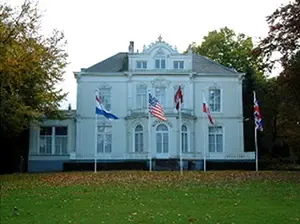
The Hartenstein Hotel dates from the mid-eighteenth, when it was a house in the middle of a country park.
After the death of the original owner it was first used as a nursing home, and then became a hotel when the site was bought by the Renkum/Oosterbeek council as late as 1942.
Following the landing of 1st Airborne Division on 17th September 1944, Major General R.E.Urquhart established his divisional headquarters here, and as the battle developed it was also used as a defensive position, aid post and signals HQ.
At the heart of the Oosterbeek perimeter, the battered and wounded survivors of 1st Airborne surrendered to the Germans on 25th September.